 $\begingroup$
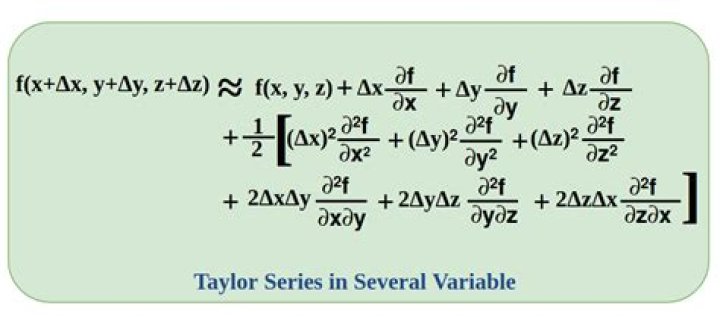
Shouldn't the taylor series of a function be equal to that function for any input value?
Why does this not work for the taylor series of $\frac {1}{\ln x}$ when $|x| \gt 1$?
Edit: I do mean the series taken about $x_o = 2$
$\endgroup$62 Answers
$\begingroup$Not all Taylor Series have the ability to converge for all $x$ values.
For example, the Taylor Series of $\ln(x+1)$ about $x_0=0$ is
$$\ln(x+1)=\sum_{n=1}^{\infty}\frac{(-1)^{n+1}x^n}{n}$$
Which doesn't converge for $x>1$. We can see that if $x>1$, then $\lim_{n\to\infty}\frac{x^n}n$ does not converge, so the summation will not converge.
So not all Taylor Series converge for all $x$, but if you could evaluate it like a Ramanujan sum, you might be able to get some right values from it.
$\endgroup$$\begingroup$Note that the Taylor expansion is $$\dfrac{1}{\ln{x}}=-\dfrac{1}{\sum_{k=1}^\infty\dfrac{(-1)^k(x-1)^k}{k}} \quad \text{for}\quad\!\!\! |x-1|<1 $$
To address your question, the Taylor series is limited by the values of $x$ that make the series converge. So, even if the original expression has domain $(0,1),(1,\infty)$, the Taylor series does not necessarily follow.
$\endgroup$1