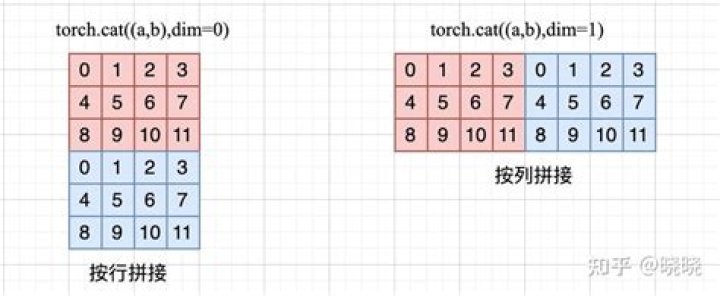
What's the difference between torch.cat and torch.stack?
OpenAI's REINFORCE and actor-critic examples for reinforcement learning have the following:
# REINFORCE: policy_loss = torch.cat(policy_loss).sum() # actor-critic: loss = torch.stack(policy_losses).sum() + torch.stack(value_losses).sum() 4 Answers
Concatenates sequence of tensors along a new dimension.
Concatenates the given sequence of seq tensors in the given dimension.
So if A and B are of shape (3, 4):
torch.cat([A, B], dim=0)will be of shape (6, 4)torch.stack([A, B], dim=0)will be of shape (2, 3, 4)
t1 = torch.tensor([[1, 2], [3, 4]]) t2 = torch.tensor([[5, 6], [7, 8]]) torch.stack | torch.cat |
|---|---|
| 'Stacks' a sequence of tensors along a new dimension:
| 'Concatenates' a sequence of tensors along an existing dimension:
|

These functions are analogous to numpy.stack and numpy.concatenate.
The original answer lacks a good example that is self-contained so here it goes:
import torch # stack vs cat # cat "extends" a list in the given dimension e.g. adds more rows or columns x = torch.randn(2, 3) print(f'{x.size()}') # add more rows (thus increasing the dimensionality of the column space to 2 -> 6) xnew_from_cat = torch.cat((x, x, x), 0) print(f'{xnew_from_cat.size()}') # add more columns (thus increasing the dimensionality of the row space to 3 -> 9) xnew_from_cat = torch.cat((x, x, x), 1) print(f'{xnew_from_cat.size()}') print() # stack serves the same role as append in lists. i.e. it doesn't change the original # vector space but instead adds a new index to the new tensor, so you retain the ability # get the original tensor you added to the list by indexing in the new dimension xnew_from_stack = torch.stack((x, x, x, x), 0) print(f'{xnew_from_stack.size()}') xnew_from_stack = torch.stack((x, x, x, x), 1) print(f'{xnew_from_stack.size()}') xnew_from_stack = torch.stack((x, x, x, x), 2) print(f'{xnew_from_stack.size()}') # default appends at the from xnew_from_stack = torch.stack((x, x, x, x)) print(f'{xnew_from_stack.size()}') print('I like to think of xnew_from_stack as a \"tensor list\" that you can pop from the front') output:
torch.Size([2, 3]) torch.Size([6, 3]) torch.Size([2, 9]) torch.Size([4, 2, 3]) torch.Size([2, 4, 3]) torch.Size([2, 3, 4]) torch.Size([4, 2, 3]) I like to think of xnew_from_stack as a "tensor list" for reference here are the definitions:
cat: Concatenates the given sequence of seq tensors in the given dimension. The consequence is that a specific dimension changes size e.g. dim=0 then you are adding elements to the row which increases the dimensionality of the column space.
stack: Concatenates sequence of tensors along a new dimension. I like to think of this as the torch "append" operation since you can index/get your original tensor by "poping it" from the front. With no arguments, it appends tensors to the front of the tensor.
Related:
- here is the link from the pytorch forum with discussions on this: I wish though that
tensor.torchconvert a nested list of tensors to a big tensor with many dimensions that respected the depth of the nested list.
Update: With nested list of the same size
def tensorify(lst): """ List must be nested list of tensors (with no varying lengths within a dimension). Nested list of nested lengths [D1, D2, ... DN] -> tensor([D1, D2, ..., DN) :return: nested list D """ # base case, if the current list is not nested anymore, make it into tensor if type(lst[0]) != list: if type(lst) == torch.Tensor: return lst elif type(lst[0]) == torch.Tensor: return torch.stack(lst, dim=0) else: # if the elements of lst are floats or something like that return torch.tensor(lst) current_dimension_i = len(lst) for d_i in range(current_dimension_i): tensor = tensorify(lst[d_i]) lst[d_i] = tensor # end of loop lst[d_i] = tensor([D_i, ... D_0]) tensor_lst = torch.stack(lst, dim=0) return tensor_lst here is a few unit tests (I didn't write more tests but it worked with my real code so I trust it's fine. Feel free to help me by adding more tests if you want):
def test_tensorify(): t = [1, 2, 3] print(tensorify(t).size()) tt = [t, t, t] print(tensorify(tt)) ttt = [tt, tt, tt] print(tensorify(ttt)) if __name__ == '__main__': test_tensorify() print('Done\a') If someone is looking into the performance aspects of this, I've done a small experiment. In my case, I needed to convert a list of scalar tensors into a single tensor.
import torch torch.__version__ # 1.10.2 x = [torch.randn(1) for _ in range(10000)] torch.cat(x).shape, torch.stack(x).shape # torch.Size([10000]), torch.Size([10000, 1]) %timeit torch.cat(x) # 1.5 ms ± 476 µs per loop (mean ± std. dev. of 7 runs, 1000 loops each) %timeit torch.cat(x).reshape(-1,1) # 1.95 ms ± 534 µs per loop (mean ± std. dev. of 7 runs, 1000 loops each) %timeit torch.stack(x) # 5.36 ms ± 643 µs per loop (mean ± std. dev. of 7 runs, 100 loops each) My conclusion is that even if you want to have the additional dimension of torch.stack, using torch.cat and then reshape is better.
Note: this post is taken from the PyTorch forum (I am the author of the original post)
1