 $\begingroup$
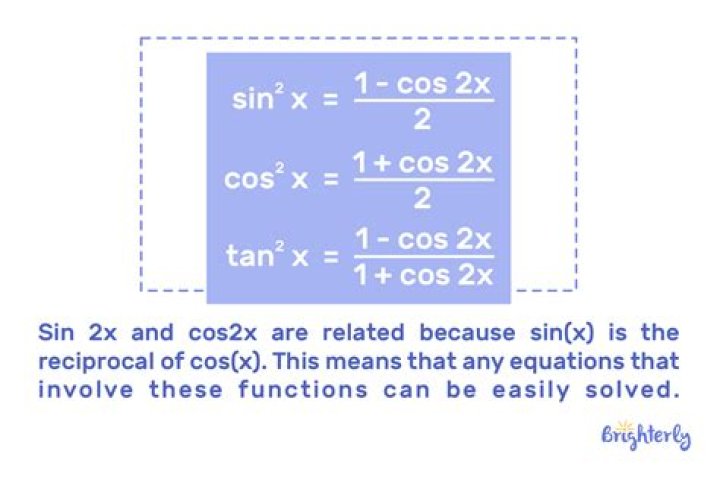
Verify that $$ 2\cos^2x-1 = \frac{1-\tan^2x}{1+\tan^2x}$$
$\endgroup$24 Answers
$\begingroup$Hint: $\tan\theta=\sin\theta/\cos \theta$ and $\cos^2\theta+\sin^2\theta=1$.
And start from the rhs.
$\endgroup$$\begingroup$It's generally easier to turn more-complicated stuff into less-complicated stuff; and one common suggestion is always "first convert to sine and cosine":
$$\begin{align} \frac{1-\tan^2\theta}{1+\tan^2\theta} &= \frac{1-\frac{\sin^2\theta}{\cos^2\theta}}{1+\frac{\sin^2\theta}{\cos^2\theta}} \\ &=\frac{\left(\cos^2\theta - \sin^2\theta\right)/\cos^2\theta}{\left(\cos^2\theta + \sin^2\theta\right)/\cos^2\theta}\\ &=\frac{\cos^2\theta - \sin^2\theta}{\cos^2\theta + \sin^2\theta} &\text{denom = 1}\\[6pt] &= \cos^2\theta - \sin^2\theta &(1)\\ &= \cos^2\theta - \left( 1 - \cos^2\theta \right) \\ &= 2 \cos^2\theta - 1 &(2) \end{align}$$
You can jump from (1) to (2) by recognizing both as forms of $\cos 2\theta$.
With a little more fluency in interrelations between more of the trig functions, you might also have taken this route:
$$\begin{align} \frac{1-\tan^2\theta}{1+\tan^2\theta} &= \frac{1-\tan^2\theta}{\sec^2\theta} \\ &=\left( 1 - \tan^2\theta \right) \cos^2\theta \\ &=\cos^2\theta - \sin^2\theta \\[6pt] &= 2\cos^2\theta - 1 \end{align}$$
$\endgroup$$\begingroup$Putting $z=e^{ix}$ we have $$ \cos x = \frac{1}{2} \left( z + \frac{1}{z} \right) = \frac{1}{2z} (z^2+1)$$ and $$ \tan x = \frac{1}{i} \frac{z - \frac{1}{z}}{ z + \frac{1}{z} } = \frac{1}{i} \frac{z^2-1}{z^2+1}.$$ Now $$2\cos^2 x - 1 = \frac{1}{2z^2} (z^2+1)^2 -1 $$ and $$\frac{1-\tan^2 x}{1 + \tan^2 x} = \frac{1+\left(\frac{z^2-1}{z^2+1}\right)^2}{1-\left(\frac{z^2-1}{z^2+1}\right)^2} = \frac{(z^2+1)^2+(z^2-1)^2}{(z^2+1)^2-(z^2-1)^2}= \frac{2z^4 + 2}{4z^2} = \frac{z^4+1}{2z^2} \\ = \frac{z^4+2z^2+1}{2z^2} -1 = \frac{1}{2z^2} (z^2+1)^2 -1.$$ I decided to post this computation because it is algorithmic. It should be easy to see that verifying trigonometric identities is equivalent to factoring rational polynomials in one variable and that these proofs can be produced automatically by a computer.
$\endgroup$$\begingroup$$$ \begin{align*} 2 \cos^2(x)-1&=2 \cos^2(x)-\sin^2(x)-\cos^2(x)\\ &= \cos^2(x)-\sin^2(x)\\ &=(\cos(x)-\sin(x))\cdot (\cos(x)+\sin(x))\\ &= \cos^2(x) (1-\tan(x)) \cdot(1+\tan(x))\\ &=\cos^2(x) (1-\tan^2(x))\\ &=\frac{\cos^2(x)}{\sin^2(x)+\cos^2(x)} \cdot (1-\tan^2(x))\\ &=\frac{1-\tan^2(x)}{1+\tan^2(x)} \end{align*} $$
$\endgroup$2