 $\begingroup$
For example, when $n=5$, what is the symbol for $5+4+3+2+1$?
$\endgroup$57 Answers
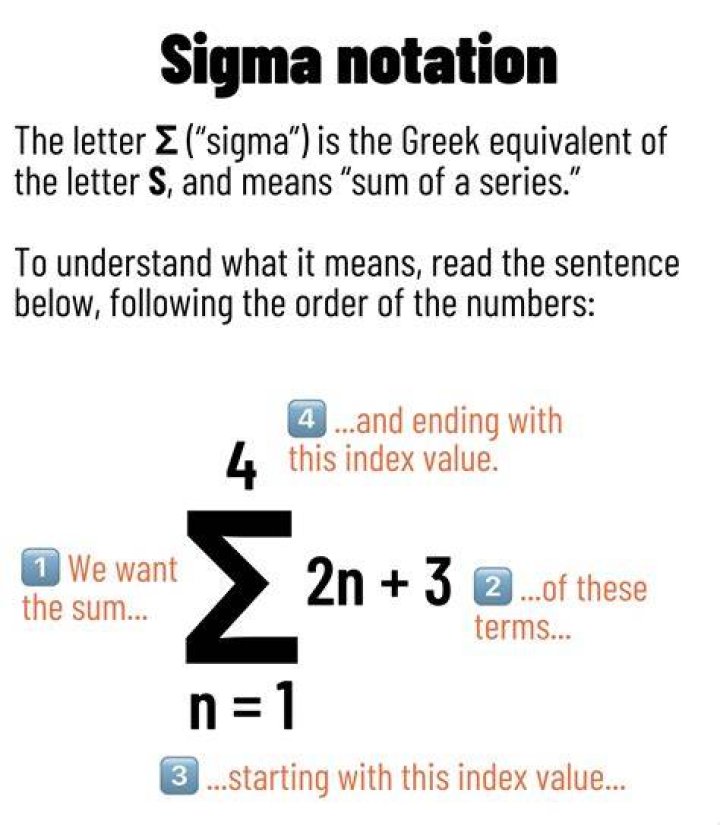
$\begingroup$Usually we use the symbol $$\sum$$ (capital sigma).
You can write $$1+2+3+4+5 = \sum_{k=1}^5 k$$
another example is
$$1^2+2^2+3^2+4^2+5^2 = \sum_{k=1}^5k^2$$
Note that if you want to write $5+4+3+2+1$ instead of $1+2+3+4+5$, you can also write
$$\sum_{k=1}^5 (6-k) =(6-1)+(6-2)+(6-3)+(6-4)+(6-5)= 5+4+3+2+1$$ See this wikipedia article for more information.
$\endgroup$$\begingroup$That is the fifth triangular number, which is sometimes written as $$T_5$$
The triangular numbers have their own symbol since they have been studied since the ancient Greeks. The Pythagoreans revered the Tetractys which is $T_4$. Triangular numbers have applications to other areas of number theory, such as perfect numbers and binomial coefficients. They are also practically the simplest example of an arithmetic sequence.
$\endgroup$$\begingroup$This is more of a theorem than a definition, but $$1+2+\cdots+n=\binom{n+1}2=\frac{n(n+1)}2$$
$\endgroup$$\begingroup$There is no symbol just for this (like the factorial for multiplication) because the result of this operation can be written in closed-form so easily: $$\sum _{k=1}^n k=\frac{n(n+1)}{2}.$$
$\endgroup$9$\begingroup$Your expression would be $$\sum_{i=1}^5 i$$
And for any $n$ $$\sum_{i=1}^n i$$
$\endgroup$$\begingroup$For $$1+2+3+4+.....\infty = \sum^{\infty}_{k=1}{k}$$
Here for some finite value you can write in place of infinity some finite value $k$.
Now you might ask how will I represent a product like $a_1a_2a_3.....a_n$. It is represented as:
$$\prod^{n}_{k=1} {a_k}$$
$\endgroup$1$\begingroup$I am pretty sure this question refers to finding a summation equivalent of the factorial symbol (!), and not the summation symbol $\sum$. For one, this is what I was looking for when I reached this page. I am not sure there is a symbol for that though.
$\endgroup$