
I've been stuck on this question for quite sometime and just can't figure it out. I just want to be able to understand what I'm missing and why it's needed. What I need to do is make a function which adds each given key/value pair to the dictionary. The argument key_value_pairs will be a list of tuples in the form (key, value).
def add_to_dict(d, key_value_pairs): newinputs = [] #creates new list for key, value in key_value_pairs: d[key] = value #updates element of key with value if key in key_value_pairs: newinputs.append((d[key], value)) #adds d[key and value to list return newinputs I can't figure out how to update the "value" variable when d and key_value_pairs have different keys.
The first three of these scenarios work but the rest fail
>>> d = {} >>> add_to_dict(d, []) [] >>> d {} >>> d = {} >>> add_to_dict(d, [('a', 2]) [] >>> d {'a': 2} >>> d = {'b': 4} >>> add_to_dict(d, [('a', 2)]) [] >>> d {'a':2, 'b':4} >>> d = {'a': 0} >>> add_to_dict(d, [('a', 2)]) [('a', 0)] >>> d {'a':2} >>> d = {'a', 0, 'b': 1} >>> add_to_dict(d, [('a', 2), ('b': 4)]) [('a', 2), ('b': 1)] >>> d {'a': 2, 'b': 4} >>> d = {'a': 0} >>> add_to_dict(d, [('a', 1), ('a': 2)]) [('a', 0), ('a':1)] >>> d {'a': 2} Thanks
Edited.
77 Answers
Python has this feature built-in:
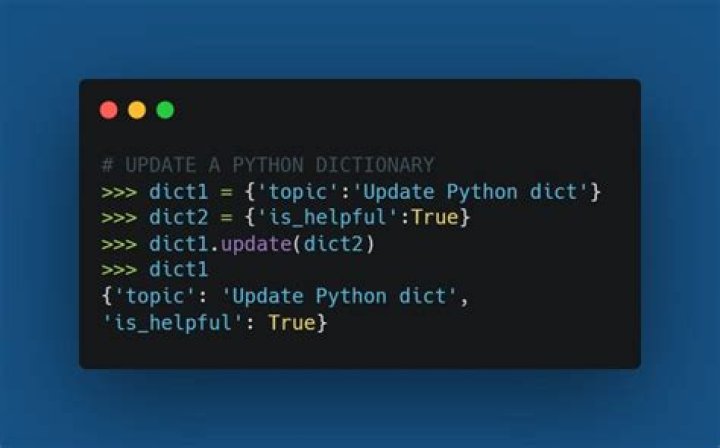
>>> d = {'b': 4} >>> d.update({'a': 2}) >>> d {'a': 2, 'b': 4} Or given you're not allowed to use dict.update:
>>> d = dict(d.items() + {'a': 2}.items()) # doesn't work in python 3 With python 3.9 you can use an |= update operator:
>>> d = {'b': 4} >>> d |= {'a': 2} >>> d {'a': 2, 'b': 4} Here's a more elegant solution, compared to Eric's 2nd snippet
>>> a = {'a' : 1, 'b' : 2} >>> b = {'a' : 2, 'c' : 3} >>> c = dict(a, **b) >>> a {'a': 1, 'b': 2} >>> b {'a': 2, 'c': 3} >>> c {'a': 2, 'b': 2, 'c': 3} It works both in Python 2 and 3
And of course, the update method
>>> a {'a': 1, 'b': 2} >>> b {'a': 2, 'c': 3} >>> a.update(b) >>> a {'a': 2, 'b': 2, 'c': 3} However, be careful with the latter, as might cause you issues in case of misuse like here
>>> a = {'a' : 1, 'b' : 2} >>> b = {'a' : 2, 'c' : 3} >>> c = a >>> c.update(b) >>> a {'a': 2, 'b': 2, 'c': 3} >>> b {'a': 2, 'c': 3} >>> c {'a': 2, 'b': 2, 'c': 3} The new version of Python3.9 introduces two new operators for dictionaries: union (|) and in-place union (|=). You can use | to merge two dictionaries, while |= will update a dictionary in place. Let's consider 2 dictionaries d1 and d2
d1 = {"name": "Arun", "height": 170} d2 = {"age": 21, "height": 170} d3 = d1 | d2 # d3 is the union of d1 and d2 print(d3) Output:
{'name': 'Arun', 'height': 170, 'age': 21} Update d1 with d2
d1 |= d2 print(d1) Output:
{'name': 'Arun', 'height': 170, 'age': 21} You can update d1 with a new key weight as
d1 |= {"weight": 80} print(d1) Output:
{'name': 'Arun', 'height': 170, 'age': 21, 'weight': 80} So if I understand you correctly you want to return a list of of tuples with (key, old_value) for the keys that were replaced.
You have to save the old value before you replace it:
def add_to_dict(d, key_value_pairs): newinputs = [] #creates new list for key, value in key_value_pairs: if key in d: newinputs.append((key, d[key])) d[key] = value #updates element of key with value return newinputs Each key in a python dict corresponds to exactly one value. The cases where d and key_value_pairs have different keys are not the same elements.
Is newinputs supposed to contain the key/value pairs that were previously not present in d? If so:
def add_to_dict(d, key_value_pairs): newinputs = [] for key, value in key_value_pairs: if key not in d: newinputs.append((key, value)) d[key] = value return newinputs Is newinputs supposed to contain the key/value pairs where the key was present in d and then changed? If so:
def add_to_dict(d, key_value_pairs): newinputs = [] for key, value in key_value_pairs: if key in d: newinputs.append((key, value)) d[key] = value return newinputs If I understand you correctly, you only want to add the keys that do not exist in the dictionary. Here is the code:
def add_to_dict(d, key_value_pairs): newinputs = []; for key, value in key_value_pairs: if key not in d.keys(): d[key] = value newinputs.append((key, value)); return newinputs For each key in new key,value pairs list you have to check if the key is new to the dictionary and add it only then. Hope it helps ;)