How can I plot the results of a unix diff command side-to-side instead of one difference after the other? See below for an example:
diff /tmp/test1 /tmp/test2 1,4c1,2 < asfdsadf < asdfsad < fsaf < fdsadf --- > asdfsafdsf > saf 6,8d3 < sadf < asdf < sadf 10d4 < fasd 12,13c6,14 < sadfa < fd --- > sadf > sadf > sadf > sadf > sadf > sadf > sadf > sadf > safa I would like to have something like:
diff /tmp/test1 /tmp/test2 1,4c1,2 < asfdsadf > asdfsafdsf < asdfsad > saf < fsaf < fdsadf --- 6,8d3 < sadf < asdf < sadf 10d4 < fasd 12,13c6,14 < sadfa > sadf < fd > sadf --- > sadf > sadf > sadf > sadf > sadf > sadf > safa 11 Answers
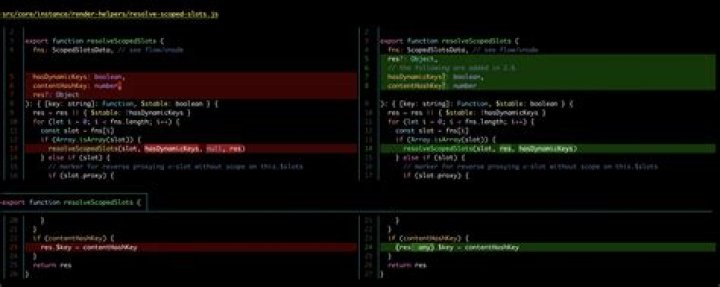
From man diff, you can use -y to do side-by-side.
-y, --side-by-side output in two columns Hence, say:
diff -y /tmp/test1 /tmp/test2 Test
$ cat a $ cat b hello hello my name my name is me is you Let's compare them:
$ diff -y a b hello hello my name my name is me | is you diff -y --suppress-common-lines file1 file2 From icdiff's homepage:
Your terminal can display color, but most diff tools don't make good use of it. By highlighting changes, icdiff can show you the differences between similar files without getting in the way. This is especially helpful for identifying and understanding small changes within existing lines.
Instead of trying to be a diff replacement for all circumstances, the goal of icdiff is to be a tool you can reach for to get a better picture of what changed when it's not immediately obvious from diff.
IMHO, its output is much more readable than diff -y.
You can use:
sdiff file1 file2 or
diff -y file1 file2 or
vimdiff file1 file2 for side by side display.
1You should have sdiff for side-by-side merge of file differences. Take a read of man sdiff for the full story.
You can simply use:
diff -y fileA.txt fileB.txt | colordiff It shows the output splitted in two colums and colorized! (colordiff)
Try cdiff - View colored, incremental diff in workspace or from stdin with side by side and auto pager support.
You can use vimdiff.
Example:
vimdiff file1 file2 If your files have inconsistent use of spaces and tabs, you may find it helpful to include the -t argument to expand the tabs:
diff -ty file1 file2 Use the -y option:
diff -y file1 file2 Enhanced diff command with color, side by side and alias
Let's say the file contents are like:
cat /tmp/test1.txt 1 2 3 4 5 8 9 and
cat /tmp/test2.txt 1 1.5 2 4 5 6 7 Now comparing side-by-side
diff --width=$COLUMNS --suppress-common-lines --side-by-side --color=always /tmp/test1.txt /tmp/test2.txt > 1.5 3 < 8 | 6 9 | 7 You can define alias to use
alias diff='diff --width=$COLUMNS --suppress-common-lines --side-by-side --color=always' Then new diff result:
diff /tmp/test1.txt /tmp/test2.txt > 1.5 3 < 8 | 6 9 | 7