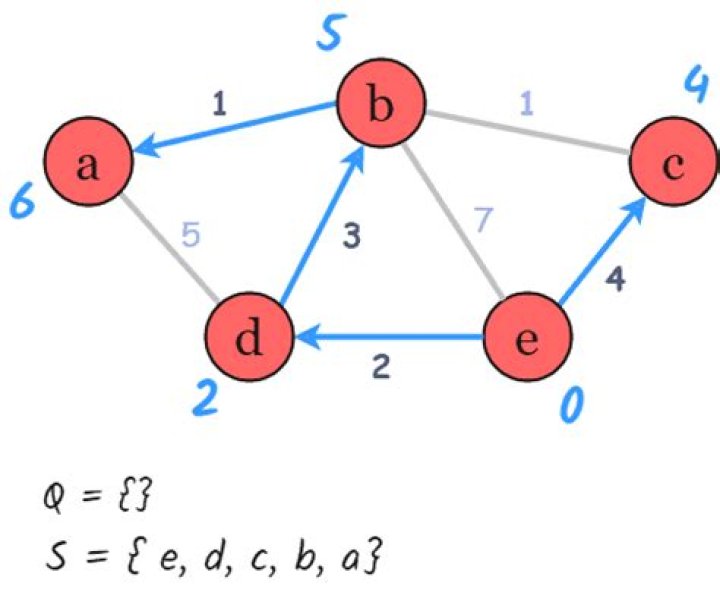
As per my understanding, I have calculated time complexity of Dijkstra Algorithm as big-O notation using adjacency list given below. It didn't come out as it was supposed to and that led me to understand it step by step.
- Each vertex can be connected to (V-1) vertices, hence the number of adjacent edges to each vertex is V - 1. Let us say E represents V-1 edges connected to each vertex.
- Finding & Updating each adjacent vertex's weight in min heap is O(log(V)) + O(1) or
O(log(V)). - Hence from step1 and step2 above, the time complexity for updating all adjacent vertices of a vertex is E*(logV). or
E*logV. - Hence time complexity for all V vertices is V * (E*logV) i.e
O(VElogV).
But the time complexity for Dijkstra Algorithm is O(ElogV). Why?
7 Answers
Dijkstra's shortest path algorithm is O(ElogV) where:
Vis the number of verticesEis the total number of edges
Your analysis is correct, but your symbols have different meanings! You say the algorithm is O(VElogV) where:
Vis the number of verticesEis the maximum number of edges attached to a single node.
Let's rename your E to N. So one analysis says O(ElogV) and another says O(VNlogV). Both are correct and in fact E = O(VN). The difference is that ElogV is a tighter estimation.
Adding a more detailed explanation as I understood it just in case:
O(for each vertex using min heap: for each edge linearly: push vertices to min heap that edge points to)V= number of verticesO(V * (pop vertex from min heap+find unvisited vertices in edges*push them to min heap))E= number of edges on each vertexO(V * (pop vertex from min heap+E*push unvisited vertices to min heap)). Note, that we can push the same node multiple times here before we get to "visit" it.O(V * (log(heap size) + E * log(heap size)))O(V * ((E + 1) * log(heap size)))O(V * (E * log(heap size)))E = Vbecause each vertex can reference all other verticesO(V * (V * log(heap size)))O(V^2 * log(heap size))- heap size is
V^2because we push to it every time we want to update a distance and can have up to V comparisons for each vertex. E.g. for the last vertex, 1st vertex has distance10, 2nd has9, 3rd has8, etc, so, we push each time to update O(V^2 * log(V^2))O(V^2 * 2 * log(V))O(V^2 * log(V))V^2is also a total number of edges, so if we letE = V^2(as in the official naming), we will get theO(E * log(V))
let n be the number of vertices and m be the number of edges.
Since with Dijkstra's algorithm you have O(n) delete-mins and O(m) decrease_keys, each costing O(logn), the total run time using binary heaps will be O(log(n)(m + n)). It is totally possible to amortize the cost of decrease_key down to O(1) using Fibonacci heaps resulting in a total run time of O(nlogn+m) but in practice this is often not done since the constant factor penalties of FHs are pretty big and on random graphs the amount of decrease_keys is way lower than its respective upper bound (more in the range of O(n*log(m/n), which is way better on sparse graphs where m = O(n)). So always be aware of the fact that the total run time is both dependent on your data structures and the input class.
In dense(or complete) graph, E logV > V^2
Using linked data & binary heap is not always best.
That case, I prefer to use just matrix data and save minimum length by row.
Just V^2 time needed.
In case, E < V / logV.
Or, max edges per vertex is less than some constant K.
Then use binary heap.
Let's try to analyze the algorithm as given in CLRS book.

for each loop in line 7: for any vertex say 'u' the number of times the loop runs is equal to the number of adjacent vertices of 'u'. The number of adjacent vertices for a node is always less than or equal to the total number of edges in the graph.
If we take V (because of while loop in line 4) and E (because of for each in line 7) and compute the complexity as VElog(V) it would be equivalent to assuming each vertex has E edges incident on it, but in actual there will be atmost or less than E edges incident on a single vertex. (the atmost E adjacent vertices for a single vertex case happens in case of a star graph for the internal vertex)
V:Number of Vertices, E:Number of total_edges Suppose the Graph is dense The complexity would be O(V*logV) + O( (1+2+...+V)*logV)
1+2+....+(V-1) = (v)*(v+1)/2 ~ V^2 ~ E because the graph is dense So the complexity would be O(ElogV).
The sum 1+2+...+ V refers to: For each vertex v in G.adj[u] but not in S If you think about Q before a vertex is extracted has V vertices then it has V-1 then V-2 ... then 1.
I find it easier to think at this complexity in the following way:
- The nodes are first inserted in a priority queue and the extracted one by one leading to
O(V log V). - Once a node is extracted, we iterate through its edges and update the priority queue accordingly. Note that every edge is explored only once, moreover, updating the priority queue is
O(log V), leading to an overallO(E log V).
TLDR. You have V extractions from the priority queue and E updates to the priority queue, leading to an overall O((V + E) log V).