 $\begingroup$
I have to construct the Taylor series of $$\frac 1 {1+x^2}$$
around $0$ and $1$ and analyze the convergence in both cases. Also (but this is a consequence of the previous series) I have to construct the Taylor series of
$$arctan(x)$$
What I have so far:
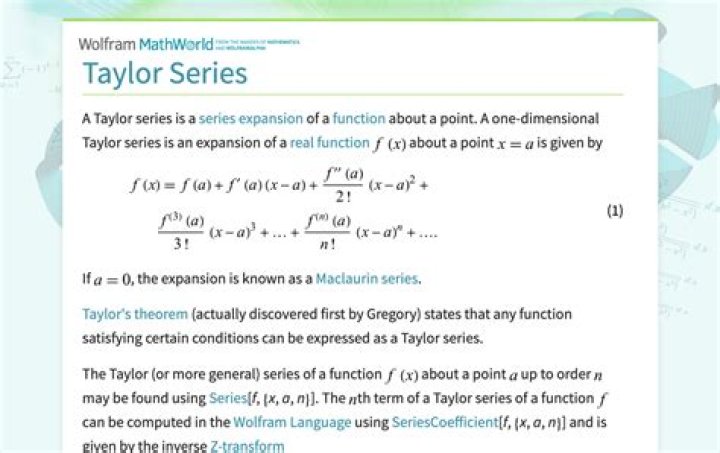
- I know that the Taylor polynomial around $0$ of $\frac 1 {1+x^2}$ is $$1-x^2+x^4-x^6+....+(-1)^nx^{2n}$$
- If I have the power series of a function f such as $F'=f$, I can construct the power series of $F$ with $F(x)=F(a)+\sum_{n=1}^{\infty}\frac {a_n} {n+1} (x-a)^{n+1}$
1 Answer
$\begingroup$If I have the power series of a function f such as $F'=f$, I can construct the power series of $F$ with $F(x)=F(a)+\sum_{n=1}^{\infty}\frac {a_n} {n+1} (x-a)^{n+1}$
Have you tried this? Note that $\frac{d}{dx} \arctan(x) = \frac{1}{1+x^2}$.
You have the power series for $\frac{1}{1+x^2}$ centered at $0$, for which $$ a_n = \begin{cases} (-1)^{n/2} & n \text{ is even}\\ 0 & \text{otherwise} \end{cases} $$
In order to find the Taylor expansion of $\frac{1}{x^2 + 1}$ at $1$, note that $$ \begin{align} \frac{1}{x^2 + 1} &= \frac{1}{1 + (1+(x-1))^2} = \frac{1}{1 + 1 + 2(x-1) + (x-1)^2} \\ & = \frac{1}{2 + 2(x-1) + (x-1)^2} = \frac{1}{2} \cdot \frac{1}{1 + \left[(x-1) + \frac{(x-1)^2}{2}\right]} \\ & = \frac 12 \left(1 - \left[(x-1) + \frac{(x-1)^2}{2}\right] + \left[(x-1) + \frac{(x-1)^2}{2}\right]^2 - \cdots \right) \\ & = \frac 12 - \frac 12 (x-1) + \frac 14(x-1)^2 \\ &\qquad- \frac 18 (x-1)^4 + \frac 18 (x-1)^5 -\frac 1{16} (x-1)^6\\ &\qquad+ \frac 1{32} (x-1)^8 - \frac 1{32} (x-1)^9 + \frac 1{64}(x-1)^{10} - \cdots \end{align} $$
$\endgroup$4