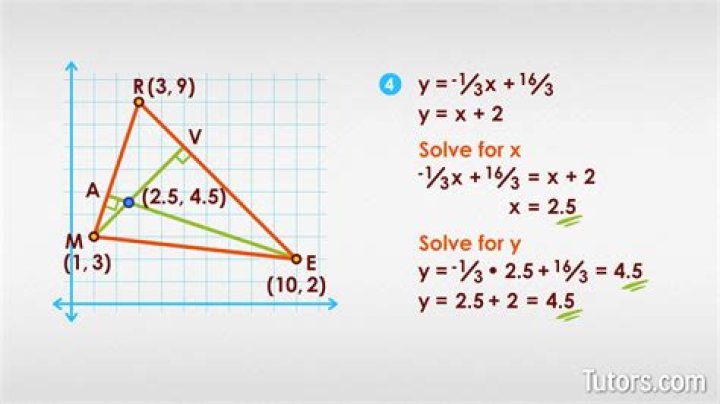
How does one calculate the coordinates of a triangle's orthocentre?
I was surfing through the net and got this formula:
$$x-\rm{coordinate}= \frac{x_1\tan A+x_2\tan B+x_3\tan C}{\tan A+\tan B+\tan C}$$
$$y-\rm{coordinate}= \frac{y_1\tan A+y_2\tan B+y_3\tan C}{\tan A+\tan B+\tan C} $$
How do you prove this? Is there any method using just the coordinates?
$\endgroup$4 Answers
$\begingroup$
Here $A\equiv (x_1,y_1)$,$B\equiv (x_2,y_2)$,$C\equiv (x_3,y_3)$. I'll use the usual notation for $a,b,c,R$ and $A,B,C$.
Using simple trigonometry, $BP=c\cos B$, $PC=b\cos C\implies\dfrac{BP}{PC}=\dfrac{c\cos B}{b\cos C}$ $$\implies P_x= \dfrac{x_2b\cos C+x_3c\cos B}{b\cos C+c\cos B}= \dfrac{x_2b\cos C+x_3c\cos B}{a}$$
Using some trig again, $AH=2R\cos A$ and $HP=2R\cos B \cos C\implies \dfrac{AH}{HP}=\dfrac{\cos A}{\cos B\cos C}$ $$\implies H_x= \dfrac{\cos A\left(\dfrac{x_2b\cos C+x_3c\cos B}{a}\right)+x_1\cos B\cos C}{\cos A+ \cos B\cos C}$$
$$H_x=\dfrac{x_1a\cos B\cos C+x_2b\cos C\cos A+x_3c\cos A\cos B}{a\cos A+a\cos B\cos C}$$
$$H_x=\dfrac{x_1a\cos B\cos C+x_2b\cos C\cos A+x_3c\cos A\cos B}{a\cos B\cos C+b\cos C\cos A+c\cos A\cos B}$$
Dividing by $\cos A\cos B\cos C$:
$$H_x=\frac{x_1a\sec A+x_2b\sec B+x_3c\sec C}{a\sec A+b\sec B+c\sec C}$$
Now using Sine Law do the substitution for $a,b,c$ and then cancel the $2R$ to get:
$$H_x=\dfrac{x_1\tan A+x_2\tan B+x_3\tan C}{\tan A+\tan B+\tan C}$$
$\endgroup$1$\begingroup$Hint: In barycentric coordinates system, coordinates of a point $X$ in the plane of triangle $\Delta ABC$ is determined by the ratios $\lambda_1=\frac{[\Delta XBC]}{[\Delta ABC]},\lambda_2 =\frac{[\Delta XCA]}{[\Delta ABC]}$, and $\lambda_3=\frac{[\Delta XAB]}{[\Delta ABC]}$ where the brackets denote the (signed) area of the enclosed triangles. That is to say $X=\lambda_1 A+\lambda_2 B + \lambda_3 C$. You only need to show that for $X$ being the orthocenter we have $\lambda_1=\frac{\tan A}{\sum \tan A}$, $\lambda_2=\frac{\tan B}{\sum \tan A}$, and $\lambda_3=\frac{\tan C}{\sum \tan A}$.
$\endgroup$2$\begingroup$yes there is a method using just the coordinates... the slope of the altitude is negative of the reverse of the side on which the altitude is dropped.... so after finding the slope with the given coordinates of the line on which the altitude is dropped , one can use the equation of the line $y-y_1=m(x-x_1)$, where $x_1$ and $y_1$ are the coordinates of the vertex from which the altitude has been dropped. similarly for more altitude can be done. the intersection point of these two altitudes is the ortho-centre.
$\endgroup$$\begingroup$Consider $ \Delta ABC $ in the plane. For now take origin at $ A $, and positions of $ B, C $ as $ \vec{b} = (b_1, b_2)$ and $ \vec{c} = (c_1, c_2) $ respectively.
Any vector perpendicular to nonzero vector $ \vec{x} = (x_1, x_2) $ is of the form $t (-x_2, x_1) $ with $ t \in \mathbb{R} $. So altitude line through $ B $ is $ (\vec{b} + t(-c_2, c_1))_{t \in \mathbb{R}}$, and that through $ C $ is $ (\vec{c} + s(-b_2, b_1))_{s \in \mathbb{R}} $.
For their intersection point we should solve $ b_1 - \color{goldenrod}{t}c_2 = c_1 - \color{goldenrod}{s} b_2 $ and $ b_2 + \color{goldenrod}{t}c_1 = c_2 + \color{goldenrod}{s}b_1 $ for $ \color{goldenrod}{s},\color{goldenrod}{t} $. Taking $ \text{Eq1} \times b_1 + \text{Eq2} \times b_2 $ eliminates $ s $ to give $ b_1 ^2 -tb_1 c_2 + b_2 ^2 + tb_2 c_1 = b_1 c_1 + b_2 c_2$, i.e. $ t = \frac{\vec{b} \cdot (\vec{b} - \vec{c})}{\text{det}(\vec{b}, \vec{c})} $. So they intersect at $ \vec{b} + \frac{\vec{b} \cdot (\vec{b} - \vec{c})}{\text{det}(\vec{b}, \vec{c})} (-c_2, c_1) $, which on expanding becomes $ \frac{\vec{b}\cdot\vec{c}}{\det(\vec{b}, \vec{c})} (-(b_2 - c_2), b_1 - c_1) .$
It can be rewritten as $ \frac{\vec{b}\cdot \vec{c}}{\det(\vec{b}, \vec{c})} (\vec{b}-\vec{c})^{\perp} $, where $ \vec{z}^{\perp} := (-z_2, z_1) $. This is clearly perpendicular to $ \vec{b} - \vec{c} $, and hence lies on the altitude through $ A $, proving concurrency.
To summarise,
Th: Consider points $ A(\vec{a}),B(\vec{b}),C(\vec{c}) $ in the plane forming a triangle. Defining $ f(\vec{x}, \vec{y}) := \dfrac{\vec{x}\cdot\vec{y}}{\det(\vec{x}, \vec{y})} (\vec{x}-\vec{y})^{\perp}$ where $ \vec{z}^{\perp} := (-z_2, z_1) $, the altitudes of $ \Delta ABC $ all intersect at $ \vec{a} + f(\vec{b}-\vec{a}, \vec{c}-\vec{a}) .$
$\endgroup$