
I have a string as
string = "firstName:name1, lastName:last1"; now I need one object obj such that
obj = {firstName:name1, lastName:last1} How can I do this in JS?
318 Answers
Actually, the best solution is using JSON:
JSON.parse(text[, reviver]);
Examples:
1)
var myobj = JSON.parse('{ "hello":"world" }'); alert(myobj.hello); // 'world' 2)
var myobj = JSON.parse(JSON.stringify({ hello: "world" }); alert(myobj.hello); // 'world' 3) Passing a function to JSON
var obj = { hello: "World", sayHello: (function() { console.log("I say Hello!"); }).toString() }; var myobj = JSON.parse(JSON.stringify(obj)); myobj.sayHello = new Function("return ("+myobj.sayHello+")")(); myobj.sayHello(); Your string looks like a JSON string without the curly braces.
This should work then:
obj = eval('({' + str + '})'); If I'm understanding correctly:
var properties = string.split(', '); var obj = {}; properties.forEach(function(property) { var tup = property.split(':'); obj[tup[0]] = tup[1]; }); I'm assuming that the property name is to the left of the colon and the string value that it takes on is to the right.
Note that Array.forEach is JavaScript 1.6 -- you may want to use a toolkit for maximum compatibility.
This simple way...
var string = "{firstName:'name1', lastName:'last1'}"; eval('var obj='+string); alert(obj.firstName); output
name1 Since JSON.parse() method requires the Object keys to be enclosed within quotes for it to work correctly, we would first have to convert the string into a JSON formatted string before calling JSON.parse() method.
var obj = '{ firstName:"John", lastName:"Doe" }'; var jsonStr = obj.replace(/(\w+:)|(\w+ :)/g, function(matchedStr) { return '"' + matchedStr.substring(0, matchedStr.length - 1) + '":'; }); obj = JSON.parse(jsonStr); //converts to a regular object console.log(obj.firstName); // expected output: John console.log(obj.lastName); // expected output: DoeThis would work even if the string has a complex object (like the following) and it would still convert correctly. Just make sure that the string itself is enclosed within single quotes.
var strObj = '{ name:"John Doe", age:33, favorites:{ sports:["hoops", "baseball"], movies:["star wars", "taxi driver"] }}'; var jsonStr = strObj.replace(/(\w+:)|(\w+ :)/g, function(s) { return '"' + s.substring(0, s.length-1) + '":'; }); var obj = JSON.parse(jsonStr); console.log(obj.favorites.movies[0]); // expected output: star warsIf you have a string like foo: 1, bar: 2 you can convert it to a valid obj with:
str .split(',') .map(x => x.split(':').map(y => y.trim())) .reduce((a, x) => { a[x[0]] = x[1]; return a; }, {}); Thanks to niggler in #javascript for that.
Update with explanations:
const obj = 'foo: 1, bar: 2' .split(',') // split into ['foo: 1', 'bar: 2'] .map(keyVal => { // go over each keyVal value in that array return keyVal .split(':') // split into ['foo', '1'] and on the next loop ['bar', '2'] .map(_ => _.trim()) // loop over each value in each array and make sure it doesn't have trailing whitespace, the _ is irrelavent because i'm too lazy to think of a good var name for this }) .reduce((accumulator, currentValue) => { // reduce() takes a func and a beginning object, we're making a fresh object accumulator[currentValue[0]] = currentValue[1] // accumulator starts at the beginning obj, in our case {}, and "accumulates" values to it // since reduce() works like map() in the sense it iterates over an array, and it can be chained upon things like map(), // first time through it would say "okay accumulator, accumulate currentValue[0] (which is 'foo') = currentValue[1] (which is '1') // so first time reduce runs, it starts with empty object {} and assigns {foo: '1'} to it // second time through, it "accumulates" {bar: '2'} to it. so now we have {foo: '1', bar: '2'} return accumulator }, {}) // when there are no more things in the array to iterate over, it returns the accumulated stuff console.log(obj) Confusing MDN docs:
Function:
const str2obj = str => { return str .split(',') .map(keyVal => { return keyVal .split(':') .map(_ => _.trim()) }) .reduce((accumulator, currentValue) => { accumulator[currentValue[0]] = currentValue[1] return accumulator }, {}) } console.log(str2obj('foo: 1, bar: 2')) // see? works! You need use JSON.parse() for convert String into a Object:
var obj = JSON.parse('{ "firstName":"name1", "lastName": "last1" }'); if you're using JQuery:
var obj = jQuery.parseJSON('{"path":"/img/filename.jpg"}'); console.log(obj.path); // will print /img/filename.jpg REMEMBER: eval is evil! :D
3I implemented a solution in a few lines of code which works quite reliably.
Having an HTML element like this where I want to pass custom options:
<div> </div> a function parses the custom options and return an object to use that somewhere:
function readCustomOptions($elem){ var i, len, option, options, optionsObject = {}; options = $elem.data('options'); options = (options || '').replace(/\s/g,'').split(';'); for (i = 0, len = options.length - 1; i < len; i++){ option = options[i].split(':'); optionsObject[option[0]] = option[1]; } return optionsObject; } console.log(readCustomOptions($('.my-element'))); string = "firstName:name1, lastName:last1"; This will work:
var fields = string.split(', '), fieldObject = {}; if( typeof fields === 'object') ){ fields.each(function(field) { var c = property.split(':'); fieldObject[c[0]] = c[1]; }); } However it's not efficient. What happens when you have something like this:
string = "firstName:name1, lastName:last1, profileUrl:"; split() will split 'http'. So i suggest you use a special delimiter like pipe
string = "firstName|name1, lastName|last1"; var fields = string.split(', '), fieldObject = {}; if( typeof fields === 'object') ){ fields.each(function(field) { var c = property.split('|'); fieldObject[c[0]] = c[1]; }); } I'm using JSON5, and it's works pretty well.
The good part is it contains no eval and no new Function, very safe to use.
In your case, The short and beautiful code
Object.fromEntries(str.split(',').map(i => i.split(':'))); This is universal code , no matter how your input is long but in same schema if there is : separator :)
var string = "firstName:name1, lastName:last1"; var pass = string.replace(',',':'); var arr = pass.split(':'); var empty = {}; arr.forEach(function(el,i){ var b = i + 1, c = b/2, e = c.toString(); if(e.indexOf('.') != -1 ) { empty[el] = arr[i+1]; } }); console.log(empty) Here is my approach to handle some edge cases like having whitespaces and other primitive types as values
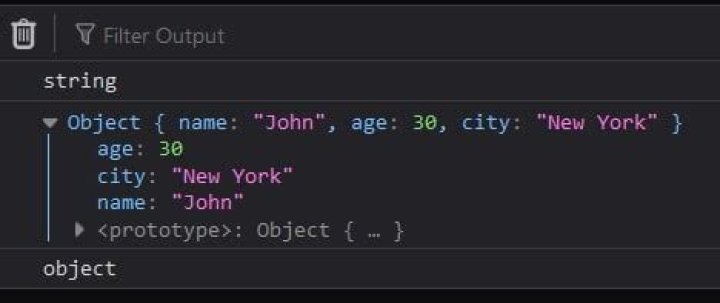
const str = " c:234 , d:sdfg ,e: true, f:null, g: undefined, h:name "; const strToObj = str .trim() .split(",") .reduce((acc, item) => { const [key, val = ""] = item.trim().split(":"); let newVal = val.trim(); if (newVal == "null") { newVal = null; } else if (newVal == "undefined") { newVal = void 0; } else if (!Number.isNaN(Number(newVal))) { newVal = Number(newVal); }else if (newVal == "true" || newVal == "false") { newVal = Boolean(newVal); } return { ...acc, [key.trim()]: newVal }; }, {}); const text = '{"name":"John", "age":30, "city":"New York"}'; const myArr = JSON.parse(text); document.getElementById("demo").innerHTML = myArr.name; In your case
var KeyVal = string.split(", "); var obj = {}; var i; for (i in KeyVal) { KeyVal[i] = KeyVal[i].split(":"); obj[eval(KeyVal[i][0])] = eval(KeyVal[i][1]); } var stringExample = "firstName:name1, lastName:last1 | firstName:name2, lastName:last2"; var initial_arr_objects = stringExample.split("|"); var objects =[]; initial_arr_objects.map((e) => { var string = e; var fields = string.split(','),fieldObject = {}; if( typeof fields === 'object') { fields.forEach(function(field) { var c = field.split(':'); fieldObject[c[0]] = c[1]; //use parseInt if integer wanted }); } console.log(fieldObject) objects.push(fieldObject); }); "objects" array will have all the objects
I know this is an old post but didn't see the correct answer for the question.
var jsonStrig = '{'; var items = string.split(','); for (var i = 0; i < items.length; i++) { var current = items[i].split(':'); jsonStrig += '"' + current[0] + '":"' + current[1] + '",'; } jsonStrig = jsonStrig.substr(0, jsonStrig.length - 1); jsonStrig += '}'; var obj = JSON.parse(jsonStrig); console.log(obj.firstName, obj.lastName); Now you can use obj.firstName and obj.lastName to get the values as you could do normally with an object.