
I run a qr factorization in numpy which returns a list of ndarrays, namely Qand R:
>>> [q,r] = np.linalg.qr(np.array([1,0,0,0,1,1,1,1,1]).reshape(3,3)) R is a two-dimensional array, having pivoted zero-lines at the bottom (even proved for all examples in my test set):
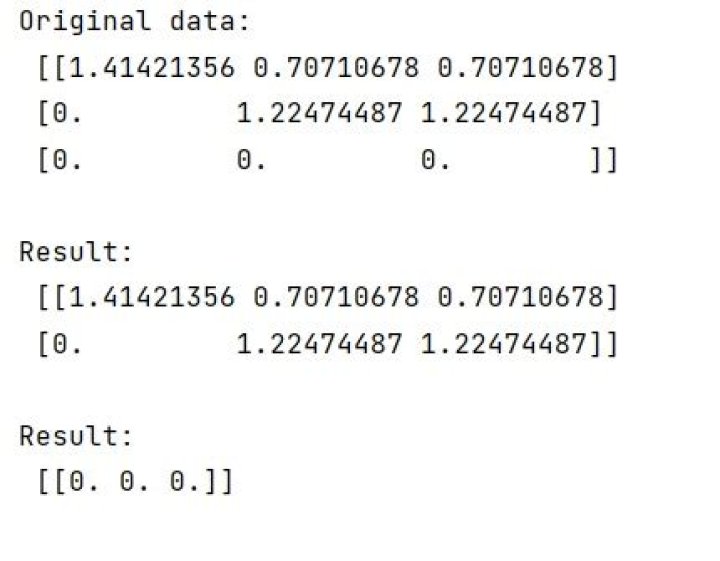
>>> print r [[ 1.41421356 0.70710678 0.70710678] [ 0. 1.22474487 1.22474487] [ 0. 0. 0. ]] . Now, I want to divide R in two matrices R_~:
[[ 1.41421356 0.70710678 0.70710678] [ 0. 1.22474487 1.22474487]] and R_0:
[[ 0. 0. 0. ]] (extracting all zero-lines). It seems to be close to this solution: deleting rows in numpy array.
EDIT:
Even more interesting: np.linalg.qr() returns a n x n-matrix. Not, what I would have expected:
A := n x m Q := n x m R := n x m 4 Answers
Use np.all with an axis argument:
>>> r[np.all(r == 0, axis=1)] array([[ 0., 0., 0.]]) >>> r[~np.all(r == 0, axis=1)] array([[-1.41421356, -0.70710678, -0.70710678], [ 0. , -1.22474487, -1.22474487]]) Because the data are not equal zero exactly, we need set a threshold value for zero such as 1e-6, use numpy.all with axis=1 to check the rows are zeros or not. Use numpy.where and numpy.diff to get the split positions, and call numpy.split to split the array into a list of arrays.
import numpy as np [q,r] = np.linalg.qr(np.array([1,0,0,0,1,1,1,1,1]).reshape(3,3)) mask = np.all(np.abs(r) < 1e-6, axis=1) pos = np.where(np.diff(mask))[0] + 1 result = np.split(r, pos) Since this is among the first google results to trim a 2D array of zero lines, I want to add my implementation to only remove leading and trailing zeros, in two dimensions:
p = np.where(t != 0) t = t[min(p[0]) : max(p[0]) + 1, min(p[1]) : max(p[1]) + 1] This assumes your array is called t and numpy is imported as np.
If you want to eliminate rows that have negligible entries, i'd use np.allclose.
zero_row_indices = [i for i in r.shape[0] if np.allclose(r[i,:],0)] nonzero_row_indices =[i for i in r.shape[0] if not np.allclose(r[i,:],0)] r_new = r[nonzero_row_indices,:]