
guys. I'm trying to find the most elegant solution to a problem and wondered if python has anything built-in for what I'm trying to do.
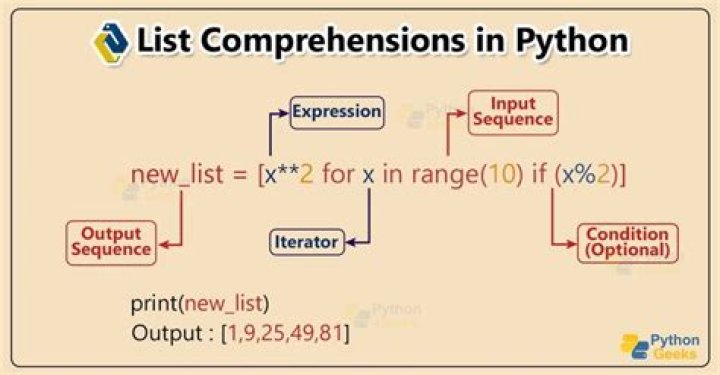
What I'm doing is this. I have a list, A, and I have a function f which takes an item and returns a list. I can use a list comprehension to convert everything in A like so;
[f(a) for a in A] But this return a list of lists;
[a1,a2,a3] => [[b11,b12],[b21,b22],[b31,b32]] What I really want is to get the flattened list;
[b11,b12,b21,b22,b31,b32] Now, other languages have it; it's traditionally called flatmap in functional programming languages, and .Net calls it SelectMany. Does python have anything similar? Is there a neat way to map a function over a list and flatten the result?
The actual problem I'm trying to solve is this; starting with a list of directories, find all the subdirectories. so;
import os dirs = ["c:\\usr", "c:\\temp"] subs = [os.listdir(d) for d in dirs] print subs currentliy gives me a list-of-lists, but I really want a list.
114 Answers
You can have nested iterations in a single list comprehension:
[filename for path in dirs for filename in os.listdir(path)] which is equivalent (at least functionally) to:
filenames = [] for path in dirs: for filename in os.listdir(path): filenames.append(filename) >>> from functools import reduce # not needed on Python 2 >>> list_of_lists = [[1, 2],[3, 4, 5], [6]] >>> reduce(list.__add__, list_of_lists) [1, 2, 3, 4, 5, 6] The itertools solution is more efficient, but this feels very pythonic.
You can find a good answer in the itertools recipes:
import itertools def flatten(list_of_lists): return list(itertools.chain.from_iterable(list_of_lists)) The question proposed flatmap. Some implementations are proposed but they may unnecessary creating intermediate lists. Here is one implementation that's based on iterators.
def flatmap(func, *iterable): return itertools.chain.from_iterable(map(func, *iterable)) In [148]: list(flatmap(os.listdir, ['c:/mfg','c:/Intel'])) Out[148]: ['SPEC.pdf', 'W7ADD64EN006.cdr', 'W7ADD64EN006.pdf', 'ExtremeGraphics', 'Logs'] In Python 2.x, use itertools.map in place of map.
You could just do the straightforward:
subs = [] for d in dirs: subs.extend(os.listdir(d)) You can concatenate lists using the normal addition operator:
>>> [1, 2] + [3, 4] [1, 2, 3, 4] The built-in function sum will add the numbers in a sequence and can optionally start from a specific value:
>>> sum(xrange(10), 100) 145 Combine the above to flatten a list of lists:
>>> sum([[1, 2], [3, 4]], []) [1, 2, 3, 4] You can now define your flatmap:
>>> def flatmap(f, seq): ... return sum([f(s) for s in seq], []) ... >>> flatmap(range, [1,2,3]) [0, 0, 1, 0, 1, 2] Edit: I just saw the critique in the comments for another answer and I guess it is correct that Python will needlessly build and garbage collect lots of smaller lists with this solution. So the best thing that can be said about it is that it is very simple and concise if you're used to functional programming :-)
0import itertools x=[['b11','b12'],['b21','b22'],['b31']] y=list(itertools.chain(*x)) print y itertools will work from python2.3 and greater
subs = [] map(subs.extend, (os.listdir(d) for d in dirs)) (but Ants's answer is better; +1 for him)
2You could try itertools.chain(), like this:
import itertools import os dirs = ["c:\\usr", "c:\\temp"] subs = list(itertools.chain(*[os.listdir(d) for d in dirs])) print subs itertools.chain() returns an iterator, hence the passing to list().
This is the most simple way to do it:
def flatMap(array): return reduce(lambda a,b: a+b, array) The 'a+b' refers to concatenation of two lists
Google brought me next solution:
def flatten(l): if isinstance(l,list): return sum(map(flatten,l)) else: return l def flat_list(arr): send_back = [] for i in arr: if type(i) == list: send_back += flat_list(i) else: send_back.append(i) return send_back You can use pyxtension:
from pyxtension.streams import stream stream([ [1,2,3], [4,5], [], [6] ]).flatMap() == range(7) If listA=[list1,list2,list3] flattened_list=reduce(lambda x,y:x+y,listA) This will do.
1