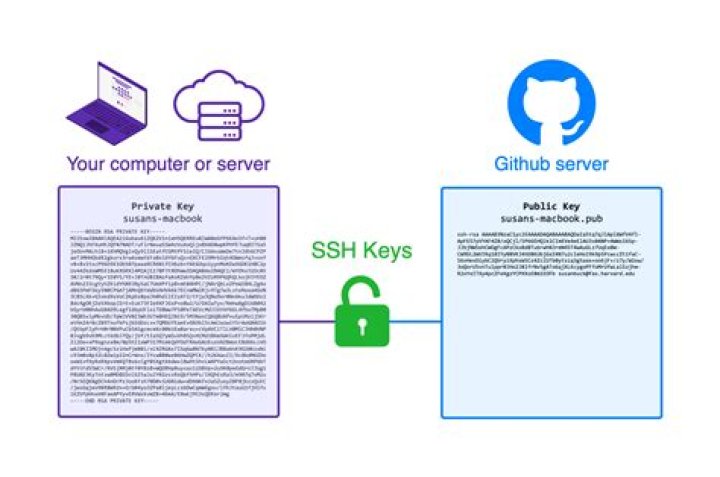

I generated an SSH key pair without a password and added the public key to GitHub.
Connection with
user@dev:/var/www/project# ssh -T Hi User! You've successfully authenticated, but GitHub does not provide shell access. was successful and when I rename the key, it fails.
But when I want to push my changes, it stills ask me for my username and password combination.
Is there a way to push without a password?
29 Answers
If it is asking you for a username and password, your origin remote is pointing at the HTTPS URL rather than the SSH URL.
Change it to ssh.
For example, a GitHub project like Git will have an HTTPS URL:
And the SSH one:
:<Username>/<Project>.git You can do:
git remote set-url origin :<Username>/<Project>.git to change the URL.
2In case you are indeed using the SSH URL, but still are asked for username and password when git pushing:
git remote set-url origin :<Username>/<Project>.git You should try troubleshooting with:
ssh -vT Below is a piece of sample output:
... debug1: Trying private key: /c/Users/Yuci/.ssh/id_rsa debug1: Trying private key: /c/Users/Yuci/.ssh/id_dsa debug1: Trying private key: /c/Users/Yuci/.ssh/id_ecdsa debug1: Trying private key: /c/Users/Yuci/.ssh/id_ed25519 debug1: No more authentication methods to try. Permission denied (publickey). I actually have already added the public key to GitHub before, and I also have the private key locally. However, my private key is of a different name called /c/Users/Yuci/.ssh/github_rsa.
According to the sample output, Git is trying /c/Users/Yuci/.ssh/id_rsa, which I don't have. Therefore, I could simply copy github_rsa to id_rsa in the same directory.
cp /c/Users/Yuci/.ssh/github_rsa /c/Users/Yuci/.ssh/id_rsa Now when I run ssh -vT again, I have:
... debug1: Trying private key: /c/Users/Yuci/.ssh/id_rsa debug1: Authentication succeeded (publickey). ... Hi <my username>! You've successfully authenticated, but GitHub does not provide shell access. ... And now I can push to GitHub without being asked for username and password :-)
2Additionally for gists, it seems you must leave out the username
git remote set-url origin :<Project code> As usual, create an SSH key and paste the public key to GitHub. Add the private key to ssh-agent. (I assume this is what you have done.)
To check everything is correct, use ssh -T
Next, don't forget to modify the remote point as follows:
git remote set-url origin :username/your-repository.git You have to use the SSH version, not HTTPS. When you clone from a repository, copy the link with the SSH version, because SSH is easy to use and solves all problems with access. You can set the access for every SSH you input into your account (like push, pull, clone, etc...)
Here is a link, which says why we need SSH and how to use it: step by step
Like the other users mentioned, you must convert it from using HTTPS to SSH. I don't see an answer with an end-to-end solution. After setting up the ssh keys, do (on your local machine) :
$ git remote set-url origin :username/your_repo.git # Convert HTTPS -> SSH $ ssh-add ~/.ssh/id_rsa_github # add private github ssh key ssh-agent (assuming you have it already running) $ git push for using SSH you must use $ git remote add origin :USERNAME/REPOSITORY.git instead of git remote add origin remote_repository_URL. you can check it with $ git remote -v, if you see 2 lines in the below format, it will work correctly:
origin :username/repo-name.git (fetch) origin :username/repo-name.git (push) You did everything ok but git still asking by password, this worked for me, execute the next commando in your current project's path:
~ ssh-add -K ~/.ssh/id_rsaYourIdRsa Add your SSH private key to the ssh-agent and store your passphrase in the keychain. If you created your key with a different name, or if you are adding an existing key that has a different name, replace id_rsaYourIdRsa in the command with the name of your private key file.
Using the command line:
Enter ls -al ~/.ssh to see if existing SSH keys are present.
In the terminal is shows: No directory exist
Then generate a new SSH key
Step 1.
ssh-keygen -t rsa -b 4096 -C "" step 2.
Enter a file in which to save the key (/Users/you/.ssh/id_rsa): <here is file name and enter the key> step 3.
Enter passphrase (empty for no passphrase): [Type a password] Enter same passphrase again: [Type password again]