 $\begingroup$
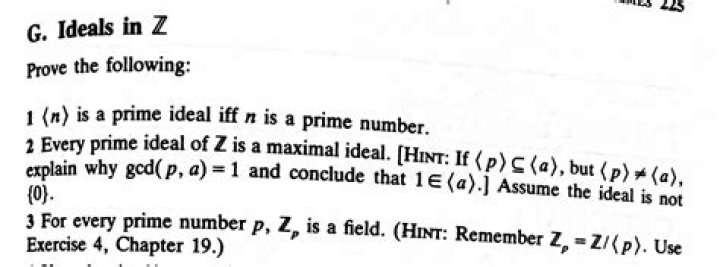
prove $(n)$ prime ideal of $\mathbb{Z}$ iff $n$ is prime or zero
Defintions
Def of prime Ideal (n) $$ ab\in (n) \implies a\in(n) \vee b\in(n) $$ Def 1] integer n is prime if $n \neq 0,\pm 1 $ and only divisors are $\pm n,\pm 1$
Def 2 of n is prime] If $n\neq0,\pm1$ only divisors of n are $\pm1,\pm n$ $$ n|ab \implies n|a \vee n|b $$
$\Rightarrow $] (Prime Ideal $(n)$ of $\mathbb{Z} $$\Rightarrow$ $n$ prime or zero)
Now consider the case where $(n)\neq (0)$. that is $n\neq 0$
Using the def of prime Ideals $$\begin{aligned} ab \in (n) \implies a \in(n) \vee b \in (n) \end{aligned} $$
Well, If an element $x\in(n) \iff x=q*n \iff n|x$
$$n|ab \implies n|a \vee n|b$$ So, $n$ is prime ,nonzero.
In the case that $(n)=(0)$ clearly $n=0$ since there are no zero divisors in $\mathbb{Z}$
$\Leftarrow$] (n is prime or zero $\Rightarrow $ $(n)$ is a prime ideal of $\mathbb{Z}$)
Consider the case where $p is prime$ so $n\neq 0, \pm1$
$$ \begin{aligned} n|ab &\implies n|a \vee n|b \\ ab \in (n) &\implies a \in (n) \vee b\in(n) \end{aligned}$$
in the case $n=0$, since $\mathbb{Z}$ has no zero divisors $$ab=0 \implies a=0 \vee b=0 $$ So (0) is a prime ideal.
Concern if this prove holds, also would be surprised if this question is not out there in this site. Did a search and clicked on similar questions and could not find it.And of course any other ways to prove it.
$\endgroup$22 Answers
$\begingroup$Another way would be to show that $\mathbb{Z}$ is a principal ideal domain or that it has unique factorization. Don't you also need the definition that a prime ideal has to be properly contained within the whole ring?
If $n = \pm 1$, then $\langle n \rangle = \mathbb{Z}$ and thus it can't be a prime ideal. If $n$ is composite and divisible by some prime $p$, then $\langle n \rangle$ is properly contained within $\langle p \rangle$ and thus $\langle n \rangle$ is not a prime ideal either.
And then you just proceed with what you have already demonstrated.
$\endgroup$$\begingroup$Yes, from $p \mid a \iff a \in (p)$ we have more generally in a commutative ring with unity, $(p)$ is a prime ideal iff $p$ is prime (in the ring theory sense: $p \mid ab \implies p \mid a \vee p \mid b$)
$\endgroup$