After failing to find a historical explanation for usage of letters $h$ and $k$ for the vertex of a parabola in most relatively recent textbooks in anglosphere, I turn to math.SE.
Is there any historical explanation for usage of these particular letters and if there is, what is it?
$\endgroup$82 Answers
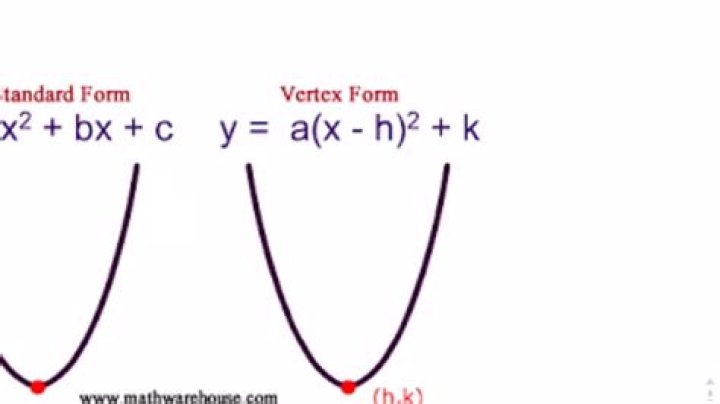
$\begingroup$The beauty of vertex form (as opposed to others) is that you can fully control the "a" amplitude (wideness) of the entire parabola, as well as the vertical and horizontal coordinates (h,k) of the vertex -- the center point of the parabola-- in a way that is more easy, interactive and user friendly.

Before reading this, please know that, the symbols, "h" and "k" were originally, only meant for use in the circle equation.
Making a speculation, one could presume that "k" could refer to Latin "kardo". When roughly translated, this can also mean "axis". But since we're talking about, an axis that moves, I want to say this means, "hinge".
Which brings us to "h", the axis of symmetry.
When looking back at the vertex form equation on the top of the page,
if "h" were to stand for "hinge", it would point out that hinges of doorknobs turn horizontally from the place they are attached to. So in analogy, I suppose that "h" tells us exactly where the axis of symmetry to the vertex is positioned horizontally. Or (when talking about circle equation) rotated horizontally.
Looking at "k" again,"k" does the same exact thing as "h", but this time it is where the axis of symmmetry is vertically positioned.
A synonym that carries the same definition as "kardo" is Latin "tenon". This word directly translates into English "tendon". Tendons help organs shift vertically.
$\endgroup$1$\begingroup$"f" and "g" are used to denote functions, "i" and "j" are used for the imaginary unit, "a" - "e" are used for a lot of various different things. "h" and "k" were just not used for much else. Thus, someone decided that they would be good to use for vertices/centers.
$\endgroup$