
I'm trying to update the column visited to give it the value 1. I use MySQL workbench, and I'm writing the statement in the SQL editor from inside the workbench. I'm writing the following command:
UPDATE tablename SET columnname=1; It gives me the following error:
You are using safe update mode and you tried to update a table without a WHERE that uses a KEY column To disable safe mode, toggle the option ....
I followed the instructions, and I unchecked the safe update option from the Edit menu then Preferences then SQL Editor. The same error still appear & I'm not able to update this value. Please, tell me what is wrong?
23 Answers
It looks like your MySql session has the safe-updates option set. This means that you can't update or delete records without specifying a key (ex. primary key) in the where clause.
Try:
SET SQL_SAFE_UPDATES = 0; Or you can modify your query to follow the rule (use primary key in where clause).
Follow the following steps before executing the UPDATE command: In MySQL Workbench
- Go to
Edit-->Preferences - Click
"SQL Editor"tab anduncheck"Safe Updates"check box Query-->Reconnect to Server// logout and then login- Now execute your SQL query
p.s., No need to restart the MySQL daemon!
4SET SQL_SAFE_UPDATES = 0; # your code SQL here SET SQL_SAFE_UPDATES = 1; SET SQL_SAFE_UPDATES=0; UPDATE tablename SET columnname=1; SET SQL_SAFE_UPDATES=1; No need to set SQL_SAFE_UPDATES to 0, I would really discourage it to do it that way. SAFE_UPDATES is by default on for a REASON. You can drive a car without safety belts and other things if you know what I mean ;) Just add in the WHERE clause a KEY-value that matches everything like a primary-key comparing to 0, so instead of writing:
UPDATE customers SET countryCode = 'USA' WHERE country = 'USA'; -- which gives the error, you just write: UPDATE customers SET countryCode = 'USA' WHERE (country = 'USA' AND customerNumber <> 0); -- Because customerNumber is a primary key you got no error 1175 any more. Now you can be assured every record is (ALWAYS) updated as you expect.
6All that's needed is: Start a new query and run:
SET SQL_SAFE_UPDATES = 0; Then: Run the query that you were trying to run that wasn't previously working.
3Error Code: 1175. You are using safe update mode and you tried to update a table without a WHERE that uses a KEY column To disable safe mode, toggle the option in Preferences -> SQL Editor and reconnect.
Turn OFF "Safe Update Mode" temporary
SET SQL_SAFE_UPDATES = 0; UPDATE options SET title= 'kiemvieclam24h' WHERE url = ' SET SQL_SAFE_UPDATES = 1; Turn OFF "Safe Update Mode" forever
Mysql workbench 8.0:
MySQL Workbench => [ Edit ] => [ Preferences ] -> [ SQL Editor ] -> Uncheck "Safe Updates"  Old version can:
MySQL Workbench => [Edit] => [Preferences] => [SQL Queries] - Preferences...
- "Safe Updates"...
- Restart server



SET SQL_SAFE_UPDATES=0; OR
Go to Edit --> Preferences
Click SQL Queries tab and uncheck Safe Updates check box
Query --> Reconnect to Server
Now execute your sql query
If you are in a safe mode, you need to provide id in where clause. So something like this should work!
UPDATE tablename SET columnname=1 where id>0 On WorkBench I resolved it By deactivating the safe update mode:
-Edit -> Preferences -> Sql Editor then uncheck Safe update.
0The simplest solution is to define the row limit and execute. This is done for safety purposes.
2I found the answer. The problem was that I have to precede the table name with the schema name. i.e, the command should be:
UPDATE schemaname.tablename SET columnname=1; Thanks all.
6In the MySQL Workbech version 6.2 don't exits the PreferenceSQLQueriesoptions.
In this case it's possible use: SET SQL_SAFE_UPDATES=0; 4
Since the question was answered and had nothing to do with safe updates, this might be the wrong place; I'll post just to add information.
I tried to be a good citizen and modified the query to use a temp table of ids that would get updated:
create temporary table ids ( id int ) select id from prime_table where condition = true; update prime_table set field1 = '' where id in (select id from ids); Failure. Modified the update to:
update prime_table set field1 = '' where id <> 0 and id in (select id from ids); That worked. Well golly -- if I am always adding where key <> 0 to get around the safe update check, or even set SQL_SAFE_UPDATE=0, then I've lost the 'check' on my query. I might as well just turn off the option permanently. I suppose it makes deleting and updating a two step process instead of one.. but if you type fast enough and stop thinking about the key being special but rather as just a nuisance..
I too got the same issue but when I off 'safe updates' in Edit -> Preferences -> SQL Editor -> Safe Updates, still I use to face the error as "Error code 1175 disable safe mode"
My solution for this error is just given the primary key to the table if not given and update the column using those primary key value.
1Eg: UPDATE [table name] SET Empty_Column = 'Value' WHERE [primary key column name] = value;
True, this is pointless for the most examples. But finally, I came to the following statement and it works fine:
update tablename set column1 = '' where tablename .id = (select id from tablename2 where tablename2.column2 = 'xyz'); This is for Mac, but must be same for other OS except the location of the preferences.
The error we get when we try an unsafe DELETE operation

On the new window, uncheck the option Safe updates
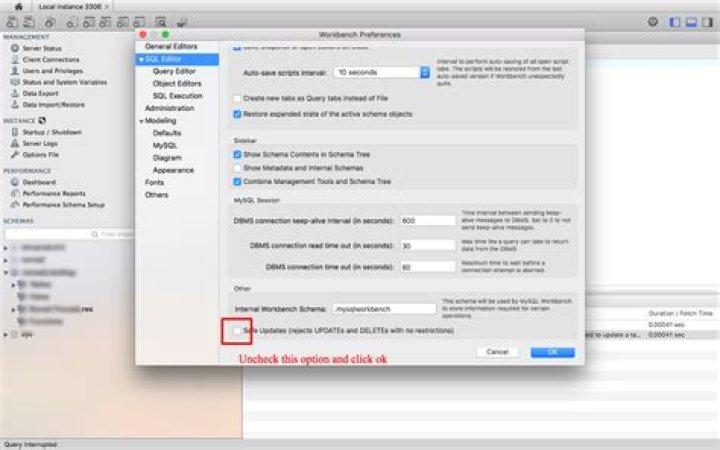
Then close and reopen the connection. No need to restart the service.
Now we are going to try the DELETE again with successful results.
So what is all about this safe updates? It is not an evil thing. This is what MySql says about it.
Using the --safe-updates Option
For beginners, a useful startup option is
--safe-updates(or--i-am-a-dummy, which has the same effect). It is helpful for cases when you might have issued aDELETE FROM tbl_namestatement but forgotten theWHEREclause. Normally, such a statement deletes all rows from the table. With--safe-updates, you can delete rows only by specifying the key values that identify them. This helps prevent accidents.When you use the
--safe-updatesoption, mysql issues the following statement when it connects to the MySQL server:
SET sql_safe_updates=1, sql_select_limit=1000, sql_max_join_size=1000000; It is safe to turn on this option while you deal with production database. Otherwise, you must be very careful not accidentally deleting important data.
just type SET SQL_SAFE_UPDATES = 0; before the delete or update and set to 1 again SET SQL_SAFE_UPDATES = 1
If you're having this problem in a stored procedure and you aren't able to use the key in the WHERE clause, you can solve this by declaring a variable that will hold the limit of the rows that should be updated and then use it in the update/delete query.
DELIMITER $ CREATE PROCEDURE myProcedure() BEGIN DECLARE the_limit INT; SELECT COUNT(*) INTO the_limit FROM my_table WHERE my_column IS NULL; UPDATE my_table SET my_column = true WHERE my_column IS NULL LIMIT the_limit; END$ As stated in previous posts, changing the default settings of the database server will result in undesired modification of existing data due to an incorrect query on the data in a published project. Therefore, to implement such commands as stated in previous posts, it is necessary to run them in a test environment on sample data and then execute them after testing them correctly.
My suggestion is to write a WHERE conditional statement that will loop through all the rows in all conditions if an update should work for all rows in a table. For example, if the table contains an ID value, the condition ID > 0 can be used to select all rows:
/** * For successful result, "id" column must be "Not Null (NN)" and defined in * INT data type. In addition, the "id" column in the table must have PK, UQ * and AI attributes. */ UPDATE schema_name.table_name SET first_column_name = first_value, second_column_name = second_value, ... WHERE id > 0; If the table does not contain an id column, the update operation can be run on all rows by checking a column that cannot be null:
/** * "first_column_name" column must be "Not Null (NN)" for successful result. */ UPDATE schema_name.table_name SET first_column_name = first_value, second_column_name = second_value, ... WHERE table_name.first_column_name IS NOT NULL; MySql workbench gave me the same error, after I unchecked safe mode , I then reconnected the server and the update function worked. Go to Query in the menu bar and reconnect the server
Query Menu -> Reconnect to Server
First: Please make sure you want to update all records in that table because without the where clause it is dangerous to update all records in that table. It's rare time you want to update all records in the table.
most of the time you want to update specific records which should include where cluase if again you want to update all records open MySQL workbench> Edit> Preference>SQL Editor > scroll down at right and uncheck the "Safe Updates(rejects UPDATEs and DELETEs with no restrictions)".
It is for safe updates.
If you uncheck the above said then there are chances that you update all records instead of one record which leads to a database backup restore. there is no rollback.