
I have multiple volumes (as nearly everybody nowadays): on Windows they end up specified as C:, D: and so on. How do I list these all like on a Unix machine with "ls /mnt/" with Powershell?
111 Answers
To get all of the file system drives, you can use the following command:
gdr -PSProvider 'FileSystem' gdr is an alias for Get-PSDrive, which includes all of the "virtual drives" for the registry, etc.
Get-Volume You will get: DriveLetter, FileSystemLabel, FileSystem, DriveType, HealthStatus, SizeRemaining and Size.
4On Windows Powershell:
Get-PSDrive [System.IO.DriveInfo]::getdrives() wmic diskdrive wmic volume dskwipe.exe -l Firstly, on Unix you use mount, not ls /mnt: many things are not mounted in /mnt.
Anyhow, there's the mountvol DOS command, which continues to work in Powershell, and there's the Powershell-specific Get-PSDrive.
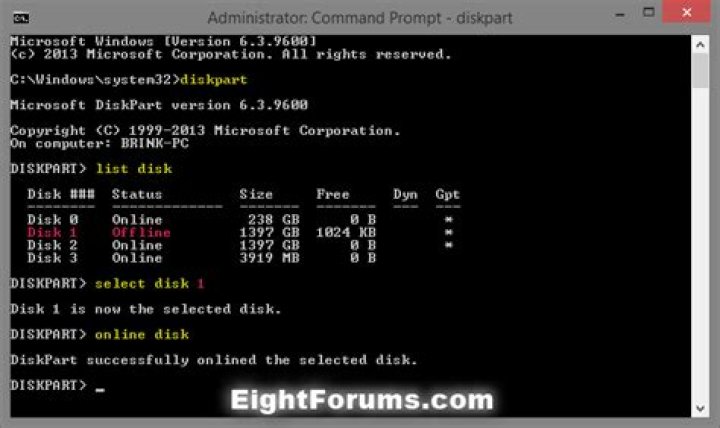
Though this isn't 'powershell' specific... you can easily list the drives and partitions using diskpart, list volume
PS C:\Dev> diskpart Microsoft DiskPart version 6.1.7601 Copyright (C) 1999-2008 Microsoft Corporation. On computer: Box DISKPART> list volume Volume ### Ltr Label Fs Type Size Status Info ---------- --- ----------- ----- ---------- ------- --------- -------- Volume 0 D DVD-ROM 0 B No Media Volume 1 C = System NTFS Partition 100 MB Healthy System Volume 2 G C = Box NTFS Partition 244 GB Healthy Boot Volume 3 H D = Data NTFS Partition 687 GB Healthy Volume 4 E System Rese NTFS Partition 100 MB Healthy Run command:
Get-PsDrive -PsProvider FileSystem For more info see:
This is pretty old, but I found following worth noting:
PS N:\> (measure-command {Get-WmiObject -Class Win32_LogicalDisk|select -property deviceid|%{$_.deviceid}|out-host}).totalmilliseconds ... 928.7403 PS N:\> (measure-command {gdr -psprovider 'filesystem'|%{$_.name}|out-host}).totalmilliseconds ... 169.474 Without filtering properties, on my test system, 4319.4196ms to 1777.7237ms. Unless I need a PS-Drive object returned, I'll stick with WMI.
EDIT: I think we have a winner: PS N:> (measure-command {[System.IO.DriveInfo]::getdrives()|%{$_.name}|out-host}).totalmilliseconds 110.9819
0We have multiple volumes per drive (some are mounted on subdirectories on the drive). This code shows a list of the mount points and volume labels. Obviously you can also extract free space and so on:
gwmi win32_volume|where-object {$_.filesystem -match "ntfs"}|sort {$_.name} |foreach-object { echo "$(echo $_.name) [$(echo $_.label)]" } You can also do it on the CLI with
net use You can use the following to find the "total" disk size on a drive as well.
Get-CimInstance -ComputerName yourhostname win32_logicaldisk | foreach-object {write " $($.caption) $('{0:N2}' -f ($.Size/1gb)) GB total, $('{0:N2}' -f ($_.FreeSpace/1gb)) GB free "}
1Microsoft have a way of doing this as part of their az vm repair scripts (see: Repair a Windows VM by using the Azure Virtual Machine repair commands).