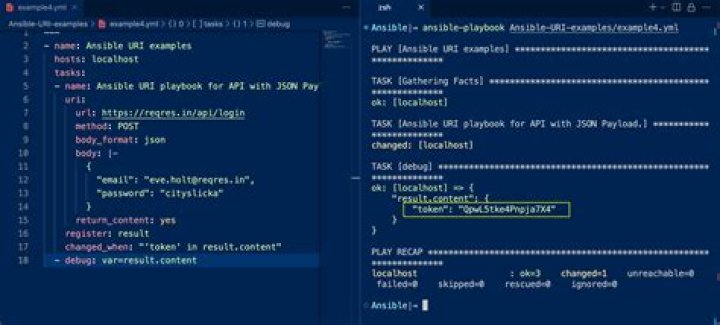

I have a service call that returns system status in json format. I want to use the ansible URI module to make the call and then inspect the response to decide whether the system is up or down
{"id":"20161024140306","version":"5.6.1","status":"UP"} This would be the json that is returned
This is the ansible task that makes a call:
- name: check sonar web is up uri: url: method: GET return_content: yes status_code: 200 body_format: json register: data Question is how can I access data and inspect it as per ansible documentation this is how we store results of a call. I am not sure of the final step which is to check the status.
3 Answers
This works for me.
- name: check sonar web is up uri: url: method: GET return_content: yes status_code: 200 body_format: json register: result until: result.json.status == "UP" retries: 10 delay: 30 Notice that result is a ansible dictionary and when you set return_content=yes the response is added to this dictionary and is accessible using json key
Also ensure you have indented the task properly as shown above.
2You've made the right first step by saving the output into a variable.
The next step is to use either when: or failed_when: statement in your next task, which will then switch based on the contents of the variable. There are a whole powerful set of statements for use in these, the Jinja2 builtin filters, but they are not really linked well into the Ansible documentation, or summarised nicely.
I use super explicitly named output variables, so they make sense to me later in the playbook :) I would probably write yours something like:
- name: check sonar web is up uri: url: method: GET return_content: yes status_code: 200 body_format: json register: sonar_web_api_status_output - name: do this thing if it is NOT up shell: echo "OMG it's not working!" when: sonar_web_api_status_output.stdout.find('UP') == -1 That is, the text "UP" is not found in the variable's stdout.
Other Jinja2 builtin filters I've used are:
changed_when: "'<some text>' not in your_variable_name.stderr"when: some_number_of_files_changed.stdout|int > 0
The Ansible "Conditionals" docs page has some of this info. This blog post was also very informative.
4Whether or not to return the body of the response as a "content" key in the dictionary result. Independently of this option, if the reported Content-type is "application/json", then the JSON is always loaded into a key called json in the dictionary results.
--- - name: Example of JSON body parsing with uri module connection: local gather_facts: true hosts: localhost tasks: - name: Example of JSON body parsing with uri module uri: url: method: GET return_content: yes status_code: 200 body_format: json register: data # failed_when: <optional condition based on JSON returned content> - name: Print returned json dictionary debug: var: data.json - name: Print certain element debug: var: data.json[0].address.city