
I want to plot RESULT vs TIME based on a testresult.csv file that has following format, and I have trouble to get the TIME column's datatype defined properly.
TIME,RESULT 03/24/2016 12:27:11 AM,2 03/24/2016 12:28:41 AM,76 03/24/2016 12:37:23 AM,19 03/24/2016 12:38:44 AM,68 03/24/2016 12:42:02 AM,44 ... To read the csv file, this is the code I wrote: raw_df = pd.read_csv('testresult.csv', index_col=None, parse_dates=['TIME'], infer_datetime_format=True)
This code works, but it is extremely slow, and I assume that the infer_datetime_format takes time. So I tried to read in the csv by default first, and then convert the object dtype 'TIME' to datetime dtype by using to_datetime(), and I hope by defining the format, it might expedite the speed.
raw_df = pd.read_csv('testresult.csv') raw_df.loc['NEWTIME'] = pd.to_datetime(raw_df['TIME'], format='%m/%d%Y %-I%M%S %p') This code complained error:
"ValueError: '-' is a bad directive in format '%m/%d%Y %-I%M%S %p'"
2 Answers
The format you are passing is invalid. The dash between the % and the I is not supposed to be there.
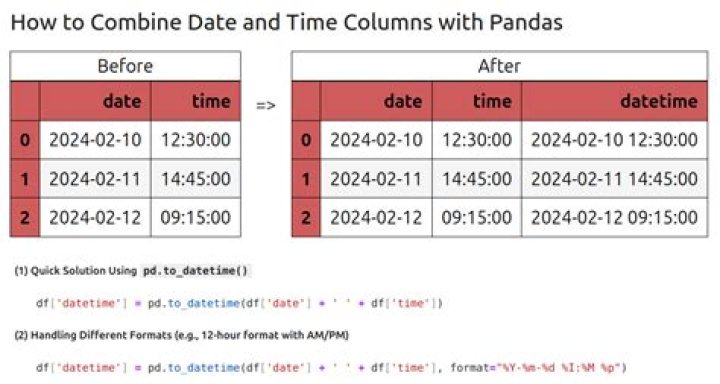
df['TIME'] = pd.to_datetime(df['TIME'], format="%m/%d/%Y %I:%M:%S %p") This will convert your TIME column to a datetime.
Alternatively, you can adjust your read_csv call to do this:
pd.read_csv('testresult.csv', parse_dates=['TIME'], date_parser=lambda x: pd.to_datetime(x, format='%m/%d/%Y %I:%M:%S %p')) Again, this uses the appropriate format with out the extra -, but it also passes in the format to the date_parser parameter instead of having pandas attempt to guess it with the infer_datetime_format parameter.
you can try this:
In [69]: df = pd.read_csv(fn, parse_dates=[0], date_parser=lambda x: pd.to_datetime(x, format='%m/%d/%Y %I:%M:%S %p')) In [70]: df Out[70]: TIME RESULT 0 2016-03-24 00:27:11 2 1 2016-03-24 00:28:41 76 2 2016-03-24 00:37:23 19 3 2016-03-24 00:38:44 68 4 2016-03-24 00:42:02 44