
I have a master and a development branch, both pushed to GitHub. I've cloned, pulled, and fetched, but I remain unable to get anything other than the master branch back.
I'm sure I'm missing something obvious, but I have read the manual and I'm getting no joy at all.
1345 Answers
First, clone a remote Git repository and cd into it:
$ git clone git:// $ cd myproject Next, look at the local branches in your repository:
$ git branch * master But there are other branches hiding in your repository! You can see these using the -a flag:
$ git branch -a * master remotes/origin/HEAD remotes/origin/master remotes/origin/v1.0-stable remotes/origin/experimental If you just want to take a quick peek at an upstream branch, you can check it out directly:
$ git checkout origin/experimental But if you want to work on that branch, you'll need to create a local tracking branch which is done automatically by:
$ git checkout experimental and you will see
Branch experimental set up to track remote branch experimental from origin. Switched to a new branch 'experimental' Here, "new branch" simply means that the branch is taken from the index and created locally for you. As the previous line tells you, the branch is being set up to track the remote branch, which usually means the origin/branch_name branch.
Now, if you look at your local branches, this is what you'll see:
$ git branch * experimental master You can actually track more than one remote repository using git remote.
$ git remote add win32 git:// $ git branch -a * master remotes/origin/HEAD remotes/origin/master remotes/origin/v1.0-stable remotes/origin/experimental remotes/win32/master remotes/win32/new-widgets At this point, things are getting pretty crazy, so run gitk to see what's going on:
$ gitk --all & If you have many remote branches that you want to fetch at once, do:
git pull --all Now you can checkout any branch as you need to, without hitting the remote repository.
Note: This will not create working copies of any non-checked out branches, which is what the question was asking. For that, see
15This Bash script helped me out:
#!/bin/bash for branch in $(git branch --all | grep '^\s*remotes' | egrep --invert-match '(:?HEAD|master)$'); do git branch --track "${branch##*/}" "$branch" done It will create tracking branches for all remote branches, except master (which you probably got from the original clone command). I think you might still need to do a
git fetch --all git pull --all to be sure.
17One liner:
git branch -a | grep -v HEAD | perl -ne 'chomp($_); s|^\*?\s*||; if (m|(.+)/(.+)| && not $d{$2}) {print qq(git branch --track $2 $1/$2\n)} else {$d{$_}=1}' | csh -xfs
As usual: test in your setup before copying rm -rf universe as we know itCredits for one-liner go to user cfi
Using the --mirror option seems to copy the remote tracking branches properly. However, it sets up the repository as a bare repository, so you have to turn it back into a normal repository afterwards.
git clone --mirror path/to/original path/to/dest/.git cd path/to/dest git config --bool core.bare false git checkout anybranch Reference: Git FAQ: How do I clone a repository with all remotely tracked branches?
19You can easily switch to a branch without using the fancy "git checkout -b somebranch origin/somebranch" syntax. You can do:
git checkout somebranch Git will automatically do the right thing:
$ git checkout somebranch Branch somebranch set up to track remote branch somebranch from origin. Switched to a new branch 'somebranch' Git will check whether a branch with the same name exists in exactly one remote, and if it does, it tracks it the same way as if you had explicitly specified that it's a remote branch. From the git-checkout man page of Git 1.8.2.1:
7If <branch> is not found but there does exist a tracking branch in exactly one remote (call it <remote>) with a matching name, treat as equivalent to
$ git checkout -b <branch> --track <remote>/<branch>
Regarding,
git checkout -b experimental origin/experimental
using
git checkout -t origin/experimental or the more verbose, but easier to remember
git checkout --track origin/experimental might be better, in terms of tracking a remote repository.
1The fetch that you are doing should get all the remote branches, but it won't create local branches for them. If you use gitk, you should see the remote branches described as "remotes/origin/dev" or something similar.
To create a local branch based on a remote branch, do something like:
git checkout -b dev refs/remotes/origin/dev Which should return something like:
Branch dev set up to track remote branch refs/remotes/origin/dev. Switched to a new branch "dev" Now, when you are on the dev branch, "git pull" will update your local dev to the same point as the remote dev branch. Note that it will fetch all branches, but only pull the one you are on to the top of the tree.
4Use aliases. Though there aren't any native Git one-liners, you can define your own as
git config --global alias.clone-branches '! git branch -a | sed -n "/\/HEAD /d; /\/master$/d; /remotes/p;" | xargs -L1 git checkout -t' and then use it as
git clone-branches Here is the best way to do this:
mkdir repo cd repo git clone --bare path/to/repo.git .git git config --unset core.bare git reset --hard At this point you have a complete copy of the remote repository with all of its branches (verify with git branch). You can use --mirror instead of --bare if your remote repository has remotes of its own.
When you do "git clone git://location", all branches and tags are fetched.
In order to work on top of a specific remote branch, assuming it's the origin remote:
git checkout -b branch origin/branchname Why you only see "master"
git clone downloads all remote branches but still considers them "remote", even though the files are located in your new repository. There's one exception to this, which is that the cloning process creates a local branch called "master" from the remote branch called "master". By default, git branch only shows local branches, which is why you only see "master".
git branch -a shows all branches, including remote branches.
How to get local branches
If you actually want to work on a branch, you'll probably want a "local" version of it. To simply create local branches from remote branches (without checking them out and thereby changing the contents of your working directory), you can do that like this:
git branch branchone origin/branchone git branch branchtwo origin/branchtwo git branch branchthree origin/branchthree In this example, branchone is the name of a local branch you're creating based on origin/branchone; if you instead want to create local branches with different names, you can do this:
git branch localbranchname origin/branchone Once you've created a local branch, you can see it with git branch (remember, you don't need -a to see local branches).
This isn't too complicated. Very simple and straightforward steps are as follows;
git fetch origin: This will bring all the remote branches to your local.
git branch -a: This will show you all the remote branches.
git checkout --track origin/<branch you want to checkout>
Verify whether you are in the desired branch by the following command;
git branch The output will like this;
*your current branch some branch2 some branch3 Notice the * sign that denotes the current branch.
4Just do this:
$ git clone git:// $ cd myproject $ git checkout branchxyz Branch branchxyz set up to track remote branch branchxyz from origin. Switched to a new branch 'branchxyz' $ git pull Already up-to-date. $ git branch * branchxyz master $ git branch -a * branchxyz master remotes/origin/HEAD -> origin/master remotes/origin/branchxyz remotes/origin/branch123 You see, 'git clone git:// fetches everything, even the branches, you just have to checkout them, then your local branch will be created.
0You only need to use "git clone" to get all branches.
git clone <your_http_url> Even though you only see the master branch, you can use "git branch -a" to see all branches.
git branch -a And you can switch to any branch which you already have.
git checkout <your_branch_name> Don't worry that after you "git clone", you don't need to connect with the remote repository. "git branch -a" and "git checkout <your_branch_name>" can be run successfully when you don't have an Internet connection. So it is proved that when you do "git clone", it already has copied all branches from the remote repository. After that, you don't need the remote repository. Your local already has all branches' code.
2A git clone is supposed to copy the entire repository. Try cloning it, and then run git branch -a. It should list all the branches. If then you want to switch to branch "foo" instead of "master", use git checkout foo.
All the answers I saw here were valid, but there is a much cleaner way to clone a repository and to pull all the branches at once.
When you clone a repository, all the information of the branches is actually downloaded, but the branches are hidden. With the command
git branch -a you can show all the branches of the repository, and with the command
git checkout -b branchname origin/branchname you can then "download" them manually one at a time.
However, when you want to clone a repository with a lot of branches, all the ways illustrated in previous answers are lengthy and tedious in respect to a much cleaner and quicker way that I am going to show, though it's a bit complicated. You need three steps to accomplish this:
1. First step
Create a new empty folder on your machine and clone a mirror copy of the .git folder from the repository:
cd ~/Desktop && mkdir my_repo_folder && cd my_repo_folder git clone --mirror .git The local repository inside the folder my_repo_folder is still empty, and there is just a hidden .git folder now that you can see with a "ls -alt" command from the terminal.
2. Second step
Switch this repository from an empty (bare) repository to a regular repository by switching the boolean value "bare" of the Git configurations to false:
git config --bool core.bare false 3. Third Step
Grab everything that inside the current folder and create all the branches on the local machine, therefore making this a normal repository.
git reset --hard So now you can just type the command "git branch" and you can see that all the branches are downloaded.
This is the quick way in which you can clone a Git repository with all the branches at once, but it's not something you want to do for every single project in this way.
2Self-Contained Repository
If you’re looking for a self-contained clone or backup that includes all remote branches and commit logs, use:
git clone git pull --all The accepted answer of git branch -a only shows the remote branches. If you attempt to checkout the branches you'll be unable to unless you still have network access to the origin server.
Credit: Gabe Kopley's for suggesting using git pull --all.
Note:
Of course, if you no longer have network access to the remote/origin server, remote/origin branches will not have any updates reflected in your repository clone. Their revisions will reflect commits from the date and time you performed the two repository cloning commands above.
Checkout a *local* branch in the usual way with `git checkout remote/origin/` Use `git branch -a` to reveal the remote branches saved within your `clone` repository.
To checkout ALL your clone branches to local branches with one command, use one of the bash commands below:
$ for i in $(git branch -a |grep 'remotes' | awk -F/ '{print $3}' \ | grep -v 'HEAD ->');do git checkout -b $i --track origin/$i; done OR
If your repo has nested branches then this command will take that into account also:
for i in $(git branch -a |grep 'remotes' |grep -v 'HEAD ->');do \ basename ${i##\./} | xargs -I {} git checkout -b {} --track origin/{}; done The above commands will checkout a local branch into your local git repository, named the same as the remote/origin/<branchname> and set it to --track changes from the remote branch on the remote/origin server should you regain network access to your origin repo server once more and perform a git pull command in the usual way.
Use my tool git_remote_branch (grb). You need Ruby installed on your machine). It's built specifically to make remote branch manipulations dead easy.
Each time it does an operation on your behalf, it prints it in red at the console. Over time, they finally stick into your brain :-)
If you don't want grb to run commands on your behalf, just use the 'explain' feature. The commands will be printed to your console instead of executed for you.
Finally, all commands have aliases, to make memorization easier.
Note that this is alpha software ;-)
Here's the help when you run grb help:
git_remote_branch version 0.2.6 Usage: grb create branch_name [origin_server] grb publish branch_name [origin_server] grb rename branch_name [origin_server] grb delete branch_name [origin_server] grb track branch_name [origin_server] Notes: - If origin_server is not specified, the name 'origin' is assumed (git's default) - The rename functionality renames the current branch The explain meta-command: you can also prepend any command with the keyword 'explain'. Instead of executing the command, git_remote_branch will simply output the list of commands you need to run to accomplish that goal. Example: grb explain create grb explain create my_branch github All commands also have aliases: create: create, new delete: delete, destroy, kill, remove, rm publish: publish, remotize rename: rename, rn, mv, move track: track, follow, grab, fetch2
Cloning from a local repo will not work with git clone & git fetch: a lot of branches/tags will remain unfetched.
To get a clone with all branches and tags.
git clone --mirror git:// myproject-local-bare-repo.git To get a clone with all branches and tags but also with a working copy:
git clone --mirror git:// myproject/.git cd myproject git config --unset core.bare git config receive.denyCurrentBranch updateInstead git checkout master OK, when you clone your repo, you have all branches there...
If you just do git branch, they are kind of hidden...
So if you'd like to see all branches name, just simply add --all flag like this:
git branch --all or git branch -a
If you just checkout to the branch, you get all you need.
But how about if the branch created by someone else after you clone?
In this case, just do:
git fetch
and check all branches again...
If you like to fetch and checkout at the same time, you can do:
git fetch && git checkout your_branch_name
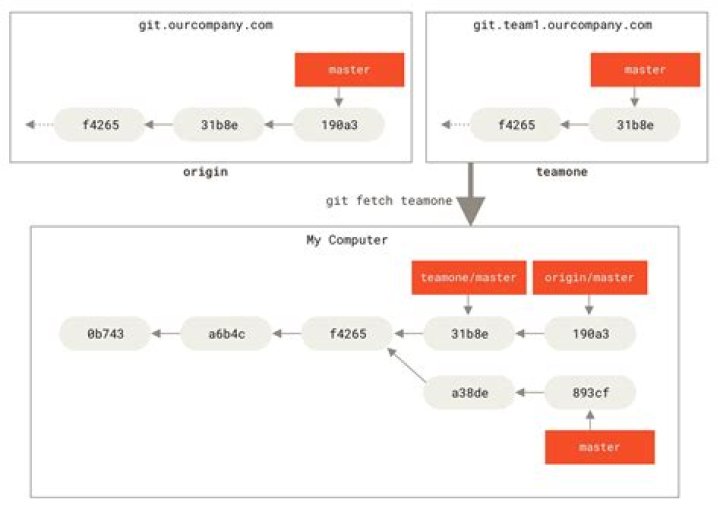
Also created the image below for you to simplify what I said:
Looking at one of the answers to the question I noticed that it's possible to shorten it:
for branch in `git branch -r | grep -v 'HEAD\|master'`; do git branch --track ${branch##*/} $branch; done But beware, if one of remote branches is named, e.g., admin_master it won't get downloaded!
3#!/bin/bash for branch in `git branch -a | grep remotes | grep -v HEAD | grep -v master `; do git branch --track ${branch#remotes/origin/} $branch done These code will pull all remote branches code to the local repository.
1git clone --mirror on the original repo works well for this.
git clone --mirror /path/to/original.git git remote set-url origin /path/to/new-repo.git git push -u origin None of these answers cut it, except user nobody is on the right track.
I was having trouble with moving a repository from one server/system to another. When I cloned the repository, it only created a local branch for master, so when I pushed to the new remote, only the master branch was pushed.
So I found these two methods very useful.
Method 1:
git clone --mirror OLD_REPO_URL cd new-cloned-project mkdir .git mv * .git git config --local --bool core.bare false git reset --hard HEAD git remote add newrepo NEW_REPO_URL git push --all newrepo git push --tags newrepo Method 2:
git config --global alias.clone-branches '! git branch -a | sed -n "/\/HEAD /d; /\/master$/d; /remotes/p;" | xargs -L1 git checkout -t' git clone OLD_REPO_URL cd new-cloned-project git clone-branches git remote add newrepo NEW_REPO_URL git push --all newrepo git push --tags newrepo Here's an answer that uses awk. This method should suffice if used on a new repo.
git branch -r | awk -F/ '{ system("git checkout " $NF) }' Existing branches will simply be checked out, or declared as already in it, but filters can be added to avoid the conflicts.
It can also be modified so it calls an explicit git checkout -b <branch> -t <remote>/<branch> command.
This answer follows Nikos C.'s idea.
Alternatively we can specify the remote branch instead. This is based on murphytalk's answer.
git branch -r | awk '{ system("git checkout -t " $NF) }' It throws fatal error messages on conflicts but I see them harmless.
Both commands can be aliased.
Using nobody's answer as reference, we can have the following commands to create the aliases:
git config --global alias.clone-branches '! git branch -r | awk -F/ "{ system(\"git checkout \" \$NF) }"' git config --global alias.clone-branches '! git branch -r | awk "{ system(\"git checkout -t \" \$NF) }"' Personally I'd use track-all or track-all-branches.
For copy-pasting into the command line:
git checkout master ; remote=origin ; for brname in `git branch -r | grep $remote | grep -v master | grep -v HEAD | awk '{gsub(/^[^\/]+\//,"",$1); print $1}'`; do git branch -D $brname ; git checkout -b $brname $remote/$brname ; done ; git checkout master For higher readability:
git checkout master ; remote=origin ; for brname in ` git branch -r | grep $remote | grep -v master | grep -v HEAD | awk '{gsub(/^[^\/]+\//,"",$1); print $1}' `; do git branch -D $brname ; git checkout -b $brname $remote/$brname ; done ; git checkout master This will:
- check out master (so that we can delete branch we are on)
- select remote to checkout (change it to whatever remote you have)
- loop through all branches of the remote except master and HEAD 0. delete local branch (so that we can check out force-updated branches) 0. check out branch from the remote
- check out master (for the sake of it)
It is based on the answer of VonC.
I wrote these small PowerShell functions to be able to checkout all my Git branches, that are on origin remote.
Function git-GetAllRemoteBranches { iex "git branch -r" <# get all remote branches #> ` | % { $_ -Match "origin\/(?'name'\S+)" } <# select only names of the branches #> ` | % { Out-Null; $matches['name'] } <# write does names #> } Function git-CheckoutAllBranches { git-GetAllRemoteBranches ` | % { iex "git checkout $_" } <# execute ' git checkout <branch>' #> } More Git functions can be found in my Git settings repository.
Use commands that you can remember
I'm using Bitbucket, a repository hosting service of Atlassian. So I try to follow their documentation. And that works perfectly for me. With the following easy and short commands you can checkout your remote branch.
At first clone your repository, and then change into the destination folder. And last, but not least, fetch and checkout:
git clone <repo> <destination_folder> cd <destination_folder> git fetch && git checkout <branch> That's it. Here a little more real-world example:
git clone project_folder cd project_folder git fetch && git checkout develop You will find detail information about the commands in the documentation: Clone Command, Fetch Command, Checkout Command
I'm cloning a repository from the Udemy course Elegant Automation Frameworks with Python and Pytest, so that I can later go over it OFFLINE. I tried downloading the zip, but this only comes for the current branch, so here are my 2 cents.
I'm working on Windows and, obviously, I resorted to the Ubuntu shell from the Windows Subsystem for Linux. Immediately after cloning, here's my branches:
$ git clone $ git branch -a * master remotes/origin/HEAD -> origin/master remotes/origin/config_recipe remotes/origin/functionaltests remotes/origin/master remotes/origin/parallel remotes/origin/parametrize remotes/origin/parametrize_data_excel remotes/origin/unittesting remotes/origin/unittesting1 Then — and after hitting a few git checkout brick walls —, what finally worked for me was:
$ for b in `git branch -a | cut -c18- | cut -d\ -f1`; do git checkout $b; git stash; done After this, here are my branches:
$ git branch -a config_recipe functionaltests master parallel parametrize parametrize_data_excel unittesting * unittesting1 remotes/origin/HEAD -> origin/master remotes/origin/config_recipe remotes/origin/functionaltests remotes/origin/master remotes/origin/parallel remotes/origin/parametrize remotes/origin/parametrize_data_excel remotes/origin/unittesting remotes/origin/unittesting1 Mine goes physical, cutting out the initial remotes/origin/ and then filtering for space delimiters. Arguably, I could just have greped out HEAD and be done with one cut, but I'll leave that for the comments.
Please notice that your current branch is now the last on the list. If you don't know why that is, you're in a tight spot there. Just git checkout whatever you want now.
I needed to do exactly the same. Here is my Ruby script.
#!/usr/bin/env ruby local = [] remote = {} # Prepare %x[git reset --hard HEAD] %x[git checkout master] # Makes sure that * is on master. %x[git branch -a].each_line do |line| line.strip! if /origin\//.match(line) remote[line.gsub(/origin\//, '')] = line else local << line end end # Update remote.each_pair do |loc, rem| next if local.include?(loc) %x[git checkout --track -b #{loc} #{rem}] end %x[git fetch]