
I'm trying to build some code on Ubuntu 10.04 LTS that uses OpenSSL 1.0.0. When I run make, it invokes g++ with the "-lssl" option. The source includes:
#include <openssl/bio.h> #include <openssl/buffer.h> #include <openssl/des.h> #include <openssl/evp.h> #include <openssl/pem.h> #include <openssl/rsa.h> I ran:
$ sudo apt-get install openssl Reading package lists... Done Building dependency tree Reading state information... Done openssl is already the newest version. 0 upgraded, 0 newly installed, 0 to remove and 3 not upgraded. But I guess the openssl package doesn't include the library. I get these errors on make:
foo.cpp:21:25: error: openssl/bio.h: No such file or directory foo.cpp:22:28: error: openssl/buffer.h: No such file or directory foo.cpp:23:25: error: openssl/des.h: No such file or directory foo.cpp:24:25: error: openssl/evp.h: No such file or directory foo.cpp:25:25: error: openssl/pem.h: No such file or directory foo.cpp:26:25: error: openssl/rsa.h: No such file or directory How do I install the OpenSSL C++ library on Ubuntu 10.04 LTS?
I did a man g++ and (under "Options for Linking") for the -l option it states: " The linker searches a standard list of directories for the library..." and "The directories searched include several standard system directories..." What are those standard system directories?
10 Answers
You want to install the development package, which is libssl-dev:
sudo apt-get install libssl-dev Run:
apt-get install libssl-dev How could I have figured that out for myself (other than asking this question here)? Can I somehow tell apt-get to list all packages, and grep for ssl? Or do I need to know the "lib*-dev" naming convention?
If you're linking with -lfoo then the library is likely libfoo.so. The library itself is probably part of the libfoo package, and the headers are in the libfoo-dev package as you've discovered.
Some people use the GUI "synaptic" app (sudo synaptic) to (locate and) install packages, but I prefer to use the command line. One thing that makes it easier to find the right package from the command line is the fact that apt-get supports bash completion.
Try typing sudo apt-get install libssl and then hit tab to see a list of matching package names (which can help when you need to select the correct version of a package that has multiple versions or other variations available).
Bash completion is actually very useful... for example, you can also get a list of commands that apt-get supports by typing sudo apt-get and then hitting tab.
I found a detailed solution here: Install OpenSSL Manually On Linux
From the blog post...:
1Steps to download, compile, and install are as follows (I'm installing version 1.0.1g below; please replace "1.0.1g" with your version number):
Step – 1 : Downloading OpenSSL:
Run the command as below :
$ wgetAlso, download the MD5 hash to verify the integrity of the downloaded file for just varifacation purpose. In the same folder where you have downloaded the OpenSSL file from the website :
$ wget
$ md5sum openssl-1.0.1g.tar.gz
$ cat openssl-1.0.1g.tar.gz.md5Step – 2 : Extract files from the downloaded package:
$ tar -xvzf openssl-1.0.1g.tar.gzNow, enter the directory where the package is extracted like here is openssl-1.0.1g
$ cd openssl-1.0.1gStep – 3 : Configuration OpenSSL
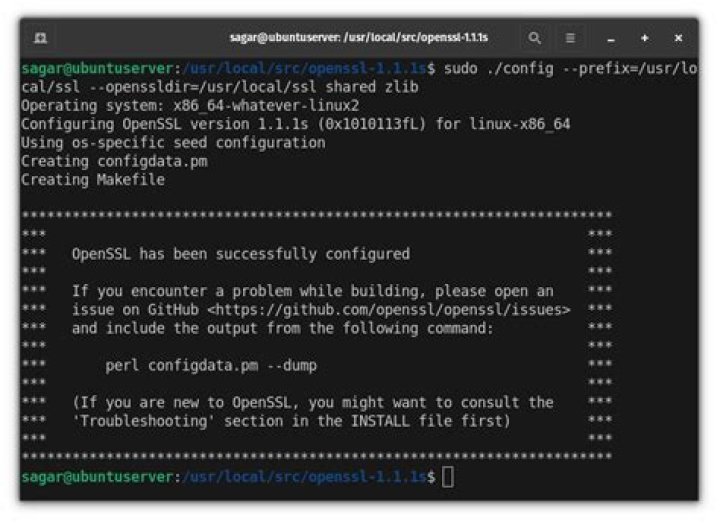
Run below command with optional condition to set prefix and directory where you want to copy files and folder.
$ ./config --prefix=/usr/local/openssl --openssldir=/usr/local/opensslYou can replace “/usr/local/openssl” with the directory path where you want to copy the files and folders. But make sure while doing this steps check for any error message on terminal.
Step – 4 : Compiling OpenSSL
To compile openssl you will need to run 2 command : make, make install as below :
$ makeNote: check for any error message for verification purpose.
Step -5 : Installing OpenSSL:
$ sudo make installOr without sudo,
$ make installThat’s it. OpenSSL has been successfully installed. You can run the version command to see if it worked or not as below :
$ /usr/local/openssl/bin/openssl version
OpenSSL 1.0.1g 7 Apr 2014
Another way to install openssl library from source code on Ubuntu, follows steps below, here WORKDIR is your working directory:
sudo apt-get install pkg-config cd WORKDIR git clone cd openssl ./config make sudo make install # Open file /etc/ld.so.conf, add a new line: "/usr/local/lib" at EOF sudo ldconfig You want the openssl-devel package. At least I think it's -devel on Ubuntu. Might be -dev. It's one of the two.
All of these answers are very outdated and from when the package was still being developed. You can now just use the "normal" command listed below:
sudo apt install openssl As a general rule, when on Debian or Ubuntu and you're missing a development file (or any other file for that matter), use apt-file to figure out which package provides that file:
~ apt-file search openssl/bio.h android-libboringssl-dev: /usr/include/android/openssl/bio.h libssl-dev: /usr/include/openssl/bio.h libwolfssl-dev: /usr/include/cyassl/openssl/bio.h libwolfssl-dev: /usr/include/wolfssl/openssl/bio.h A quick glance at each of the packages that are returned by the command, using apt show will tell you which among the packages is the one you're looking for:
~ apt show libssl-dev Package: libssl-dev Version: 1.1.1d-2 Priority: optional Section: libdevel Source: openssl Maintainer: Debian OpenSSL Team <> Installed-Size: 8,095 kB Depends: libssl1.1 (= 1.1.1d-2) Suggests: libssl-doc Conflicts: libssl1.0-dev Homepage: Tag: devel::lang:c, devel::library, implemented-in::TODO, implemented-in::c, protocol::ssl, role::devel-lib, security::cryptography Download-Size: 1,797 kB APT-Sources: unstable/main amd64 Packages Description: Secure Sockets Layer toolkit - development files This package is part of the OpenSSL project's implementation of the SSL and TLS cryptographic protocols for secure communication over the Internet. . It contains development libraries, header files, and manpages for libssl and libcrypto. N: There is 1 additional record. Please use the '-a' switch to see it Go to the official website and download the source code for the version you need
Then unzip the update package and execute the following command
./config --prefix=/usr/local/ssl --openssldir=/usr/local/ssl -Wl,-rpath,/usr/local/ssl/lib shared
Because the default is to generate only static libraries, if you want dynamic libraries, add the "shared" option
make && make install
sudo apt-get install libcurl4-openssl-dev