I want to apply a Discrete Cosine Transform (as well as the inverse) to an image in Python and I'm wondering what is the best way to do it and how. I've looked at PIL and OpenCV but I still don't understand how to use it.
12 Answers
From OpenCV:
DCT(src, dst, flags) → None Performs a forward or inverse Discrete Cosine transform of a 1D or 2D floating-point array. Parameters: src (CvArr) – Source array, real 1D or 2D array dst (CvArr) – Destination array of the same size and same type as the source flags (int) – Transformation flags, a combination of the following values CV_DXT_FORWARD do a forward 1D or 2D transform. CV_DXT_INVERSE do an inverse 1D or 2D transform. CV_DXT_ROWS do a forward or inverse transform of every individual row of the input matrix. This flag allows user to transform multiple vectors simultaneously and can be used to decrease the overhead (which is sometimes several times larger than the processing itself), to do 3D and higher-dimensional transforms and so forth.
Here is an example of it being used.
The DCT is also available in scipy.fftpack.
4Example with scipy.fftpack:
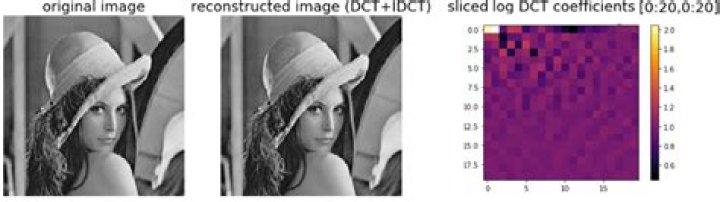
from scipy.fftpack import dct, idct # implement 2D DCT def dct2(a): return dct(dct(a.T, norm='ortho').T, norm='ortho') # implement 2D IDCT def idct2(a): return idct(idct(a.T, norm='ortho').T, norm='ortho') from skimage.io import imread from skimage.color import rgb2gray import numpy as np import matplotlib.pylab as plt # read lena RGB image and convert to grayscale im = rgb2gray(imread('images/lena.jpg')) imF = dct2(im) im1 = idct2(imF) # check if the reconstructed image is nearly equal to the original image np.allclose(im, im1) # True # plot original and reconstructed images with matplotlib.pylab plt.gray() plt.subplot(121), plt.imshow(im), plt.axis('off'), plt.title('original image', size=20) plt.subplot(122), plt.imshow(im1), plt.axis('off'), plt.title('reconstructed image (DCT+IDCT)', size=20) plt.show() Also, if you plot a small slice of the 2D DCT coefficients array imF (in log domain), you will get a figure like the following (with a checkerboard pattern):