I am just confused with the execution sequence of a SQL query when we use GROUP BY and HAVING with a WHERE clause. Which one gets executed first? What is the sequence?
10 Answers
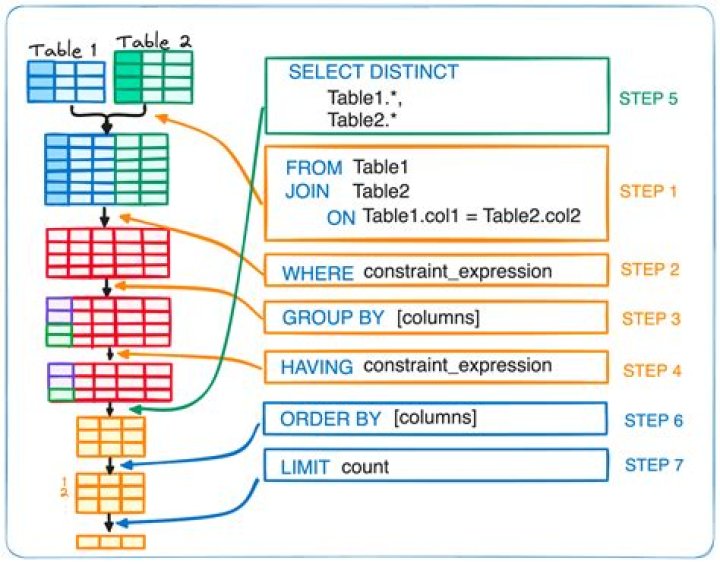
in order:
6FROM & JOINs determine & filter rows
WHERE more filters on the rows
GROUP BY combines those rows into groups
HAVING filters groups
ORDER BY arranges the remaining rows/groups
LIMIT filters on the remaining rows/groups
Here is the complete sequence for sql server :
1. FROM 2. ON 3. JOIN 4. WHERE 5. GROUP BY 6. WITH CUBE or WITH ROLLUP 7. HAVING 8. SELECT 9. DISTINCT 10. ORDER BY 11. TOP So from the above list, you can easily understand the execution sequence of GROUP BY, HAVING and WHERE which is :
1. WHERE 2. GROUP BY 3. HAVING Get more information about it from Microsoft
4WHERE is first, then you GROUP the result of the query, and last but not least HAVING-clause is taken to filter the grouped result. This is the "logical" order, I don't know how this is technically implemented in the engine.
1This is the SQL Order of execution of a Query,
You can check order of execution with examples from this article.
For you question below lines might be helpful and directly got from this article.
- GROUP BY --> The remaining rows after the WHERE constraints are applied are then grouped based on common values in the column specified in the GROUP BY clause. As a result of the grouping, there will only be as many rows as there are unique values in that column. Implicitly, this means that you should only need to use this when you have aggregate functions in your query.
- HAVING --> If the query has a GROUP BY clause, then the constraints in the HAVING clause are then applied to the grouped rows, discard the grouped rows that don't satisfy the constraint. Like the WHERE clause, aliases are also not accessible from this step in most databases.
References:-
- SQL Order of Operations (recommended)
- SQL Lesson 12: Order of execution of a Query
- SQL Query Order of Execution
- What Is the Order of Execution of an SQL Query?
I think it is implemented in the engine as Matthias said: WHERE, GROUP BY, HAVING
Was trying to find a reference online that lists the entire sequence (i.e. "SELECT" comes right down at the bottom), but I can't find it. It was detailed in a "Inside Microsoft SQL Server 2005" book I read not that long ago, by Solid Quality Learning
2In below Order
- FROM & JOIN
- WHERE
- GROUP BY
- HAVING
- SELECT
- ORDER BY
- LIMIT
In Oracle 12c, you can run code both in either sequence below:
Where Group By Having Or
Where Having Group by Think about what you need to do if you wish to implement:
- WHERE: Its need to execute the JOIN operations.
- GROUP BY: You specify Group by to "group" the results on the join, then it has to after the JOIN operation, after the WHERE usage.
- HAVING: HAVING is for filtering as GROUP BY expressions says. Then, it is executed after the GROUP BY.
The order is WHERE, GROUP BY and HAVING.
1Having Clause may come prior/before the group by clause.
Example: select * FROM test_std; ROLL_NO SNAME DOB TEACH
1 John 27-AUG-18 Wills 2 Knit 27-AUG-18 Prestion 3 Perl 27-AUG-18 Wills 4 Ohrm 27-AUG-18 Woods 5 Smith 27-AUG-18 Charmy 6 Jony 27-AUG-18 Wills Warner 20-NOV-18 Wills Marsh 12-NOV-18 Langer FINCH 18-OCT-18 Langer 9 rows selected.
select teach, count() count from test_std having count() > 1 group by TEACH ;
TEACH COUNT
Langer 2 Wills 4
SELECT
FROM
JOINs
WHERE
GROUP By
HAVING
ORDER BY