
I'm trying to convert a string returned from flag.Arg(n) to an int. What is the idiomatic way to do this in Go?
5 Answers
For example,
package main import ( "flag" "fmt" "os" "strconv" ) func main() { flag.Parse() s := flag.Arg(0) // string to int i, err := strconv.Atoi(s) if err != nil { // handle error fmt.Println(err) os.Exit(2) } fmt.Println(s, i) } Converting Simple strings
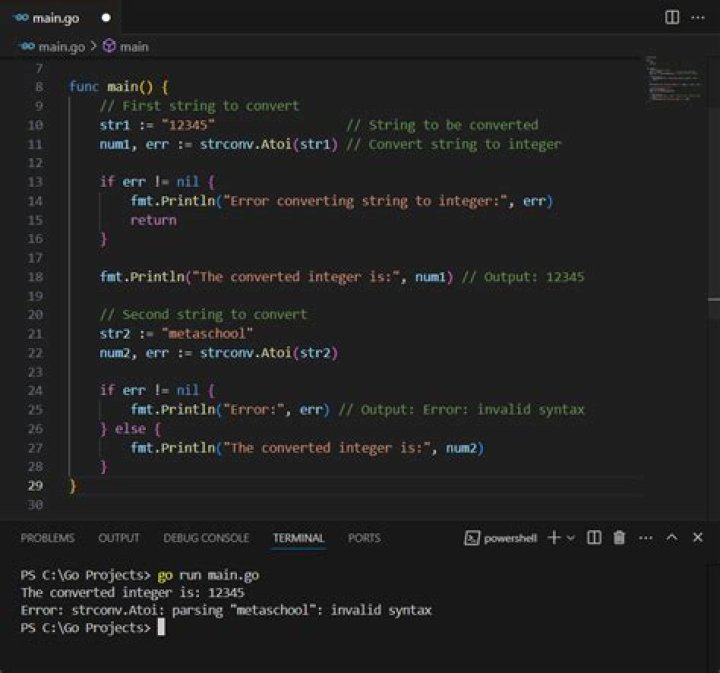
The easiest way is to use the strconv.Atoi() function.
Note that there are many other ways. For example fmt.Sscan() and strconv.ParseInt() which give greater flexibility as you can specify the base and bitsize for example. Also as noted in the documentation of strconv.Atoi():
Atoi is equivalent to ParseInt(s, 10, 0), converted to type int.
Here's an example using the mentioned functions (try it on the Go Playground):
flag.Parse() s := flag.Arg(0) if i, err := strconv.Atoi(s); err == nil { fmt.Printf("i=%d, type: %T\n", i, i) } if i, err := strconv.ParseInt(s, 10, 64); err == nil { fmt.Printf("i=%d, type: %T\n", i, i) } var i int if _, err := fmt.Sscan(s, &i); err == nil { fmt.Printf("i=%d, type: %T\n", i, i) } Output (if called with argument "123"):
i=123, type: int i=123, type: int64 i=123, type: int Parsing Custom strings
There is also a handy fmt.Sscanf() which gives even greater flexibility as with the format string you can specify the number format (like width, base etc.) along with additional extra characters in the input string.
This is great for parsing custom strings holding a number. For example if your input is provided in a form of "id:00123" where you have a prefix "id:" and the number is fixed 5 digits, padded with zeros if shorter, this is very easily parsable like this:
s := "id:00123" var i int if _, err := fmt.Sscanf(s, "id:%5d", &i); err == nil { fmt.Println(i) // Outputs 123 } Here are three ways to parse strings into integers, from fastest runtime to slowest:
strconv.ParseInt(...)fasteststrconv.Atoi(...)still very fastfmt.Sscanf(...)not terribly fast but most flexible
Here's a benchmark that shows usage and example timing for each function:
package main import "fmt" import "strconv" import "testing" var num = 123456 var numstr = "123456" func BenchmarkStrconvParseInt(b *testing.B) { num64 := int64(num) for i := 0; i < b.N; i++ { x, err := strconv.ParseInt(numstr, 10, 64) if x != num64 || err != nil { b.Error(err) } } } func BenchmarkAtoi(b *testing.B) { for i := 0; i < b.N; i++ { x, err := strconv.Atoi(numstr) if x != num || err != nil { b.Error(err) } } } func BenchmarkFmtSscan(b *testing.B) { for i := 0; i < b.N; i++ { var x int n, err := fmt.Sscanf(numstr, "%d", &x) if n != 1 || x != num || err != nil { b.Error(err) } } } You can run it by saving as atoi_test.go and running go test -bench=. atoi_test.go.
goos: darwin goarch: amd64 BenchmarkStrconvParseInt-8 100000000 17.1 ns/op BenchmarkAtoi-8 100000000 19.4 ns/op BenchmarkFmtSscan-8 2000000 693 ns/op PASS ok command-line-arguments 5.797s Try this
import ("strconv") value := "123" number,err := strconv.ParseUint(value, 10, 32) finalIntNum := int(number) //Convert uint64 To int If you control the input data, you can use the mini version
package main import ( "testing" "strconv" ) func Atoi (s string) int { var ( n uint64 i int v byte ) for ; i < len(s); i++ { d := s[i] if '0' <= d && d <= '9' { v = d - '0' } else if 'a' <= d && d <= 'z' { v = d - 'a' + 10 } else if 'A' <= d && d <= 'Z' { v = d - 'A' + 10 } else { n = 0; break } n *= uint64(10) n += uint64(v) } return int(n) } func BenchmarkAtoi(b *testing.B) { for i := 0; i < b.N; i++ { in := Atoi("9999") _ = in } } func BenchmarkStrconvAtoi(b *testing.B) { for i := 0; i < b.N; i++ { in, _ := strconv.Atoi("9999") _ = in } } the fastest option (write your check if necessary). Result :
Path>go test -bench=. atoi_test.go goos: windows goarch: amd64 BenchmarkAtoi-2 100000000 14.6 ns/op BenchmarkStrconvAtoi-2 30000000 51.2 ns/op PASS ok path 3.293s