From what point should I look when determining what trig ratio to use? If they can use hypotenuse over opposite, they can also use opposite over hypotenuse. Were should I look to determine the correct ratio? In relation to what point? The angle?
$\endgroup$43 Answers
$\begingroup$You can just write $$5=y\sin 70^{\circ}$$ as a first step, which is simple and equivalent to the other expressions.
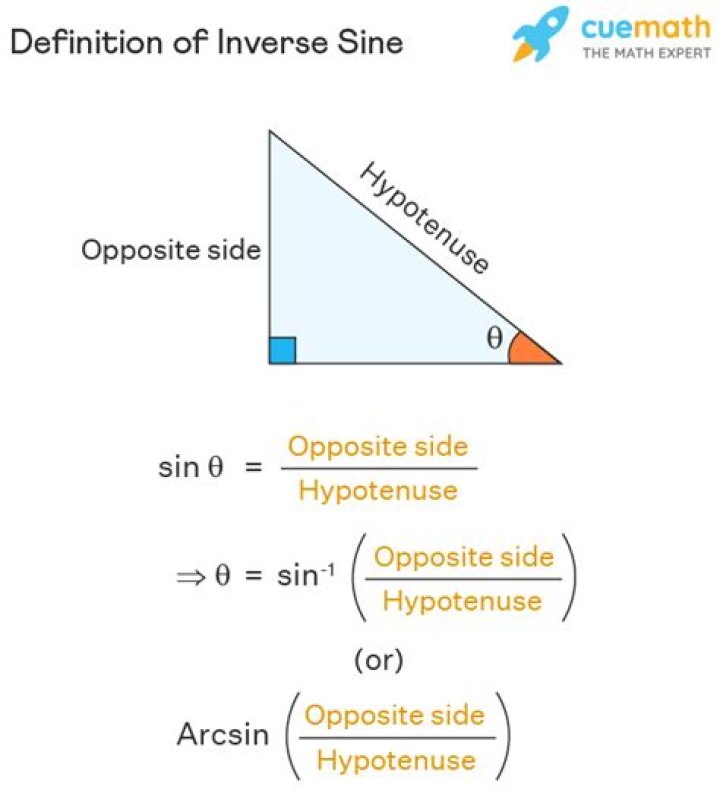
You know to use the sine function because you are dealing with the opposite and the hypotenuse.
$\endgroup$$\begingroup$How the book solved your question:
Start by writing a ration involving $y$.
For example, $\frac{y}{5}$. Now, I see that $5$ is the length of the opposite catete of the angle I know, so this means $\frac{y}{5} = \frac{\text{hyppotenuse}}{\text{opposite}}$. But I know that $\sin(\alpha) = \frac{\text{opposite}}{\text{hyppotenuse}}$, meaning that $$\frac{y}{5} = \frac{\text{hyppotenuse}}{\text{opposite}} = \frac{1}{\frac{\text{opposite}}{\text{hyppotenuse}}} = \frac{1}{\sin 70}$$ Now, if you want to calculate, $y$, just multiply the equation by $5$ to get $$y=\frac{5}{\sin 70}$$
Another way you could solve this:
Start with what you have. You have one angle, one (opposite) line and you want the hyppotenuse. What is the equation that connects these three things? Well, you know that $$\sin\alpha = \frac{\text{opposite}}{\text{hyppotenuse}}$$ and you know that $\text{opposite}=5$ and $\text{hyppotenuse} = y$, so $$\sin70=\frac{5}{y}$$ Now, solve this equation for $y$: $$y\sin 70 = 5\\y=\frac{5}{\sin 70}$$ same as before.
$\endgroup$$\begingroup$In question like these and many other trigonometric question, I recommend change of perspective. You can rotate the triangle so that the $90^\circ$ angle lies on the horizontal pointing upwards, and then you can visualize the ratios and angle in a better way.
In this diagram, $y$ is hypotenuse and 5 is the perpendicular opposite to $70^\circ$ angle.
$\therefore \sin 70^\circ=\large \frac{5}y$
Then it is just transposition, so that the same is written as
$ y=\large \frac{5}{\sin 70^\circ}$
which is, $y=5\times cosec70^\circ$
Secondly, No matter which ratio you choose, depending on the angle the value of $y$ will remain the same. You can calculate $y$ using $cosine$ as well(try it for fun).
$\endgroup$