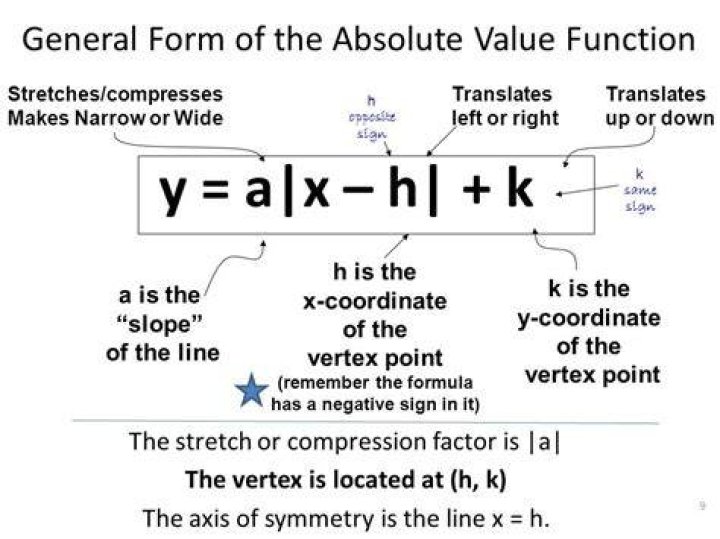
In my notebook it is given that for the above function, we would have:
$f(x) = {-(x+1), x<-1; (x+1), x\geq-1}$
What I don't get is why did we take $-1$ instead of $0$ as is the case for the function $|x|$? Will the function change substantially if I use $0$ instead of $-1$?
$\endgroup$41 Answer
$\begingroup$$$|x| = \begin{cases} x &\mbox{if } x \geq 0 \\ -x & \mbox{if } x < 0. \end{cases}$$
The above function says that the function $|x|$ works by adding a minus sign whenever $x$ is negative, making $x$ overall positive and leaving $x$ as it is when $x \geq 0$. Now let's shift this function to the left by $1$ unit.
We get $$|x+1| = \begin{cases} x+1 &\mbox{if } x+1 \geq 0 \\ -(x+1) & \mbox{if } x+1 < 0. \end{cases}$$
But $x+1 \geq 0 \iff x \geq -1$ and similarly for $x+1 < 0 \iff x < -1$ so we can rewrite the above as $$|x+1| = \begin{cases} x+1 &\mbox{if } x \geq -1 \\ -(x+1) & \mbox{if } x < -1. \end{cases}$$
This says that whenever $x+1$ is positive, we leave $x+1$ as it is. But $x+1$ is positive as long as $x \geq -1$ However if $x+1$ is negative, then we tack on a minus sign to make it positive again. But $x+1$ is negative whenever $x<-1$.
You can see this from the graph of $|x+1|$ and $x+1$: