 $\begingroup$
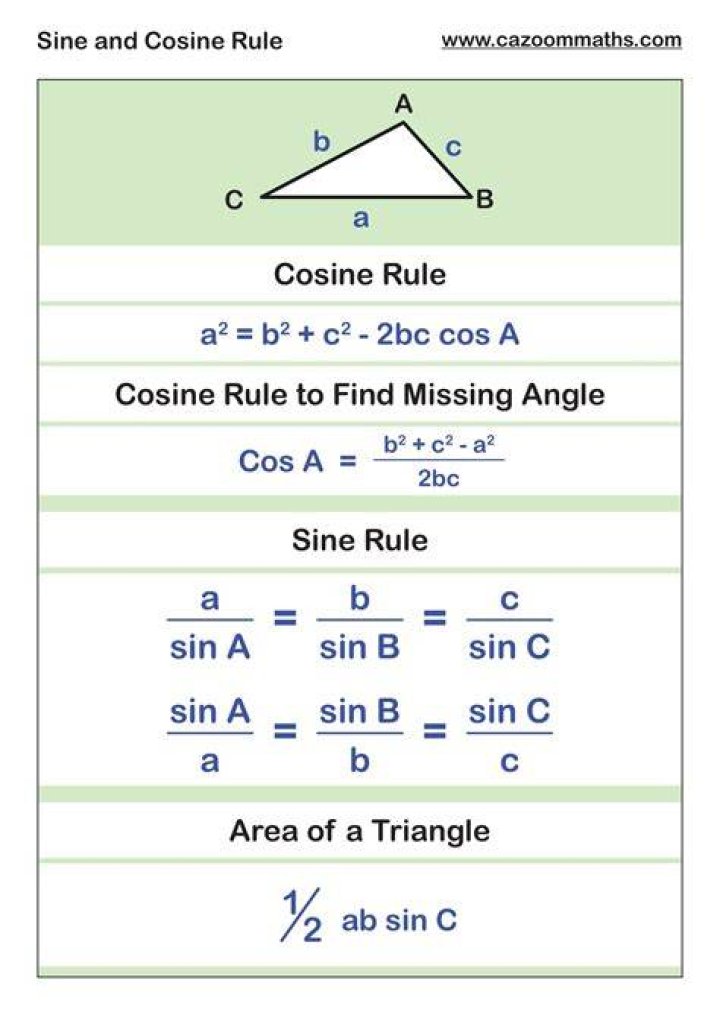
I've been computing the angles of a triangle with sides a = 17, b = 6 and c = 15 using the law of cosines to find the first angle and then the law of sines to find the other 2. I follow the convention of naming the angles opposite these sides A, B and C respectively. Here are my results:
$ C = \arccos( \frac {6^2+17^2-15^2}{2(6)(17)}) = 60.647$ degrees to 3 d.p.
$ B = \arcsin( \frac {6 \sin C}{15}) = 20.405$ degrees to 3 d.p.
$ A = \arcsin( \frac {17 \sin B}{6}) = 81.051$ degrees to 3 d.p.
Clearly, adding these should give $180$ degrees, but it gives 162 degrees to 3 s.f. Assuming I haven't made any mistakes, the error seems quite high and I'm just wondering if anyone knows why this is? It seems high enough to challenge the validity of the laws.
$\endgroup$83 Answers
$\begingroup$OK, I did the Law of Cosines 3 times and came up with 60.647 , 20.404 and 98.949 respectively for angles A, B and C. Remember, the Law of Cosines does not have an ambiguous case, unlike the Law of Sines. I suspect (without further investigating) that his may be the culprit. My advice: Always use the Law of Cosines whenever you can. In this case, when all sides are known, clearly a case for Law of Cosines
$\endgroup$$\begingroup$Switching from Law of Cosines to Law of Sines may introduce the ambiguous case and create extraneous solutions, so it is better to stick with Law of Cosines as much as possible. If you do change to Law of Sines, you can test your results by substituting ALL of your sides and angles into the proportion. If you do not obtain equivalent results, you have the extraneous solution and will need to rework the problem using the supplement of the angle you initially obtained. The link connects to Google Slides I prepared for my students. Testing solutions using Law of Sines
$\endgroup$1$\begingroup$Remember that $$sin(180-θ)=sinθ$$
$sin(180-81.051)=sin(98.949)=0.987$
$60.647+20.405+81.051=162.103$
$60.647+20.405+98.949=180.001$
The correct angle should be 98.949
In graph perspective, positive cosine means acute angle(Q1) while negative cosine means obtuse angle(Q2). But with sine we have to test if the angle is in Q1 or Q2 since it has the same sine values of 0.987. Hence, we calculate which degree of the two adds up to 180. Therefore, as mentioned by others, it is advisable to use law of cosines.
$\endgroup$