I have a Powercom Imperial Series UPS (625 VA) and I want to connect it to a PC and a monitor.
Which outlets should I prefer and why? Do you know the difference between battery backup and surge protected outlets?
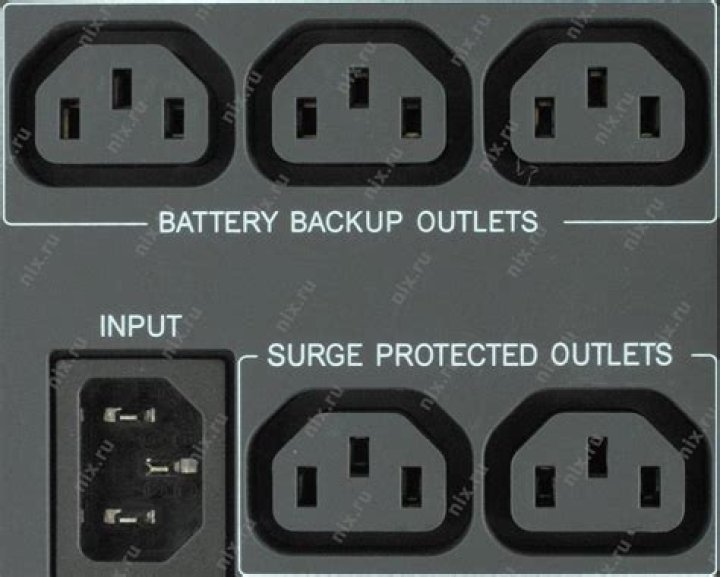
Here are the outlets of my UPS.
3 Answers
The biggest difference between the surge protected and battery backup slots are, that when the power fails, the surge protected slots will not be battery powered.
All 5 slots will be protected against a lightning strike travelling inwards over the input, so your devices are protected against a static discharge.
Now to answer your question which one you should use for your pc and monitor.
Obviously the PC one would be used for the battery. The question is if you want to be able to use your pc during a power outage, or if you just settle for: Just keep it running, I'll start using it again when the power comes back.
If this is the case, connect the monitor to the surge protected outlet. If you want to keep using the pc, the monitor is crucial, so put that to the battery backup too. Do note, that it will drain the UPS battery quicker because now 2 devices are draining its battery.
For that reason, my recommendation would be to use the PC on battery, monitor on surge and not use the pc during an outage.
5Battery Backup Outlets will supply Quality power to your equipment as well as run it on the batteries during a Brown out or black out. The outlets will also provide surge protection to what is plugged in.
The Surge Protected outlets. Will do what it say provide clean power when there is a surge or spike through the power lines in your home.
Depending on how much power your computer uses is how long it will stay on during a outage. Mostly will give you enough time to wrap things up and safely shutdown the computer.
One of my recommendations is have the pc hooked up to the Battery Backup outlets but have your computer shut down as soon as it gets on the power. And have your modem and router hooked up so you will still have online access for reasons during a storm. Because Power still flows through the Coaxial most of the time. Ive been through a few brown outs and have still been able to use the internet when the power was out on my mobile devices.
The Surge Protected outlets. Will do what it claims to provide clean power when there is a surge or spike through the power lines in your home.
And then we view specification numbers. It will absorb maybe hundreds of joules. Destructive surges can be hundreds of thousands of joules. What happens when a near zero (UPS) protector tries to absorb a destructive surge? Destruction of a UPS.
A surge is electricity. That means when a surge current is incoming to a UPS, at the same time, that same current is also outgoing into any attached PC or monitor. Where is this protection?
Advertising hypes subjective claims to a public that ignores spec numbers. It says it is 'surge protection'. Then it must 'absorb' or 'block' surges - to protect PC and monitor. How does its near zero joules 'absorb' hundreds of thousands of joules? It does not. How does its 2 cm protector part 'block' what three miles of sky could not? It does not. It only claims to protect from a tiny surge that are already made irrelevant by more robust protection standard inside all electronics - including PC and monitor.
Either a surge is all but invited inside to hunt for earth ground destructively via appliances (and adjacent protectors sometimes make that damage easier). Or a surge is connected harmlessly to earth BEFORE entering a building. This 'whole house' solution is an only solution always found in facilities that cannot have surge damage. This superior solution costs about $1 per protection appliances. And is essential to even protect that UPS.
Then include numbers. For example, lightning is typically 20,000 amps. So a minimal and properly earthed 'whole house' protector is 50,000 amps. Even direct lighting strikes do not damage the superior solution. Then hundreds of thousands of joules harmlessly dissipate outside a house. Then all appliances (dishwasher, furnace, bathroom GFCIs, recharging phone, clocks, refrigerator, air conditioner, etc) are protected. If that PC needs protection, then everything needs protection. Informed consumers earth one 'whole house' protector to actually have surge protection.
How to separate effective solutions from near zero solutions? Every effective protector makes a low impedance (ie less than 10 feet) connection to single point earth ground. Why does that UPS not even discuss earth ground? Because it does not have that connection and does not claim to protect from surges that are typically destructive. A protector is only as effective as its earth ground.
Demonstrated is a difference between recommendations based in knowledge and experience compared to others who only recite what is promoted by advertising. Anyone can read those numbers. Most recommend by ignoring even the simplest numbers.
4