 $\begingroup$
This is a question from Khan Academy I do not understand.
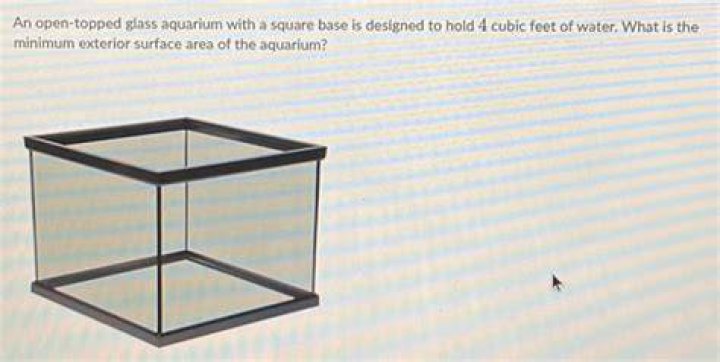
An open-topped glass aquarium with a square base is designed to hold $32$ space cubic feet of water. What is the minimum possible exterior surface area of the aquarium?
This is what I realize:
Surface area = $x^2+4xy$
Volume = $32=x^2\cdot y$
How do I use this to solve the problem?
$\endgroup$3 Answers
$\begingroup$Well, the fact that $y=\frac{32}{x^2}$ should allow you to rewrite the surface area in terms of $x$ only. Can you take it from there?
$\endgroup$$\begingroup$As well as Cameron Buie's suggestion to express $y$ in terms of $x$, and then use calculus to find the minimum area, there is a neat trick that gives the answer more directly:
Instead of making one such aquarium, make two. Then invert the second one, and place it on top of the first one. Now you have a cuboid with volume $64$.
The minimum surface area of a cuboid with given volume is attained by a cube, which in this case has sides of length $\sqrt[3]{64}=4$. So each of the two original aquaria has a $4\times 4$ base and a height of $y=2$.
You can use this method for other problems. For instance, what is the shape of a soup bowl of maximum volume, with a given surface area? Just make two bowls, and put the second one upside-down on top of the first! We see immediately that each bowl must be hemispherical, because a sphere is the maximum volume enclosed by a given surface area.
$\endgroup$$\begingroup$Using Lagrange multipliers:
$$L=x^2 +4xy - \lambda(x^2y - 32)$$
$$0=\frac{1}{2}\frac{\partial L}{\partial x} = x+2y- \lambda x y$$
$$0=\frac{\partial L}{\partial y} = 4x - \lambda x^2$$
$$0=\frac{\partial L}{\partial \lambda} = x^2 y - 32$$
Solving for $\lambda$: $$\lambda =4/x \Rightarrow x=2y$$
So
$$y=2 \textrm { and } x=4.$$
The minimum surface area is 48.
How do we know this is a minimum? We can perturb the solution and see that this increases the surface area. For example, replace $y$ by $2-\epsilon$ and $x$ by $\frac{4\sqrt{2}}{\sqrt{2-\epsilon}}$.
$\endgroup$2