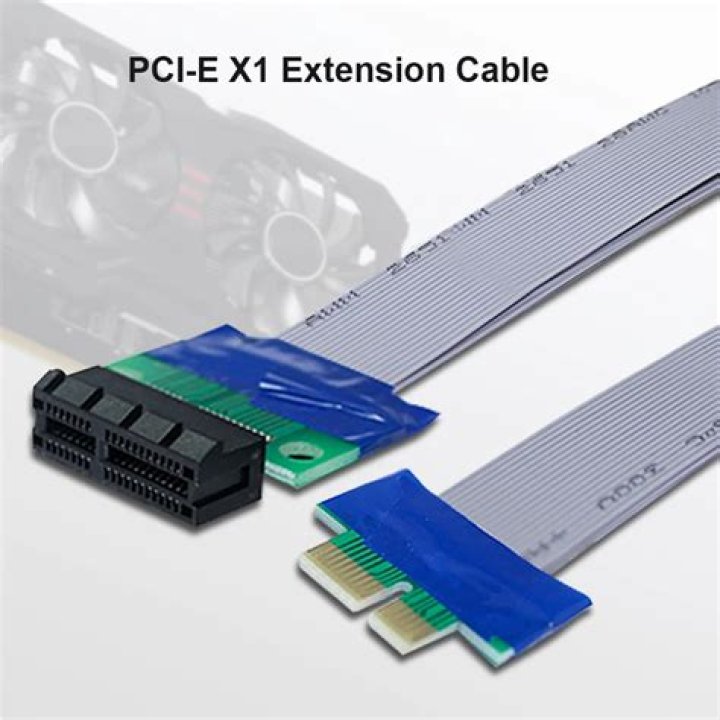
What is the maximum length a PCI-Express bus can be extended with a PCI-Express Flexible Extension Cable like this (36 Pin):

4 Answers
The maximum length for PCIe cable (all lane sizes) generation wise are as follows:
PCIe Gen 1: 15 inches.
PCIe Gen 2: 12 inches.
PCIe Gen 3: 8 inches.
2the total valid length up to PCI-E 3.0 is reported to be 20 inch. it seems that 5 inch are "assigned" for usage by the PCB. So 15 inch are left over for extenders.
a relatively old research (might have been done on PCI-E 1.0; see ) showed cable lengths in operation of 50, 30 and 20 cm to work quite nice - only stacking of two of the shorter cables to full length might have degraded the signal that much that a blue screen could be observed - the exact reason so far remains unclear so its open if alternatively the stacking rather caused a power supply issue instead of a signal quality issue.
according to this ( ) source for PCI-E 4.0 the total length is reduced to 8 to 12 inch, leaving about 3 to 7 inch for cabling.
when checking with amazon for current offers you can find a bunch of "certified 4.0" riser cables (many of them are of the x16 type) with lengths of e.g. 30, 35 or even 45 cm - meaning the product offer is about 12, 14 or even nearly 18 inch. but even if you doubt this self-certificate or it wont work for your particular machine to PCI-E card model (with its internal PCB lengths) - the more general and also more trustworthy co-attribute of all those offers is that the given length will quite likely work for most PCI-E 3.0 setups because this means only half of the "certified" transfer rate is used.
relatively current publications (e.g. ) on upcoming PCI 5.0 are just excluding the topic of raiser cards and cables all together, thus also staying quite silent about any length or even the pure continuation of this possibility.
This looks like a cheap (unshielded riser) and the answer with the short lengths is probably true. On the other hand, watch this video
With good risers Linus achieved over 3m extension.
3One Stop Systems went a couple of hundred meters with their fiber optic cabled expansion chassis and daughter boards.
But for a small cable like that, it is really determined by the motherboard and your motherboard's north bridge's ability to handle electrical noise introduced by having physically longer traces. Shorter traces are generally better and some cables, much like the one you have shown, have introduced shielding to help prevent noise from being introduced on the longer traces but ultimately it's your motherboard's tolerance for that noise which will determine how long you can make a cable as you desire. This will vary wildly between different motherboards, even between different motherboards of the same make and model. For example: I used to test PCI-E charactaristics for a fortune 500 company's NVME drives. As a group, we would buy dozens of motherboards and then cherry pick a couple which had the best noise tolerance for performance testing. Although we never attached any extension cables to these boards, I imagine that you could get some pretty long cables to work with those boards because of the amount of electrical noise that they were able to tolerate. We would then take the boards which didn't meet those stringent requirements and then ship them to other parts of the company for use.
Your results will vary wildly with the use of such a basic cable. Maybe 50 Ft. Maybe 1 inch. This is not really determined by the cable.