 $\begingroup$
I'm looking for the derivative of $x^y$ with respect to $y$.
I have done it by taking log of both sides, how do I do it if I try to write $\log e^{x^y} = x^y$?
$\endgroup$64 Answers
$\begingroup$Since $x^y =e^{y\log(x)}$, the derivative with respect to $y$ is $\log(x)e^{y\log(x)}$
$\endgroup$2$\begingroup$Notice,
- if $x$ is treated as a constant then applying formula $\frac{d}{dt}(a^t)=a^t\ln a$ as follows
$$\frac{d}{dy}(x^y)=x^y\ln x$$
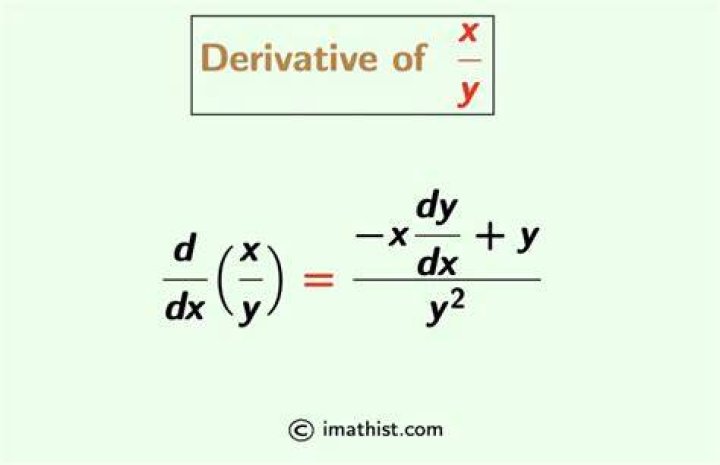
- If $x$ is treated as a variable then let $$u=x^y$$$$\implies \ln u=y\ln x$$ differentiating w.r.t $y$, we get $$\frac{d}{dy}(\ln u)=\frac{d}{dy}(y\ln x)$$ $$\frac{d}{dy}(\ln u)=y\frac{d}{dy}(\ln x)+\ln x\frac{d}{dy}(y)$$ $$\frac{1}{u}\frac{du}{dy}=\frac{y}{x}\frac{dx}{dy}+\ln x$$ $$\frac{du}{dy}=u\left(\frac{y}{x}\frac{dx}{dy}+\ln x\right)$$ setting $u=x^y$ $$\frac{d}{dy}(x^y)=x^y\left(\frac{y}{x}\frac{dx}{dy}+\ln x\right)$$
If $x$ is a constant in $y$, then $$\frac{d}{dy} x^y = \frac{d}{dy} \left(e^{\ln{x}}\right)^y = \frac{d}{dy} e^{y\ln{x}} = e^{y\ln{x}} \cdot \frac{d}{dy}y\ln{x} = e^{y\ln{x}} \cdot \ln{x} $$
First and second step by exponential laws, third step by chain rule, fourth by the derivative of a linear function.
$\endgroup$$\begingroup$Assuming $x$ is a constant: $$\frac{d}{dy} x^y = \frac{d}{dy} (e^{\ln{x}})^y $$ $$= \frac{d}{dy} e^{y \ln{x}} $$ $$= {\ln x} \cdot e^{y \ln{x}} $$ $$= {\ln x} \cdot (e^{\ln{x}})^y $$ $$= {\ln x} \cdot x^y $$ To avoid confusion with the symbols (since constants aren't usually expressed in $x$'s), $$= x^y \cdot {\ln x}$$
You can use the same strategy to find the derivative of $2^x$.
$\endgroup$