I have some bricks that form a trapezoid shape. They have the following dimensions:
a = 4.25 in
b = 9.05 in
c = 2.375 in
d = 9.05 in

I want to arrange these such that they form a giant lawn circle, with a radius of 255 inches (circumference of 1602 inches), without any gaps between them.
- Gaps are to be avoided as much as possible.
- The bricks are to be set on top of a perfectly circular wall that is already constructed. It has a 255-inch radius.
- The bricks can overlap the 255-inch circle, in fact that is desired as it would look poor if they are perfectly flush, but they can't overlap more than 1".
- They can be arranged so either side $\overline{a}$ or $\overline{c}$ are pointing outwards.
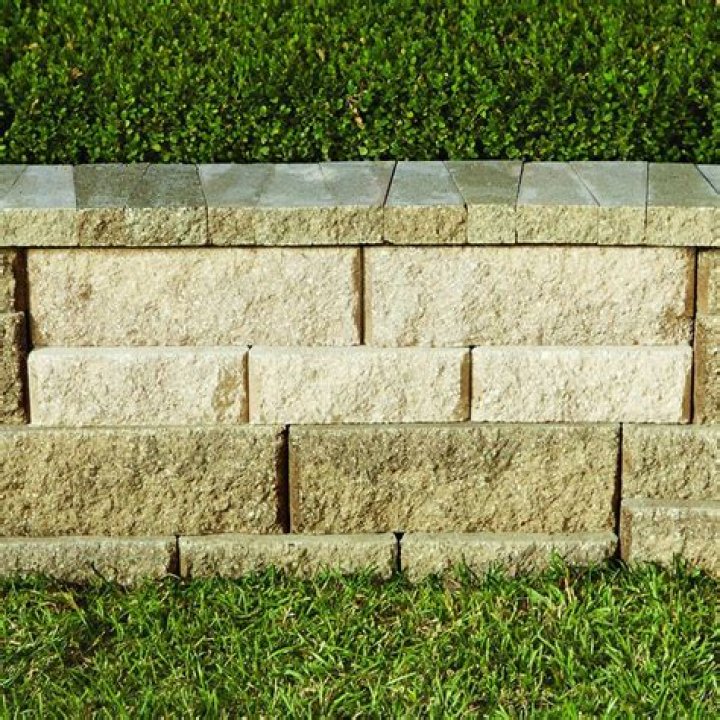
The bricks sit on a wall like this, except the wall forms a perfect circle:
If I simply arrange them within the circle, with side $\overline{a}$ along the circumference, it has many large gaps between the bricks, which is not good:
If I arrange them in an alternating pattern, some with side $\overline{a}$ along the circumference, while others with $\overline{c}$ along the circumference, I can reduce the gaps, but there are still many large gaps visible:
Unfortunately, with this pattern, if no gaps are given, the bricks just form a straight line and do not match the curve of the circle. Note that the goal is a nice fit around the circumference, without any gaps:
If I create some pattern, such that it alternates between sides $\overline{a}$ and $\overline{c}$ being placed outwards, before having two $\overline{a}$'s outwards in a row, this creates a giant regular polygon. This is an ideal solution, as no gaps are present between bricks. A small extra overlap outside the circle is also welcome athletically.
The best solution I can come up with it to create a giant tetracontakaitrigon (43-sided regular polygon) using 43 sets of six $\overline{a}$-out-facing and five $\overline{c}$-out-facing blocks. Each set is rotated by 8 degrees, leaving a gap of ~3 degrees of gap between the sets. I believe I calculated the degrees right, as in there will be an empty gap between sets, and it doesn't require something impossible, like bricks magically overlapping.
- Each set would measure 37.375 inches, so 43 sets would create a circumference of 1607.125 inches.
- This slightly larger circumference would mean the bricks need to overlap the circumference by .39 inches at the center of each set of bricks.
- The solution requires 473 bricks.
Did I make any mistakes in my calculations?
Is there a better solution that reduces the 3-degree gaps between bricks?
$\endgroup$71 Answer
$\begingroup$Comment:
The angle of brick $2\alpha$ is:
$sin(\alpha)=\frac{4.25-2.375}{2\times9,05}=0.1000..$
$\alpha≈ 5.75^o $ ⇒ $2\alpha=11.5^o$
The radius of the garden is $255"$ we have:
$d=255 sin (11.5) ≈ 50.84" $
Now if you make a set of 5 bricks, you get a trapezoid ( as shown in figure) we have:
Short side of trapezoid : $2\times4.25+3\times2.375=7.125$
Long side of trapezoid: $3\times 4.25+2\times 2.375=17.5$
Now a set out of three of these sets has outer side as:
$2\times 17.5+15.625=50.625 $
This almost equal to $d=50.84$
That means you have to make sets of 5 bricks; total number of brick is:
$\frac{360}{11.5}\times 15=469.5 ≈470$
$\endgroup$2