 $\begingroup$
Look at the following problem:
Consider the plane $\alpha$ defined by $x-2y+z+3=0$ and $A(0;0;2)$.
Write an equation of the plane that is parallel to $\alpha$ and goes through A.
My book states the solution is:
The direction vector of $\alpha$ is $\vec{n}(1;-2;1)$ so the equation of the plane is $x-2y+z+d=0$.
A is in the plane, so:
$$0 - 2 \cdot 0 + 2 +d = 0 \Leftrightarrow d = -2$$
So the equation is: $x-2y+z-2=0$
What was the reasoning behind this? What does $d$ represent?
$\endgroup$4 Answers
$\begingroup$The plane $x-2y+z=0$ is a plane that goes through the origin, with normal vector $(1;-2;1)$. The plane $x-2y+z+d=0$ has the same normal vector (it is parallel to the previous plane), but it may not go through the origin; changing $d$ amounts to sliding/translating the plane.
$\endgroup$3$\begingroup$The equation of a plane that goes through the origin can be written as $ax+by+cz=0$; notice that the origin $(0,0,0)$ satisfies this equation and hence belongs to the plane. Another of writing this equation is as follows:
$$\langle (a,b,c),(x,y,z)\rangle = 0$$
In other words, the vector $(x,y,z)$ is perpendicular to the vector $(a,b,c)$.
Now, what happens if we introduce the parameter $d$ to this equation? We get
$$\langle (a,b,c),(x,y,z)\rangle = -d$$
Does that help? Probably not much, but what if you take some vector $(x_0,y_0,z_0)$ with $\langle (a,b,c),(x_0,y_0,z_0)\rangle=d$? Then, the equation becomes
\begin{align} &\langle (a,b,c),(x,y,z)\rangle = -\langle (a,b,c),(x_0,y_0,z_0)\rangle\\ \iff &\langle (a,b,c),(x,y,z)+(x_0,y_0,z_0)\rangle=0\\ \iff &\langle (a,b,c),(x+x_0,y+y_0,z+z_0)\rangle=0 \end{align}
In other words, it's the set of vectors whose translation by $(x_0,y_0,z_0)$ is perpendicular to $(a,b,c)$. This shows in a very direct way that this equation yields a translated version of our previous result.
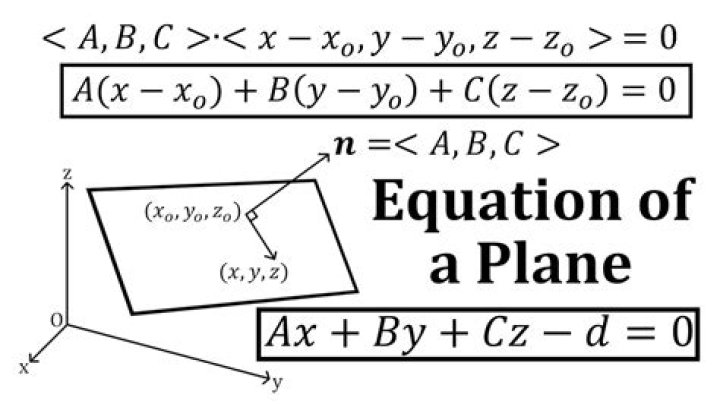
$\endgroup$$\begingroup$Another interpretation for $d$ is that you can rewrite the equation: $x-2y+z+d = 0$ as $(1,-2,1)\cdot (x-0,y-0,z-2) = 0\implies x-2y+z-2 = 0\implies d = -2$. Thus we can generalize to general case: $\vec n=(a,b,c)$, and $A = (x_0,,y_0,z_0) \in \alpha\implies \vec n\cdot (x-x_0,y-y_0,z-z_0) = 0\implies (a,b,c)\cdot (x-x_0,y-y_0,z-z_0)=0 \implies a(x-x_0)+b(y-y_0)+c(z-z_0) = 0 \implies ax+by+cz - ax_0 - by_0 - cz_0 = 0\implies d = -ax_0-by_0-cz_0$
$\endgroup$$\begingroup$A bit more general :
1) Consider a family of planes with normalized (length = 1) normal vectors $\vec{n} $.
2) Let one of the family members with normal $\vec{n}$ pass through a point $\vec{r_0}$ .
The equation reads:
$(\vec{r} - \vec{r_0}) \cdot \vec{n}$ = $0$, or
$\vec{r} \cdot \vec{n} - \vec{r_0} \cdot \vec{n}$ = $0$.
The second term is
$d: = - \vec{r_0} \cdot \vec{n}$.
It is the (negative) projection of $\vec{r_0}$, the point the plane passes through, onto the normal, I.e. the (negative) length of the vector component of $\vec{r_0}$ along $\vec{n}$.
Different family members, i.e. parallel planes, will have $\alpha \vec{r_0}, \alpha \in \mathbb{R}$, I.e. will pass through different points, where $\alpha \vec{r_0} \cdot \vec{n}$ is the (negative) length of the vector component along $\vec{n}$.
$\endgroup$