We have the integral of type 1 : $\int_0^1 \left (\int_{e^x}^e f(x,y)dy\right )dx$ and we want to transform it into an integral of type 2.
The region of type 1 is $D_1=\{(x,y) \mid 0\leq x\leq 1, e^x\leq y\leq e\}$. The respective region of type 2 is $D_2=\{(x,y) \mid 0\leq x\leq \ln y, 1\leq y\leq e\}$.
But how can we tranform the region of type 1 into a region of type 2 using the graph?
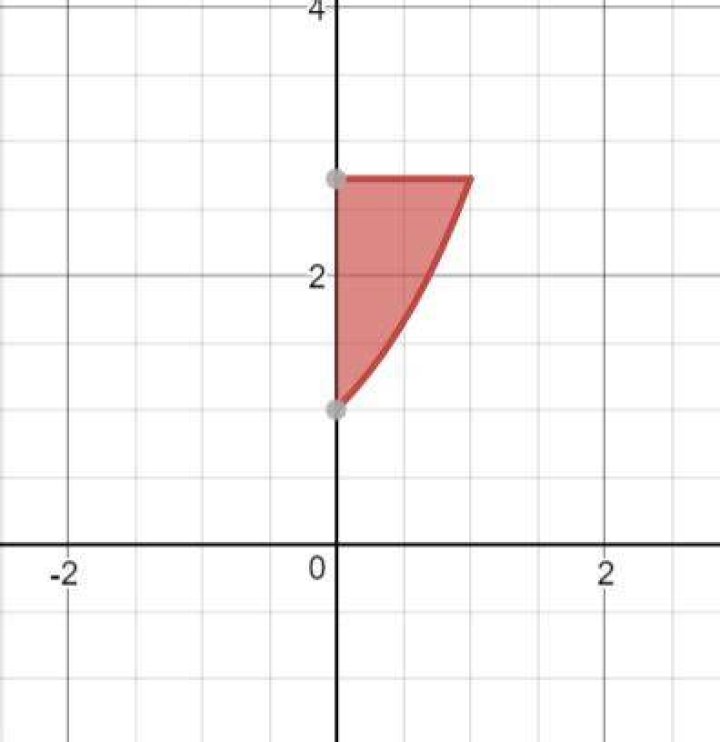
The region of type 1 $D_1$ is the following:

How can we use this graph to get the respective region of type 2 $D_2$ ?
$\endgroup$32 Answers
$\begingroup$Guide:
The trick is to tilt your graph $90^\circ$ anticlockwise and then describe the region using the same technique you used to describe type $1$ region.
To help you get started, note that since $e^x \leq y$, then we have $x \leq \ln y$.
Try to find lower bound for $x$ as well.
Also, find constant bounds for lower and upper bound for values of $y$.
Graphically it is exactly the same region, just different way of describing the same region.
$\endgroup$1$\begingroup$First check the range of $y$. I think it's easy to see that $1 \leq y \leq e$ from the graph. To find the range of $x$, one hint is to draw horizontal lines inside the region. Left to right, they go from the $y$-axis to the curve $y = e^x$, so $x = \ln y$. Thus, $x$ starts as zero and finishes as $\ln y$, giving us the range $0 \leq x \leq \ln y$.
$\endgroup$