 $\begingroup$
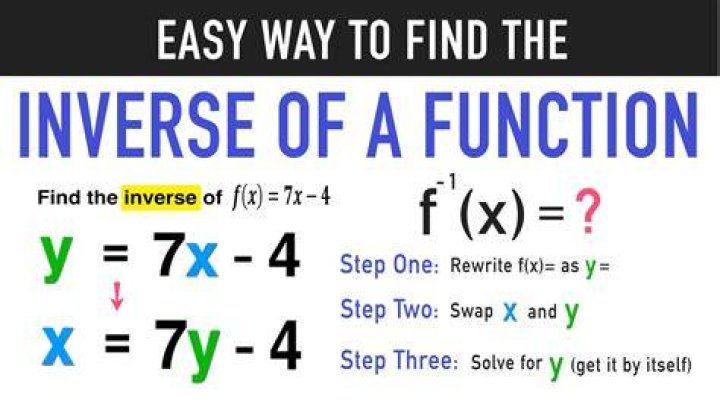
I am not getting how to prove its bijection. My textbook says I need to manipulate it such that, $(x,y) = f(m,n)$ to $f(x,y) =(m,n)$.
All I get is $(5x+4y, 4x+3y) = (5m+4n, 4m+3n)$
And then I find the inverse by making the system of equations equal to $m$ and $n$, such that-
$(m, n) = (5x+4y, 4x+3y)$
$5x+4y = m \rightarrow x = \frac{m-4n}{5}, 4x+3y = n \rightarrow y = \frac{n-4m}{3}$
Then, $(x, y) = (\frac{m-4n}{5}, \frac{n-4m}{3})$
So, $f^{-1} (m, n) = (\frac{x-4y}{5}, \frac{y-4x}{3})$
$\endgroup$22 Answers
$\begingroup$Another description of $f$: $f(x,y)$ is precisely the column vector you obtain when you multiply the colummn vector $(x,y)$ by the matrix $A=\begin{bmatrix} 5&4\\4&3\end{bmatrix}$ on the left. The inverse is obtained by multiplying by $A^{-1}$ on the left. I'll let you calculate $A^{-1}$ by yourself.
$\endgroup$2$\begingroup$Your current answer is incorrect. Here's a way to go about it: $$ x = 5m + 4n \implies m = \frac{x - 4n}{5} $$ Now, substitute this into the next equation $$ y = 4m + 3n = 4 \frac{x - 4n}{5} + 3n \implies\\ y = -\frac{1}{5}n + \frac 45 x $$ now, solve this equation for $n$, then substitute into $m = \frac{x-4n}{5}$. Then, you'll have a formula for the "inputs" $m,n$ in terms of the "outputs" $x,y$, which is what you're looking for.
In particular, we find $$ y = -\frac{1}{5}n + \frac 45 x \implies\\ n = 4 x - 5y $$ Similarly, we have $$ m = \frac{x-4n}{5} = \frac{x - 4(4 x - 5y )}{5} = -3x + 5y $$ So, the formula for our inverse is $$ f(x,y) = (-3x + 5y, 4x - 5y) $$
$\endgroup$2