 $\begingroup$
Suppose $AB=AC$, where $B$ and $C$ are matrices, and $A$ is invertible. Show that $B$=enter image description here$C$. Is this true, in general, when $A$ is not invertible? What can be deduced from the assumptions that will help to show $B=C$?
$\endgroup$2 Answers
$\begingroup$If $A$ is invertible, then:
$$AB = AC \Rightarrow A^{-1}AB = A^{-1}AC \Rightarrow B = C.$$
If $A$ is not invertible, $AB = AC \Rightarrow B =C $ does not work.
Consider for instance:
$$A = \begin{bmatrix}1 & 0 \\ 0 & 0\end{bmatrix}, B = \begin{bmatrix}1 & 1 \\ 2 & 3\end{bmatrix}~\text{and}~ C = \begin{bmatrix}1 & 1 \\ -5 & 1\end{bmatrix}.$$
Notice that $A$ is not invertible. Moreover:
$$AB = AC = \begin{bmatrix}1 & 1 \\ 0 & 0\end{bmatrix},$$
but $B \neq C.$
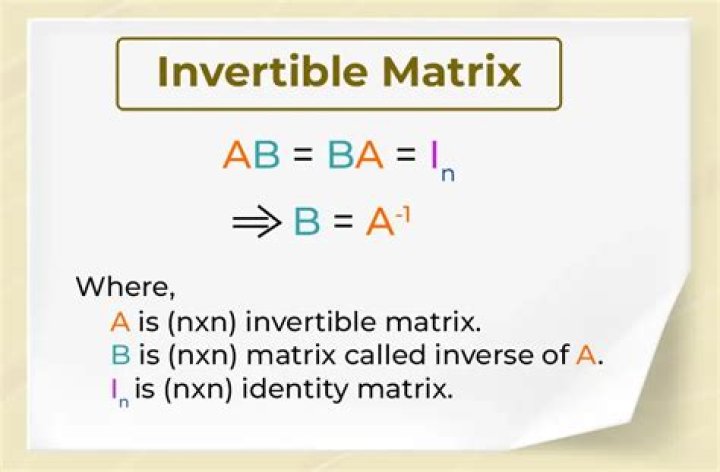
$\endgroup$$\begingroup$If the matrix $A$ is invertible, there exists an inverse matrix $A^{-1}$ with $AA^{-1}=I=A^{-1}A$, where $I$ is the identity matrix. The inverse matrix is uniquely determined.
If $AB=AC$ and $A$ is invertible, then multiplying with $A^{-1}$ from the left, using associativity and that $A^{-1}A=I$ gives $B=C$.
$\endgroup$1