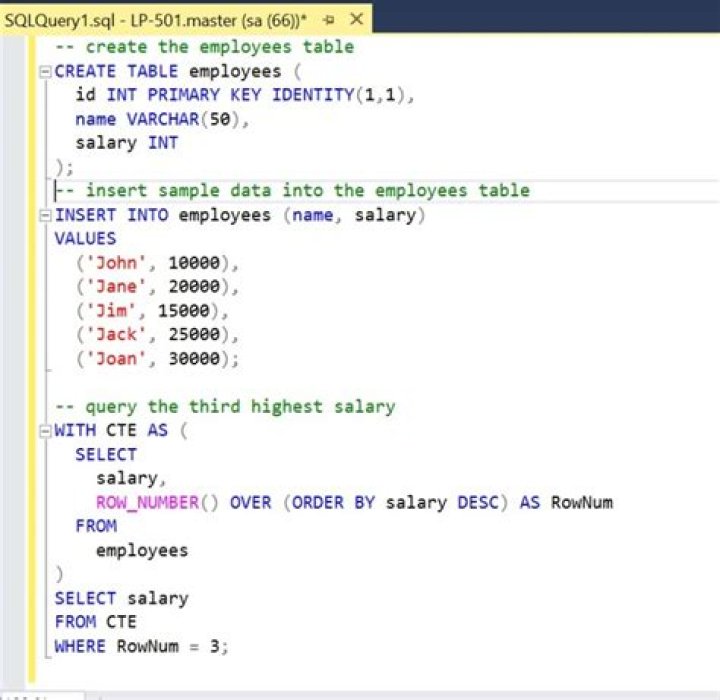

I need to write a query that will return the third highest salaried employee in the company.
I was trying to accomplish this with subqueries, but could not get the answer. My attempts are below:
select Max(salary) from employees where Salary not in (select Max(salary) from employees where Salary not in (select Max(salary) from employees)); My thought was that I could use 2 subqueries to elimitate the first and second highest salaries. Then I could simply select the MAX() salary that is remaining. Is this a good option, or is there a better way to achieve this?
32 Answers
The most simple way that should work in any database is to do following:
SELECT * FROM `employee` ORDER BY `salary` DESC LIMIT 1 OFFSET 2; Which orders employees by salary and then tells db to return a single result (1 in LIMIT) counting from third row in result set (2 in OFFSET). It may be OFFSET 3 if your DB counts result rows from 1 and not from 0.
This example should work in MySQL and PostgreSQL.
0You can get the third highest salary by using limit , by using TOP keyword and sub-query
TOPkeywordSELECT TOP 1 salary FROM (SELECT TOP 3 salary FROM Table_Name ORDER BY salary DESC) AS Comp ORDER BY salary ASClimit
SELECT salary FROM Table_Name ORDER BY salary DESC LIMIT 2, 1by subquery
SELECT salary FROM (SELECT salary FROM Table_Name ORDER BY salary DESC LIMIT 3) AS Comp ORDER BY salary LIMIT 1;
I think anyone of these help you.
You may try (if MySQL):
SELECT salary FROM employee ORDER BY salary DESC LIMIT 2, 1; This query returns one row after skipping two rows.
You may also want to return distinct salary. For example, if you have 20,20,10 and 5 then 5 is the third highest salary. To do so, add DISTINCT to the above query:
SELECT DISTINCT salary FROM employee ORDER BY salary DESC LIMIT 2, 1; SELECT Max(salary) FROM employee WHERE salary < (SELECT Max(salary) FROM employee WHERE salary NOT IN(SELECT Max(salary) FROM employee)) hope this helped you
If SQL Server this could work
SELECT TOP (1) * FROM (SELECT TOP (3) salary FROM employees ORDER BY salary DESC) T ORDER BY salary ASC As for your number of subqueries question goes it depends on your language. Check this for more information
Is there a nesting limit for correlated subqueries in Oracle?
2SELECT id FROM tablename ORDER BY id DESC LIMIT 2 , 1
This is only for get 3rd highest value .
You may use this for all employee with 3rd highest salary:
SELECT * FROM `employee` WHERE salary = ( SELECT DISTINCT(`salary`) FROM `employee` ORDER BY `salary` DESC LIMIT 1 OFFSET 2 ); Some DBMS's don't allow you to run several nested queries. Here is a solution that only uses 1 nested query:
SELECT salary FROM ( SELECT salary FROM employees ORDER BY salary LIMIT 3 ) as TBL1 ORDER BY salary DESC LIMIT 1; It should give you the desired result. It first finds the 3 largest salaries, then selects the smallest of the three (or the third one if they are equal). Here is an SQLFiddle
8I found a very good explanation in
This query should give nth highest salary
SELECT * FROM Employee Emp1 WHERE (N-1) = ( SELECT COUNT(DISTINCT(Emp2.Salary)) FROM Employee Emp2 WHERE Emp2.Salary > Emp1.Salary) SELECT * FROM employee ORDER BY salary DESC LIMIT 1 OFFSET 2;
You can use nested query to get that, like below one is explained for the third max salary. Every nested salary is giving you the highest one with the filtered where result and at the end it will return you exact 3rd highest salary irrespective of number of records for the same salary.
select * from users where salary < (select max(salary) from users where salary < (select max(salary) from users)) order by salary desc limit 1 Below query will give accurate answer. Follow and give me comments:
select top 1 salary from ( select DISTINCT top 3 salary from Table(table name) order by salary ) as comp order by personid salary you can get any order for salary with that:
select * from ( select salary,row_Number() over (order by salary DESC ) RN FROM employees )s where RN = 3 -- put RN equal to any number of orders. --for your question put 3
You can find Nth highest salary by making use of just one single query which is very simple to understand:-
select salary from employees e1 where N-1=(select count(distinct salary) from employees e2 where e2.salary>e1.salary);
Here Replace "N" with number(1,2,3,4,5...).This query work properly even when where salaries are duplicate. The simple idea behind this query is that the inner subquery count how many salaries are greater then (N-1). When we get the count then the cursor will point to that row which is N and it simply returns the salary present in that row.
SELECT salary FROM employees e1 WHERE N-1 = (SELECT COUNT(DISTINCT salary) FROM employees e2 WHERE e2.salary > e1.salary) Here, I have solved it with a correlated nested query. It is a generalized Query so if you want to print 4th, 5th, or any number of highest salary it will work perfectly even if there are any duplicate salaries.
So, what you have to do is simply change the N value here. So, in your case, it will be,
SELECT salary FROM employees e1 WHERE 3-1 = (SELECT COUNT(DISTINCT salary) FROM employees e2 WHERE e2.salary > e1.salary) SELECT MAX(salary) FROM employees GROUP BY salary ORDER BY salary DESC LIMIT 1 OFFSET 2; For me this query work fine in Mysql it will return third max salary from table
SELECT salary FROM users ORDER BY salary DESC LIMIT 1 OFFSET 2;
or
SELECT salary FROM users ORDER BY salary DESC LIMIT 2,1;
select min (salary) from Employee where Salary in (Select Top 3 Salary from Employee order by Salary desc)
SELECT TOP 1 BILL_AMT Bill_Amt FROM ( SELECT DISTINCT TOP 3 NH_BL_BILL.BILL_AMT FROM NH_BL_BILL ORDER BY BILL_AMT DESC) A ORDER BY BILL_AMT ASC SELECT DISTINCT MAX(salary) AS max FROM STAFF WHERE salary IN (SELECT salary FROM STAFF WHERE salary<(SELECT MAX(salary) AS maxima FROM STAFF WHERE salary< (SELECT MAX(salary) AS maxima FROM STAFF)) GROUP BY salary); I have tried other ways they are not right. This one works.
1We can find the Top nth Salary with this Query.
WITH EMPCTE AS ( SELECT E.*, DENSE_RANK() OVER(ORDER BY SALARY DESC) AS DENSERANK FROM EMPLOYEES E ) SELECT * FROM EMPCTE WHERE DENSERANK=&NUM
WITH CTE AS ( SELECT Salary, RN = ROW_NUMBER() OVER (ORDER BY Salary DESC) FROM Employee ) SELECT salary FROM CTE WHERE RN = 3
for oracle it goes like this:
select salary from employee where rownnum<=3 order by salary desc minus select salary from employee where rownnum<=2 order by salary desc; The SQL-Server implementation of this will be:
SELECT SALARY FROM EMPLOYEES OFFSET 2 ROWS FETCH NEXT 1 ROWS ONLY This is a MYSQL query.
Explanation: The subquery returns top 3 salaries. From the returned result, we select the minimum salary, which is the 3rd highest salary.
SELECT MIN(Salary) FROM ( SELECT Salary FROM Employees ORDER BY Salary DESC LIMIT 3 ) AS TopThreeSalary; in Sql Query you can get nth highest salary
select * from( select empname, sal, dense_rank() over(order by sal desc)r from Employee) where r=&n;
To find to the 2nd highest sal set n = 2
To find 3rd highest sal set n = 3 and so on.
This works fine with Oracle db.
select SAL from ( SELECT DISTINCT SAL FROM EMP ORDER BY SAL DESC FETCH FIRST 3 ROWS ONLY ) ORDER BY SAL ASC FETCH FIRST 1 ROWS ONLY SELECT * FROM maintable_B7E8K order by Salary desc limit 1 offset 2; --Oracle SQL with temp as ( select distinct salary from HR.EMPLOYEES order by SALARY desc ) select min(temp.salary) from temp where rownum <= 3;
SELECT * FROM(
SELECT salary, DENSE_RANK()
OVER(ORDER BY salary DESC)r FROM Employee)
WHERE r=&n;
To find the 3rd highest salary set n = 3