
I've inherited the following DB design. Tables are:
customers --------- customerid customernumber invoices -------- invoiceid amount invoicepayments --------------- invoicepaymentid invoiceid paymentid payments -------- paymentid customerid amount My query needs to return invoiceid, the invoice amount (in the invoices table), and the amount due (invoice amount minus any payments that have been made towards the invoice) for a given customernumber. A customer may have multiple invoices.
The following query gives me duplicate records when multiple payments are made to an invoice:
SELECT i.invoiceid, i.amount, i.amount - p.amount AS amountdue FROM invoices i LEFT JOIN invoicepayments ip ON i.invoiceid = ip.invoiceid LEFT JOIN payments p ON ip.paymentid = p.paymentid LEFT JOIN customers c ON p.customerid = c.customerid WHERE c.customernumber = '100' How can I solve this?
15 Answers
I am not sure I got you but this might be what you are looking for:
SELECT i.invoiceid, sum(case when i.amount is not null then i.amount else 0 end), sum(case when i.amount is not null then i.amount else 0 end) - sum(case when p.amount is not null then p.amount else 0 end) AS amountdue FROM invoices i LEFT JOIN invoicepayments ip ON i.invoiceid = ip.invoiceid LEFT JOIN payments p ON ip.paymentid = p.paymentid LEFT JOIN customers c ON p.customerid = c.customerid WHERE c.customernumber = '100' GROUP BY i.invoiceid This would get you the amounts sums in case there are multiple payment rows for each invoice
3Thank you very much for the replies!
Saggi Malachi, that query unfortunately sums the invoice amount in cases where there is more than one payment. Say there are two payments to a $39 invoice of $18 and $12. So rather than ending up with a result that looks like:
1 39.00 9.00 You'll end up with:
1 78.00 48.00 Charles Bretana, in the course of trimming my query down to the simplest possible query I (stupidly) omitted an additional table, customerinvoices, which provides a link between customers and invoices. This can be used to see invoices for which payments haven't made.
After much struggling, I think that the following query returns what I need it to:
SELECT DISTINCT i.invoiceid, i.amount, ISNULL(i.amount - p.amount, i.amount) AS amountdue FROM invoices i LEFT JOIN invoicepayments ip ON i.invoiceid = ip.invoiceid LEFT JOIN customerinvoices ci ON i.invoiceid = ci.invoiceid LEFT JOIN ( SELECT invoiceid, SUM(p.amount) amount FROM invoicepayments ip LEFT JOIN payments p ON ip.paymentid = p.paymentid GROUP BY ip.invoiceid ) p ON p.invoiceid = ip.invoiceid LEFT JOIN payments p2 ON ip.paymentid = p2.paymentid LEFT JOIN customers c ON ci.customerid = c.customerid WHERE c.customernumber='100' Would you guys concur?
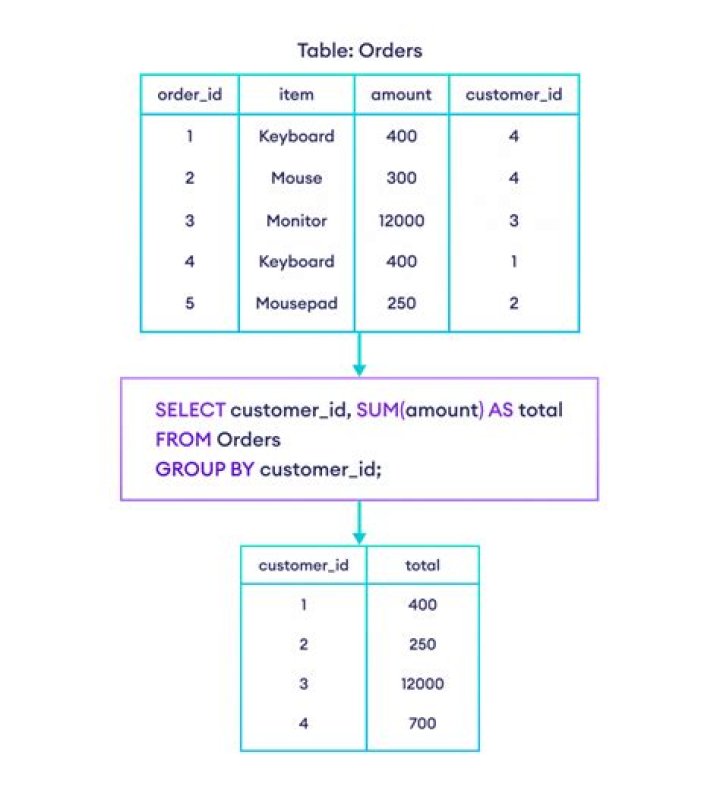
0I have a tip for those, who want to get various aggregated values from the same table.
Lets say I have table with users and table with points the users acquire. So the connection between them is 1:N (one user, many points records).
Now in the table 'points' I also store the information about for what did the user get the points (login, clicking a banner etc.). And I want to list all users ordered by SUM(points) AND then by SUM(points WHERE type = x). That is to say ordered by all the points user has and then by points the user got for a specific action (eg. login).
The SQL would be:
SELECT SUM(points.points) AS points_all, SUM(points.points * (points.type = 7)) AS points_login FROM user LEFT JOIN points ON user.id = points.user_id GROUP BY user.id The beauty of this is in the SUM(points.points * (points.type = 7)) where the inner parenthesis evaluates to either 0 or 1 thus multiplying the given points value by 0 or 1, depending on wheteher it equals to the the type of points we want.
First of all, shouldn't there be a CustomerId in the Invoices table? As it is, You can't perform this query for Invoices that have no payments on them as yet. If there are no payments on an invoice, that invoice will not even show up in the ouput of the query, even though it's an outer join...
Also, When a customer makes a payment, how do you know what Invoice to attach it to ? If the only way is by the InvoiceId on the stub that arrives with the payment, then you are (perhaps inappropriately) associating Invoices with the customer that paid them, rather than with the customer that ordered them... . (Sometimes an invoice can be paid by someone other than the customer who ordered the services)
1I know this is late, but it does answer your original question.
/*Read the comments the same way that SQL runs the query 1) FROM 2) GROUP 3) SELECT 4) My final notes at the bottom */ SELECT list.invoiceid , cust.customernumber , MAX(list.inv_amount) AS invoice_amount/* we select the max because it will be the same for each payment to that invoice (presumably invoice amounts do not vary based on payment) */ , MAX(list.inv_amount) - SUM(list.pay_amount) AS [amount_due] FROM Customers AS cust INNER JOIN Payments AS pay ON pay.customerid = cust.customerid INNER JOIN ( /* generate a list of payment_ids, their amounts, and the totals of the invoices they billed to*/ SELECT inpay.paymentid AS paymentid , inv.invoiceid AS invoiceid , inv.amount AS inv_amount , pay.amount AS pay_amount FROM InvoicePayments AS inpay INNER JOIN Invoices AS inv ON inv.invoiceid = inpay.invoiceid INNER JOIN Payments AS pay ON pay.paymentid = inpay.paymentid ) AS list ON list.paymentid = pay.paymentid /* so at this point my result set would look like: -- All my customers (crossed by) every paymentid they are associated to (I'll call this A) -- Every invoice payment and its association to: its own ammount, the total invoice ammount, its own paymentid (what I call list) -- Filter out all records in A that do not have a paymentid matching in (list) -- we filter the result because there may be payments that did not go towards invoices! */ GROUP BY /* we want a record line for each customer and invoice ( or basically each invoice but i believe this makes more sense logically */ cust.customernumber , list.invoiceid /* -- we can improve this query by only hitting the Payments table once by moving it inside of our list subquery, -- but this is what made sense to me when I was planning. -- Hopefully it makes it clearer how the thought process works to leave it in there -- as several people have already pointed out, the data structure of the DB prevents us from looking at customers with invoices that have no payments towards them. */