Solve in the interval $0^\circ\leq \theta\leq 360^\circ$ the equation $\sin \theta + \cos \theta=1$.
I've got the two angles in the interval to be $0^\circ$ and $90^\circ$, it's not an answer I'm after, I'd just like to see different approaches one could take with a problem like this. Thank you!
Sorry, my approach:
$$\begin{align} \frac{1}{\sqrt 2}\sin \theta + \frac{1}{\sqrt 2}\cos \theta &= \frac{1}{{\sqrt 2 }} \\ \cos 45^\circ\sin \theta + \sin 45^\circ\cos \theta &= \frac{1}{\sqrt 2} \\ \sin(\theta + 45^\circ) &= \frac{1}{\sqrt 2} \\ \theta + 45^\circ &= 45^\circ,\ 135^\circ \\ \theta &= 0^\circ, \ 90^\circ \end{align}$$
$\endgroup$28 Answers
$\begingroup$A slightly 'expanded-upon' version of user67418's answer:

The circle here represents the parametric curve $(x=\cos\theta, y=\sin\theta)$, and the line is the line $x+y=1$, so their points of intersection are the points where $\cos\theta+\sin\theta=1$; at least for me, this is the clearest way of seeing that there are only the two solutions already mentioned.
$\endgroup$1$\begingroup$We have $$\sin(\theta) + \cos(\theta) = 1 \text{ and } \sin^2(\theta) + \cos^2(\theta) = 1$$ If we have $$a+b = 1 \text{ and } a^2 + b^2 =1 \tag{$\star$}$$then either $a=0,b=1$ or $a=1, b=0$. This gives us $$\sin(\theta) = 0, \cos(\theta) = 1 \text{ (or) }\sin(\theta) = 1, \cos(\theta) = 0$$Hence, $$\theta = 0^{\circ},90^{\circ}$$
EDIT(Expanding out the implications of $(\star)$).
We shall show here that $(\star) \implies$ either $a=0,b=1$ or $a=1, b=0$.
We have $a=1-b$. Plugging this in $a^2 + b^2 = 1$, we get that $$(1-b)^2 + b^2 = 1 \implies 1-2b+b^2 + b^2 = 1 \implies 2b^2-2b = 0 \implies 2b(b-1) = 0$$ Hence, $b=0$ or $b=1$. Plugging in $b=0$ in $a=1-b$ gives us $a=1$. Similarly, plugging in $b=1$ in $a=1-b$ gives us $a=0$. Hence, the possible solutions are $$(a,b) = (0,1) \text{ or }(1,0)$$
$\endgroup$1$\begingroup$I'd write $\sin \theta + \cos \theta = \sqrt{2} \sin \left(\theta + \dfrac{\pi}{4}\right)$ and go from there.
A similar tactic works for all equations of the form $a \sin \theta + b \cos \theta = c$ for constant $a,b,c$.
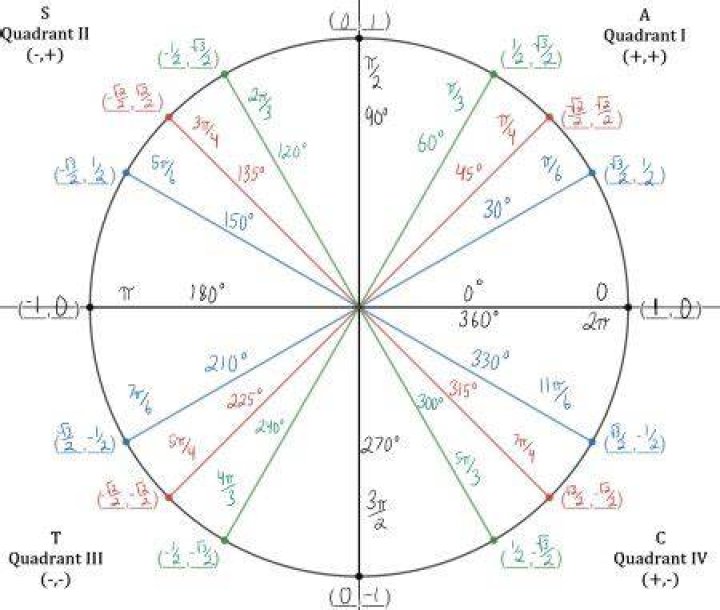
$\endgroup$2$\begingroup$Are you familiar with the unit circle? If so, then take that approach to see that $\sin \theta + \cos \theta =1$ is only satisfied when either $\theta = 90^{\circ}$ or $\theta = 0^{\circ}$, or equivalently, $\theta = 360^{\circ}$. This comes from the fact that the unit circle has points $(1,0)$ at $0^{\circ}$, and (0,1) at $90^{\circ}$.
$\endgroup$2$\begingroup$$$1=\sin\theta+\cos\theta\implies\frac{1}{\sqrt 2}=\sin\theta\cos\frac{\pi}{4}+\sin\frac{\pi}{4}\cos\theta=\sin\left(\theta+\frac{\pi}{4}\right)\Longrightarrow$$
$$\theta+\frac{\pi}{4}=\begin{cases}\frac{\pi}{4}\\{}\\\pi-\frac{\pi}{4}=\frac{3\pi}{4}\end{cases}\implies\theta=0\;\;\vee\;\;\frac{\pi}{2}$$
If you don't like radians, change
$$\frac{\pi}{4}\sim45^\circ\;,\;\;\frac{3\pi}{4}\sim 135^\circ\;,\;\;\pi\sim 180^\circ$$
$\endgroup$$\begingroup$Another approach not so fast in this case but not yet mentioned is a general method to solve any linear equation in $\sin \theta $ and $\cos \theta $ of the form $a\sin \theta +b\cos \theta =c$. We express these functions in terms of $t=\tan \frac{\theta }{2}$: $$ \begin{equation*} \sin \theta =\frac{2t}{1+t^{2}} ,\qquad \cos \theta =\frac{1-t^{2}}{1+t^{2}} \end{equation*}$$ and solve a quadratic equation in $t$. The equation $\sin \theta +\cos \theta =1$ is transformed in $$ \begin{eqnarray*} 2t+1-t^{2}=1+t^{2} &\Leftrightarrow &\left( t-1\right)t=0\Leftrightarrow t=1,t=0. \end{eqnarray*} $$ For $t=\tan \frac{\theta }{2}=1$ we get the solution $\theta =90{{}^\circ}$ and for $t=\tan \frac{\theta }{2}=0$ the solution $\theta=0{{}^\circ}$.
$\endgroup$1$\begingroup$Using the fact that $\sin \theta+\cos \theta=\sqrt{2}\cdot\sin (\theta+\frac{\pi}{4})$, this problem is reduced to find an angle $\theta\in [0, 2\pi]$ such that $$\sin (\theta+\frac{\pi}{4})=\frac{\sqrt{2}}{2}.$$ As we know, if $\sin\alpha=\sqrt{2}/2$, it must be the case that $\alpha=\frac{\pi}{4}+2k_1\pi$ or $\alpha=\frac{3\pi}{4}+2k_2\pi$, where $k_1$ and $k_2$ can be any integer. In this problem, since $\theta\in [0,2\pi]$, we have $$\theta+\frac{\pi}{4}\in\bigg[\frac{\pi}{4}, \frac{9\pi}{4}\bigg].$$ Thus,the possible values of $k$'s are: $k_1=0$, $k_1=1$, $k_2=0$, which correspond to three angles in $[0, 2\pi]$: $\theta_1=\frac{\pi}{4}-\frac{\pi}{4}=0$, $\theta_2=\frac{9\pi}{4}-\frac{\pi}{4}=2\pi$, and $\theta_3=\frac{3\pi}{4}-\frac{\pi}{4}=\frac{\pi}{2}$.
$\endgroup$$\begingroup$$\sin x+ \cos x=1 \implies \sin^2 x + \cos^2 x+ 2 \sin x \cos x = 1 \implies 2\sin x \cos x =0$, so either $\sin x=0$ or $\cos x = 0$, giving you the solutions $0$, $\dfrac {\pi}{2}$.
$\endgroup$