 $\begingroup$
Base case: $n=1$. Picking $2n+1$ random numbers 5,6,7 we get $5+6+7=18$. So, $2(1)+1=3$ which indeed does divide 18. The base case holds. Let $n=k>=1$ and let $2k+1$ be true. We want to show $2(k+1)+1$ is true. So, $2(k+1)+1=(2k+2) +1$....
Now I'm stuck. Any ideas?
$\endgroup$24 Answers
$\begingroup$For clarity, we start by taking $n=4$.
Look at the following $2n+1=9$ consecutive integers: $$-4, \quad-3,\quad -2, \quad -1,\quad 0,\quad 1,\quad 2,\quad 3,\quad 4.$$
The sum of these is $0$, obviously divisible by $2n+1$.
Now any $9$ consecutive integers can be obtained by adding a suitable constant $b$, possibly negative, to each of the numbers above.
But that means their sum is $0$, incremented by $9b$. So their sum is a multiple of $9$.
Exactly the same argument works for general $2n+1$, except that we start with the nmbers $0, \pm 1, \pm 2, \dots, \pm(n-1)$, arranged in increasing order.
$\endgroup$$\begingroup$A variation on Marvis answer: let $a$ be the middle number. So the numbers are
$$ a-n,\dots,a-2,a-1,a,a+1,a+2,\dots,a+n $$
So their sum is clearly $(2n+1)a$ which is divisible by $2n+1$.
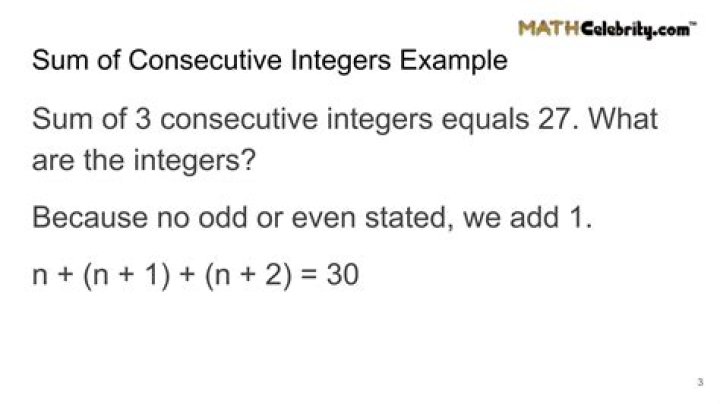
$\endgroup$$\begingroup$Let $a$ be the starting number. Then the $2n+1$ consecutive numbers are $$a,a+1,a+2,\ldots,a+2n$$ The sum of these number is $$S(a,n) = (2n+1)a + \dfrac{2n(2n+1)}2 = (2n+1)(a+n)$$ Clearly, $(2n+1) \mid S(a,n)$.
$\endgroup$2$\begingroup$The sum of a sequence of consecutive integers is the average of the sequence, which is also the average of the largest and smallest terms, times the number of terms in the sequence. If the smallest term of a sequence of length $2n+1$ is $k$, the largest is $k+2n$. The average is $k+n$. Thus, the sum is $(2n+1)(k+n)$, which is easily divisible by $2n+1$.
$\endgroup$