I am given an example file for solving a second order ODE using ODE 45
function ex_with_2eqs t0 = 0; tf = 20; y0 = [10;60]; a = .8; b = .01; c = .6; d = .1; [t,y] = ode45(@f,[t0,tf],y0,[],a,b,c,d); u1 = y(:,1); u2 = y(:,2); % y in output has 2 columns corresponding to u1 and u2 figure(1); subplot(2,1,1); plot(t,u1,'b-+'); ylabel('u1'); subplot(2,1,2); plot(t,u2,'ro-'); ylabel('u2'); figure(2) plot(u1,u2); axis square; xlabel('u_1'); ylabel('u_2'); % plot the phase plot %---------------------------------------------------------------------- function dydt = f(t,y,a,b,c,d) u1 = y(1); u2 = y(2); dydt = [ a*u1-b*u1*u2 ; -c*u2+d*u1*u2 ]; I am supposed to alter this function to solve another equation.
$y''+ 4y'+ 3y = \cos(t)$ with $y(0) = −1; y'(0) = 0$
They gave me the following to define the function
function dYdt = f(t,Y) u1 = Y(1); u2 = Y(2); dYdt = [ v ; cos(t)-4*v-3*y ]; end So, what I have now is
function LAB04ex1 t0 = 0; tf = 40; y0 = [-1;0]; [t,Y] = ode45(@f,[t0,tf],y0,[]); u1 = Y(:,1); u2 = Y(:,2); % y in output has 2 columns corresponding to u1 and u2 figure(1); subplot(2,1,1); plot(t,u1,'b-+'); ylabel('u1'); subplot(2,1,2); plot(t,u2,'ro-'); ylabel('u2'); figure(2) plot(u1,u2); axis square; xlabel('u_1'); ylabel('u_2'); % plot the phase plot end %---------------------------------------------------------------------- function dYdt = f(t,Y) u1 = Y(1); u2 = Y(2); dYdt = [ v ; cos(t)-4*v-3*y ]; end But when I run the file absolutely nothing happens. I think I am way off on my part. I figured the parameters a,b,c,d were no longer needed. I think I changed the right y's to Y's. But overall, I am completely lost.
$\endgroup$11 Answer
$\begingroup$It's because your v and y are undefined in the scope of the function dYdy.
Change that function to this:
function dYdt = f(t,Y) u1 = Y(1); u2 = Y(2); dYdt = [ u2 ; cos(t)-4*u2-3*u1 ]; end and you should be fine.
(v changed to u2, y changed to u1).
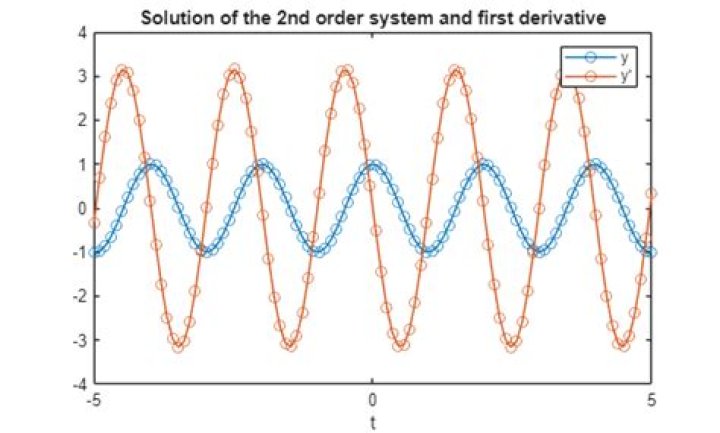
Here's figure 1:
Very nice stable LCO behavior there.
$\endgroup$