
I want to generate two really large prime numbers using an algorithm I found online and changed slightly.
I get this error on line 5:
Python OverflowError: cannot fit 'long' into an index=sized integer My code:
import math def atkin(end): if end < 2: return [] lng = ((end/2)-1+end%2) **sieve = [True]*(lng+1)** for i in range(int(math.sqrt(end)) >> 1): if not sieve[i]: continue for j in range( (i*(i + 3) << 1) + 3, lng, (i << 1) + 3): sieve[j] = False primes = [2] primes.extend([(i << 1) + 3 for i in range(lng) if sieve[i]]) return primes How can I fix my error?
If you know a better way to generate large primes, that would be helpful also.
32 Answers
The following code demonstrates the problem that you are running into:
import sys x = [True]*(sys.maxint+1) which yields an OverflowError. If you instead do:
x = [True]*(sys.maxint) then you should get a MemoryError.
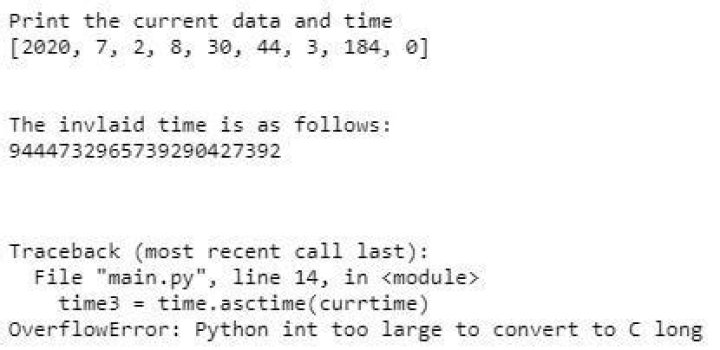
Here is what is going on. Python can handle arbitrarily large integers with its own extendible data type. However, when you try to make a list like above, Python tries to convert the number of times the small list is repeated, which is a Python integer, to a C integer of type Py_ssize_t. Py_ssize_t is defined differently depending on your build but can be a ssize_t, long, or int. Essentially, Python checks if the Python integer can fit in the C integer type before doing the conversion and raises the OverflowError if it won't work.
1Line 5 trues to allocate a really long list full of True values. Probably your lng is too large to fit that list in memory?
I was not able to exactly reproduce your error; in the worst case I ended up with just a MemoryError instead.
Probably the algorithm is ok (though I can't bet), just try a smaller number.