 $\begingroup$
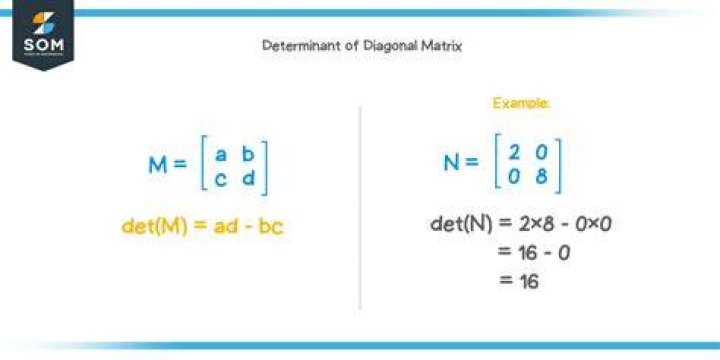
Prove that the determinant of an upper triangular matrix is the product of its diagonal entries.
What I have so far:
We will prove this by induction for an $n$ $\times$ $n$ matrix. For the case of a $2 \times 2$ matrix, let A=$ \left( \begin{array}{ccc} a_{11} & a_{12} \\ 0 & a_{22} \end{array} \right)$. So det($A$)=$a_{11}a_{22}$ and the statement is true for the case of a $2 \times 2$ matrix. Now suppose that this statement is true for an $n$ $\times$ $n$ matrix. We will show that it also is true for an $(n + 1)$ $\times$ $(n + 1)$ matrix. Let A =$ \left( \begin{array}{ccc} a_{11} & a_{12} & \cdots & a_{1(n+1)}\\ 0 & a_{22} & \cdots & a_{2(n+1)} \\ \vdots & \cdots & & \vdots\\ 0 & 0 & \cdots & a_{(n+1)(n+1)}\end{array} \right)$.
I don't know what to do after this.
$\endgroup$32 Answers
$\begingroup$Using the cofactor expansion along the first column we get $$|A|=(-1)^{1+1}a_{11} \left |\begin{matrix} a_{22}&a_{23} & \cdots & a_{2(n+1)} \\ 0 &a_{33} & \cdots & a_{3(n+1)} \\ \vdots & \vdots & \vdots & \vdots \\ 0 & 0 & 0 & a_{n+1n+1} \end{matrix}\right |$$ (Note that remaining terms in the expansion are zero.)
Using the induction hypothesis (you know det of the $n\times n$ matrix), we get
$|A|$=$a_{11}a_{22}a_{33}\cdots a_{n+1n+1}$
$\endgroup$1$\begingroup$Use the Laplace expansion to finish the induction. If you take the minor $A_{12}$ for example, you'll get the determinant of an upper triangle matrix with top-left entry $0$, which by induction is $0$. The only minor of the top row which is not $0$ is $A_{11}$.
[edit] Used the notation for minors found here.
$\endgroup$