 $\begingroup$
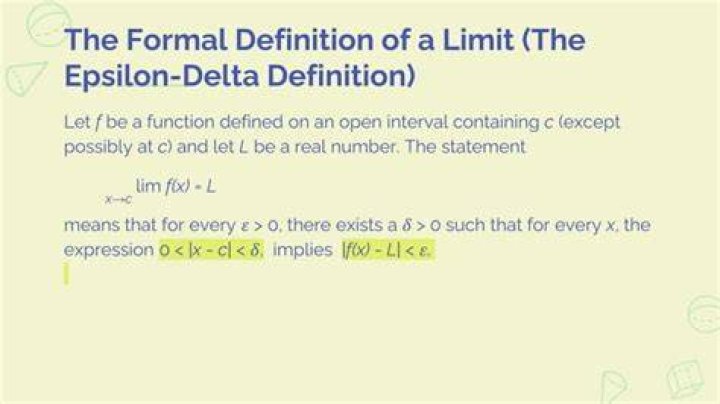
I need to prove that the $$\lim_{x\to3}\frac{x^2 - 9}{x - 3} = 6$$ using $\delta-\epsilon$ definition of limit.
Now, I have started with a discussion, saying that what we want is that if $\left| x - 3\right| < \delta$, then we have $\left|\frac{x^2 - 9}{x - 3} - 6\right| < \epsilon$, then if we simplify it, we arrive at $\left| x - 3\right| < \epsilon$, so it seems that if we have $\left| x - 3\right| < \delta$, then we also have $\left| x - 3\right| < \epsilon$, so I could make $\delta = \epsilon$, given any $\epsilon$, but this seems to be just a stupid thing to do, I think I am not understanding what's going on.
Am I right? If not, where am I wrong and how can I finish this proof?
$\endgroup$32 Answers
$\begingroup$Note you're using a slightly incorrect definition: it's $$\lim_{x\to 3}\frac{x^2-9}{x-3}=6$$
iff for all $\epsilon>0$ you can find a $\delta>0$ such that
$$\displaystyle{0<|x-3|<\delta\implies \left|\frac{x^2-9}{x-3}-6\right|<\epsilon}$$
and not
$$\displaystyle{|x-3|<\delta\implies \left|\frac{x^2-9}{x-3}-6\right|<\epsilon}$$
In this case:
$$\left|\frac{x^2-9}{x-3}-6\right|<\epsilon\iff \begin{array}&|x-3|<\epsilon\\ x\neq 3\end{array}\iff 0<|x-3|<\epsilon$$
So your problem is equivalent to finding a $\delta$ such that $$0<|x-3|<\delta\implies 0<|x-3|<\epsilon$$
So $\delta=\epsilon$ suffices. $\delta$ suffices iff $0<\delta\le \epsilon$.
$\endgroup$$\begingroup$$|\frac {x^2-9}{x-3}-6|$=$|x+3-6|$=$|x-3|$.
Hence for any given $\epsilon \gt 0$, choose $\delta=\epsilon$ so that $|\frac {x^2-9}{x-3}-6| \lt \epsilon$ whenever $|x-3| \lt \delta$.
$\endgroup$2