
I am using TypeScript Version 2 for an Angular 2 component code.
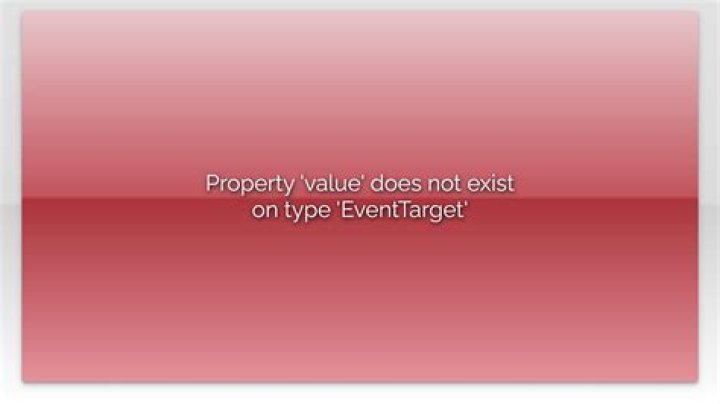
I am getting error "Property 'value' does not exist on type 'EventTarget'" for below code, what could be the solution. Thanks!
e.target.value.match(/\S+/g) || []).length
import { Component, EventEmitter, Output } from '@angular/core'; @Component({ selector: 'text-editor', template: ` <textarea (keyup)="emitWordCount($event)"></textarea> ` }) export class TextEditorComponent { @Output() countUpdate = new EventEmitter<number>(); emitWordCount(e: Event) { this.countUpdate.emit( (e.target.value.match(/\S+/g) || []).length); } } 16 Answers
You need to explicitly tell TypeScript the type of the HTMLElement which is your target.
The way to do it is using a generic type to cast it to a proper type:
this.countUpdate.emit((<HTMLTextAreaElement>e.target).value./*...*/) or (as you like)
this.countUpdate.emit((e.target as HTMLTextAreaElement).value./*...*/) or (again, matter of preference)
const target = e.target as HTMLTextAreaElement; this.countUpdate.emit(target.value./*...*/) This will let TypeScript know that the element is a textarea and it will know of the value property.
The same could be done with any kind of HTML element, whenever you give TypeScript a bit more information about their types it pays you back with proper hints and of course less errors.
To make it easier for the future you might want to directly define an event with the type of its target:
// create a new type HTMLElementEvent that has a target of type you pass // type T must be a HTMLElement (e.g. HTMLTextAreaElement extends HTMLElement) type HTMLElementEvent<T extends HTMLElement> = Event & { target: T; // probably you might want to add the currentTarget as well // currentTarget: T; } // use it instead of Event let e: HTMLElementEvent<HTMLTextAreaElement>; console.log(e.target.value); // or in the context of the given example emitWordCount(e: HTMLElementEvent<HTMLTextAreaElement>) { this.countUpdate.emit(e.target.value); } Here is the simple approach I used:
const element = event.currentTarget as HTMLInputElement const value = element.value The error shown by TypeScript compiler is gone and the code works.
1Since I reached two questions searching for my problem in a slightly different way, I am replicating my answer in case you end up here.
In the called function, you can define your type with:
emitWordCount(event: { target: HTMLInputElement }) { this.countUpdate.emit(event.target.value); } This assumes you are only interested in the target property, which is the most common case. If you need to access the other properties of event, a more comprehensive solution involves using the & type intersection operator:
event: Event & { target: HTMLInputElement } You can also go more specific and instead of using HTMLInputElement you can use e.g. HTMLTextAreaElement for textareas.
Angular 10+
Open tsconfig.json and disable strictDomEventTypes.
"angularCompilerOptions": { .... ........ "strictDomEventTypes": false } In my case, I had:
const handleOnChange = (e: ChangeEvent) => { doSomething(e.target.value); } And the issue was that I did not provide a type argument to ChangeEvent so that it knows e.target was an HTMLInputElement. Even if I manually told it that target was an input element (e.g. const target: HTMLInputElement = e.target), the ChangeEvent still didn't know that made sense.
The solution was to do:
// add type argument const handleOnChange = (e: ChangeEvent<HTMLInputElement>) => { doSomething(e.target.value); } consider $any()
<textarea (keyup)="emitWordCount($any($event))"></textarea> For those who are getting this error in angular 13, since upgrading from a previous version
The issue for me was I was using the following in my HTML (which was allowed before)
(keyup)="applyFilter($event.target.value)" The fix for this was:
HTML:
(keyup)="applyFilter($event)" Component - in my called function:
applyFilter(event: Event) { const filterValue = (event.target as HTMLInputElement).value; // ... etc.... } And now I could use filterValue again as before, to filter my values in my page
1Here is another simple approach, I used;
inputChange(event: KeyboardEvent) { const target = event.target as HTMLTextAreaElement; var activeInput = target.id; } fromEvent<KeyboardEvent>(document.querySelector('#searcha') as HTMLInputElement , 'keyup') .pipe( debounceTime(500), distinctUntilChanged(), map(e => { return e.target['value']; // <-- target does not exist on {} }) ).subscribe(k => console.log(k)); Maybe something like the above could help. Change it based on the real code. The issue is ........ target['value']
Angular 11+
Open tsconfig.json and disable strictTemplates.
"angularCompilerOptions": { .... ........ "strictTemplates": false } Don't use the workarounds from other answers that involve casting the event, the event target or entirely disabling type checking. It is not safe.
Instead you should "pluck" the value from the HTML element and pass that as an argument instead.
Oversimplified example:
<input #searchBox type="text" (input)="doSearch(searchBox.value)"> doSearch(text: string): void { } So if you expand that to the original example, you should get this:
import { Component, EventEmitter, Output } from '@angular/core'; @Component({ selector: 'text-editor', template: ` <textarea #text (keyup)="emitWordCount(text.value)"></textarea> ` }) export class TextEditorComponent { @Output() countUpdate = new EventEmitter<number>(); emitWordCount(text: string) { this.countUpdate.emit( (text.match(/\S+/g) || []).length); } } Best way is to use templating => add id to your input and then use it value
<input type="text" #notaryLockup (keyup) = "searchNotary(notaryLockup.value)"placeholder="Entrez des information" >
searchNotary(value: string) { // your logic } this way you will never have Typescript error when strict verification is activated => See angular Docs
User TypeScript built in utility type Partial<Type>
In your template
(keyup)="emitWordCount($event.target)" In your component
emitWordCount(target: Partial<HTMLTextAreaElement>) { this.countUpdate.emit(target.value./*...*/); } I believe it must work but any ways I'm not able to identify. Other approach can be,
<textarea (keyup)="emitWordCount(myModel)" [(ngModel)]="myModel"></textarea> export class TextEditorComponent { @Output() countUpdate = new EventEmitter<number>(); emitWordCount(model) { this.countUpdate.emit( (model.match(/\S+/g) || []).length); } } Here is one more way to specify event.target:
import { Component, EventEmitter, Output } from '@angular/core'; @Component({ selector: 'text-editor', template: `<textarea (keyup)="emitWordCount($event)"></textarea>` }) export class TextEditorComponent { @Output() countUpdate = new EventEmitter<number>(); emitWordCount({ target = {} as HTMLTextAreaElement }) { // <- right there this.countUpdate.emit( // using it directly without `event` (target.value.match(/\S+/g) || []).length); } }Use currentValue instead, as the type of currentValue is EventTarget & HTMLInputElement.