 $\begingroup$
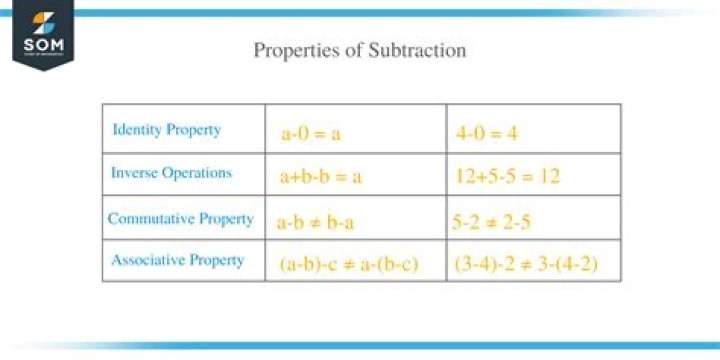
I'm (re)learning math and was looking for the properties of the most basic math operations. For addition and multiplication these are very easy to find (e.g. and . I also tried to find this for subtraction and division and there are some list of properties but i also found this: here some people answered:
Addition and multiplication have properties, such as the commutative property. Division is actually multiplication of the inverse, and does not have its own properties. Subtraction is actually addition of a negative, and does not have its own properties.
and :
Subtraction is addition in a negative, so it doesn't have its own properties. Division is multiplication of the inverse, and it doesn't have its own properties.
Is there any truth in this? If so how can I use this when doing/solving subtraction/division problems?
$\endgroup$41 Answer
$\begingroup$Similar to the addition operation, subtraction has its own special properties but they are not as widely stated explicitly. $$ 0 - x = -x.\tag{1} $$ $$ x - 0 = x. \tag{2} $$ $$ x - x = 0. \tag{3} $$ $$ x - y = -(y - x). \tag{4} $$ $$ (x - y) - (z - w) = (x - z) - (y - w). \tag{5} $$
There is a similar list in an answer to MSE question 1225445 "Abelian groups axioms with minus in place of plus".
$\endgroup$1