 $\begingroup$
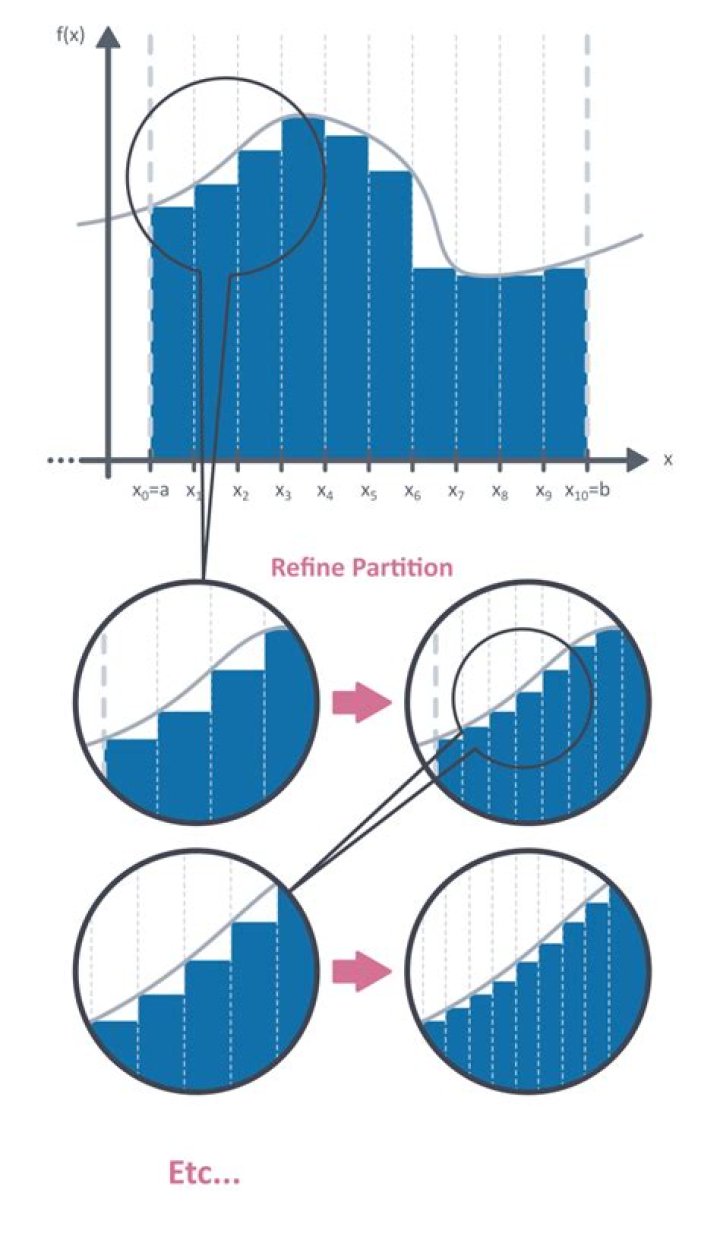
The question asks to prove that if a partition $Q$ of some interval $I$ is finer than partition $P$ on the same interval$(Q \supseteq P)$ then the norm of the finer partition is less than or equal to that of the other partition.
What I'm thinking is to construct two partitions which are identical aside from the fact that Q--the finer partition-- is constructed as $x_0,x_1,...,x_{n-1}, x_{n}$, while P is constructed as $x_0,x_1,...,x_{n-2}, x_{n}$. and then to make the obvious point that, since the values of $x$ are increasing along the partition, the fact that $P$ is missing the element $x_{n-1}$ makes the max greater than that of $Q$, if $[x_{n-2}, x_n]$ does happen to be the max distance. If it isn't, then they're equal in all other cases.
I'm not sure about my constructions in order to make this argument. Does is account for all possible partition constructions? Is it general enough to make the sweeping argument?
Thanks in advance
Edit
I just found a proof that instead begins with only the less refined partition --$x_0,x_1,...,x_{n-1}, x_{n}$ --and then states that for some value $c$ in the interval $x_{k-1} \leq c \leq x_k$ ,if $c$ is equal to either $x_{k-1}$ or $x_k$ then the norms are equal but if c isn't then you can make a list of all the sub-intervals created by both partitions on the interval and use the triangle inequality to $|x_k-x_{k-1}|$ in order to prove it's great than the intervals created where $c$ is contained in between x_k, and x_{k-1}
$\endgroup$3 Answers
$\begingroup$Depending on your definition of finer, $P$ and $Q$ could be identical but in that case their norms are too. So take $Q \ne P$, meaning that $Q$ contains at least one more point than $P$. Suppose $Q$ contains exactly one element more than $P$ (if there are more, the argument can be repeated). Write for $P$: $$P = \left\{ x_0 , x_1 , \ldots , x_{n-1} , x_n \right\}$$ and let $y$ be the extra element in $Q$, then $x_{k} < y < x_{k+1}$ for some $k$. Now in the list of lengths of the subintervals (where the norm is the maximal one), all remain the same except that $x_{k+1} - x_{k}$ from $P$ is replaced by two new lengths: $x_{k+1}-y$ and $y-x_{k}$. Triangle inequality!
Can you wrap it up?
$\endgroup$$\begingroup$This is in the right direction, but not fully correct (and too specific in the construction). The differences between $P$ and $Q$ may manifest at different places than the(?) maximal subinterval of the finer. Nevertheless, every longest subinterval of $Q$ is completely contained in (allowing equality) some subinterval of $P$, and any longest subinterval of $P$ is at least as long as that subinterval.
$\endgroup$1$\begingroup$What you are suggesting is just an example of such a situation and not a proof that for every two partitions $P,Q$ with $P\subseteq Q$, it holds that $$||Q||\leq||P||$$
So, to prove this, let $P=\{x_0<x_1<\dots<x_n\}$ be a partition of $I$ and let $Q$ be another partition of $I$, such that: $$P\subseteq Q$$ Since $$||P||=\max\underbrace{\{|x_i-x_j|:x_i,x_j\in I,\ i\neq j\}}_{A}$$ it is evident that, since $A$ is a finite set, there exist two elements $x_{i_0},x_{j_0}$, such that: $$||P||=|x_{i_0}-x_{j_0}|$$ So, now, since $x_{i_0},x_{j_0}\in P\subseteq Q$ we clearly have that: $$||Q||\leq|x_{i_0}-x_{j_0}|=||P||$$ because $Q$ may not contain two elements that are "wider" than $x_{i_0},x_{j_0}$.
Hope this helped! :)
$\endgroup$