 $\begingroup$
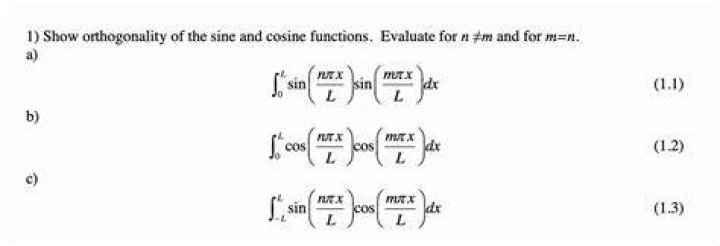
How to prove that $$ \int_{t_0}^{t_0+T} \sin(m\omega t)\sin(n\omega t)\,\mathrm{d}t$$ will equal to $0$ when $m\ne n$ and $\frac{T}{2}$ when $m=n\ne 0$? Besides $$ \int_{t_0}^{t_0+T} \cos(m\omega t)\cos(n\omega t)\,\mathrm{d}t$$ will equal to $0$ when $m\ne n$ and $\frac{T}{2}$ when $m=n\ne 0$ and $T$ when $m=n=0$?
$\endgroup$3 Answers
$\begingroup$I will assume that $T$ is the period and $\omega $ is the angular frequency of the wave $\sin (\omega t)$. In such a case, which is important to obtain the final results, the following relation holds $$\omega =\frac{2\pi }{T}.\tag{1}$$ Let $x=\omega t$, $x_{0}=\omega t_{0}$. Then
\begin{eqnarray*} I(m,n) &=&\int_{t_{0}}^{t_{0}+T}\sin (m\omega t)\sin (n\omega t)\,dt\tag{2} \\ &=&\frac{1}{\omega }\int_{x_{0}}^{x_{0}+2\pi }\sin (mx)\sin (nx)\,dx \\ &=&\frac{1}{2\omega }\int_{x_{0}}^{x_{0}+2\pi }\cos (\left( m-n\right) x)-\cos (\left( m+n\right) x)\,dx\text{,}\tag{3} \end{eqnarray*} because in general \begin{equation*} \cos (\alpha -\beta )-\cos (\alpha +\beta )=2\sin \alpha \sin \beta ,\tag{4} \end{equation*} as can be seen by subtracting
\begin{equation*} \cos (\alpha +\beta )=\cos \alpha \cos \beta -\sin \alpha \sin \beta \end{equation*} from \begin{equation*} \cos (\alpha -\beta )=\cos \alpha \cos \beta +\sin \alpha \sin \beta . \end{equation*}
- For $m\neq n$, since \begin{eqnarray*} \int_{x_{0}}^{x_{0}+2\pi }\cos (\left( m-n\right) x)\,dx &=&\left. \frac{ \sin (\left( m-n\right) x)}{m-n}\right\vert _{x_{0}}^{x_{0}+2\pi }=0 \\ \int_{x_{0}}^{x_{0}+2\pi }\cos (\left( m+n\right) x)\,dx &=&\left. \frac{ \sin (\left( m+n\right) x)}{m+n}\right\vert _{x_{0}}^{x_{0}+2\pi }=0\tag{5} \end{eqnarray*} the integral $I(m,n)=0$.
- For $m=n\ne 0$, by $(1)$ \begin{eqnarray*} I(m,n)&=&I(m,m) =\frac{1}{2\omega }\int_{x_{0}}^{x_{0}+2\pi }1-\cos (2mx)\,dx\\&=&\left. \frac{1}{2\omega }\left( x-\frac{\sin (2mx)}{2m}\right) \right\vert _{x_{0}}^{x_{0}+2\pi } \\ &=&\frac{1}{2\omega }\left( 2\pi \right) =\frac{\pi }{\omega } =\frac{T}{2}\tag{6}. \end{eqnarray*}
The evaluation of the second integral is similar.
$\endgroup$2$\begingroup$Your statement is not quite correct (it is only true for some values of $T,$) but to prove it use the addition formulae (for example,$2\sin x \sin y = \cos(x+y) - \cos(x-y)$ is good for the first integral).
$\endgroup$3$\begingroup$Hints:
Use trigonometric identities:
$$\sin mwt\sin nwt=\frac12\left(\cos\left[(m-n)wt\right]-\cos\left[(m+n)wt\right] \right)$$
so
$$\int\limits_{t_0}^{t_0+T}\sin mwt\sin nwt\,dt=\int\limits_{t_0}^{t_0+T}\frac12\left(\cos\left[(m-n)wt\right]-\cos\left[(m+n)wt\right] \right)dt\stackrel{m\neq n}=$$
$$=\frac12\left(\frac1{(m-n)w}\sin\left[(m-n)wt\right]-\frac1{(m+n)wt}\sin\left[(m+n)wt\right]\right)_{t_0}^{t_0+T}=\;\ldots$$
Now, if $\;m=n\;$ then the integrand is $\;\sin^2mwt\;$ , and we have that
$$\int\sin^2x\,dx=\frac{x-\sin x\cos x}2+C(=\text{constant})$$
$\endgroup$