
On few consumer laptops I have noticed that the laptop’s firmware provides an option for RAID.
Firmware -> SATA Operation -> RAID ON or AHCI (AHCI and RAID ON are mutually exclusive)
The laptop’s configuration allows only one drive and this is what puzzles me.
From my understanding, RAID configuration is only possible when there are at least two drive’s in the setup and the few of the laptops I have seen have provision for just one drive.
So what is the significance of "RAID ON" here and what does it mean?
4 Answers
Assuming that the laptop uses an Intel chipset (and CPU), the "RAID" option does more than just RAID. It also enables other parts of Intel Rapid Storage Technology (IRST), especially Intel Smart Response Technology (ISRT, gotta love the abbreviations).
Smart Response Technology is a rather non-descriptive name for tiered storage, notably with SSDs and now possibly Optane. Around the time when SSDs were still quite expensive, it was common for mid-range laptops to come with a large HDD and a small (16-32 GB) mSATA SSD, with the SSD configured as a cache for the HDD. You could get very good performance approaching pure SSD with a lot more space and less cost.
But Smart Response Technology builds on top of Rapid Storage Technology, which is enabled by the "RAID" option in the firmware. So "RAID" is enabled, because it offers the ability to use SRT, and costs nothing extra over AHCI.
As a side note, some modern firmware now have an option for "Optane without RAID" - apparently this is because Optane caching is mutually exclusive with RST RAID.
AHCI and RAID are mutually exclusive in the BIOS, but not in operation.
In effect, enabling RAID also enables AHCI. In other words, you may see RAID as a superset of AHCI. In tests run by Dell, no performance difference was found between the two modes.
An important point is that it is very easy to convert an existing installation from RAID to AHCI, but the other direction is much harder.
I would suggest not to change this setting in the BIOS. If it is set to RAID, leave it this way. It is true that it doesn't add anything that you need, but it's not harmful in any way. Changing it may cause problems in the future.
References:
- Dell M.2 FAQ regarding AHCI vs RAID ON, Storage Drivers, M.2 Lanes, Performance and more
- AHCI VS RAID: Which One Should I Choose for Better Performance?
- Switching between AHCI and RAID on the Dell XPS 15
There is very little technical difference between RAID and AHCI mode, other than in RAID mode, the chips use different PCI IDs.
The reason is that Microsoft Windows has generic drivers which would take ownership of the AHCI chip, preventing Intel drivers being used. Switching to RAID mode changes the PCI IDs so that the Microsoft drivers no longer recognize the chips as AHCI chips and the Intel drivers (which have more features, such as software RAID) can bind to them.
Other operating systems typically do not recognize RAID mode at all (e.g. GNU/Linux) and require AHCI mode to be used, as RAID mode does not offer any advantages - the chips are the same with the same features.
Therefore RAID mode is merely a hack for Intel's windows drivers to make the AHCI chips artificially incompatible to AHCI.
This is why even laptops that can only use a single disk have a functional RAID/AHCI switch in their firmware - it's an unfortunate result of marketing, where RAID sounds better than AHCI, therefore even your laptop with only one disk has to have a RAID mode.
Another way to view this is as a king of copy protection - if the Intel AHCI chips used the "correct" PCI IDs then the Intel drivers would work with non-Intel AHCI chips, and people would be able to use them to have RAID features for these chips as well, as they are emulated within the driver - the RAID mode acts as a kind of dongle.
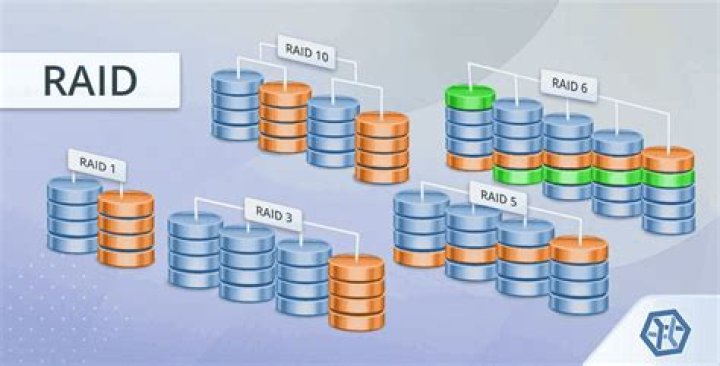
4There is a difference between AHCI (andvanced host controller interface) and RAID (redundant array of independent disks).
AHCI lets your computer and your operating system to communicate with disk directly. Hardware RAID is used to represent a set of disks to the operating system as a single device.
There are more differences. On hardware level system will communicate with disk drives via AHCI, but on a software level in AHCI mode you see disks separately, where in RAID your operating system sees it as single device (if they ae true hardware RAID and not fake like early Intel ones). Also if you want to use software RAID, you have to enable AHCI and not RAID.
There is also difference on software level. In RAID mode, OS uses single stream, so theoretically you use PCI bus more efficiently, whereas in AHCI, you use separate streams for each disk, so in theory, the more disks you add, the more likely you will hit the upper limit of PCI bus.
I would go against hardware RAID as in case of disk failure, recovery is going to be pain, since there is no standard RAID format. And disks do crash, especially old HDD ones.
2