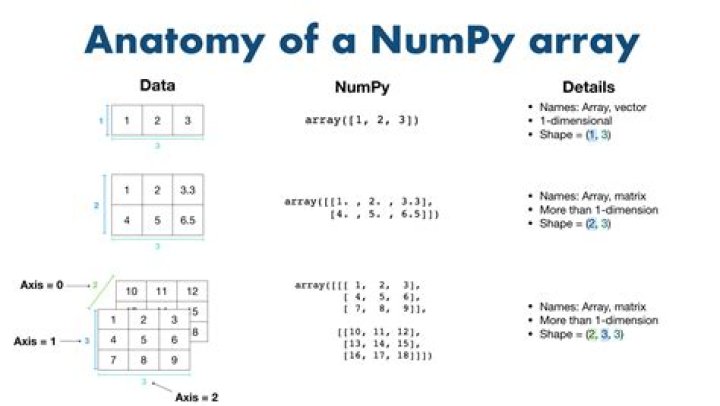

I have a 2D Numpy array, in which I want to normalise each column to zero mean and unit variance. Since I'm primarily used to C++, the method in which I'm doing is to use loops to iterate over elements in a column and do the necessary operations, followed by repeating this for all columns. I wanted to know about a pythonic way to do so.
Let class_input_data be my 2D array. I can get the column mean as:
column_mean = numpy.sum(class_input_data, axis = 0)/class_input_data.shape[0] I then subtract the mean from all columns by:
class_input_data = class_input_data - column_mean By now, the data should be zero mean. However, the value of:
numpy.sum(class_input_data, axis = 0) isn't equal to 0, implying that I have done something wrong in my normalisation. By isn't equal to 0, I don't mean very small numbers which can be attributed to floating point inaccuracies.
41 Answer
Something like:
import numpy as np eg_array = 5 + (np.random.randn(10, 10) * 2) normed = (eg_array - eg_array.mean(axis=0)) / eg_array.std(axis=0) normed.mean(axis=0) Out[14]: array([ 1.16573418e-16, -7.77156117e-17, -1.77635684e-16, 9.43689571e-17, -2.22044605e-17, -6.09234885e-16, -2.22044605e-16, -4.44089210e-17, -7.10542736e-16, 4.21884749e-16]) normed.std(axis=0) Out[15]: array([ 1., 1., 1., 1., 1., 1., 1., 1., 1., 1.])